Paid advertising is any form of marketing where you pay a platform to place your message in front of a defined audience, rather than earning that attention for free. It covers paid search ads on Google, paid social ads on Meta and LinkedIn, video ads on YouTube, display and retargeting ads across the web, and more. You set a budget, choose who to reach, and pay based on actions like clicks, impressions, or conversions.
The appeal is speed and control. Where organic reach builds slowly over months, paid advertising can put your offer in front of thousands of the right people today, with precise targeting and measurable results. The tradeoff is that the traffic stops the moment you stop paying, which is why the strongest programs pair paid reach with content that compounds.
This guide covers the whole picture: the main types of paid advertising, the platforms that matter in 2026, how to build a strategy, what makes creative convert, and what it costs. Each section links to a deeper guide.
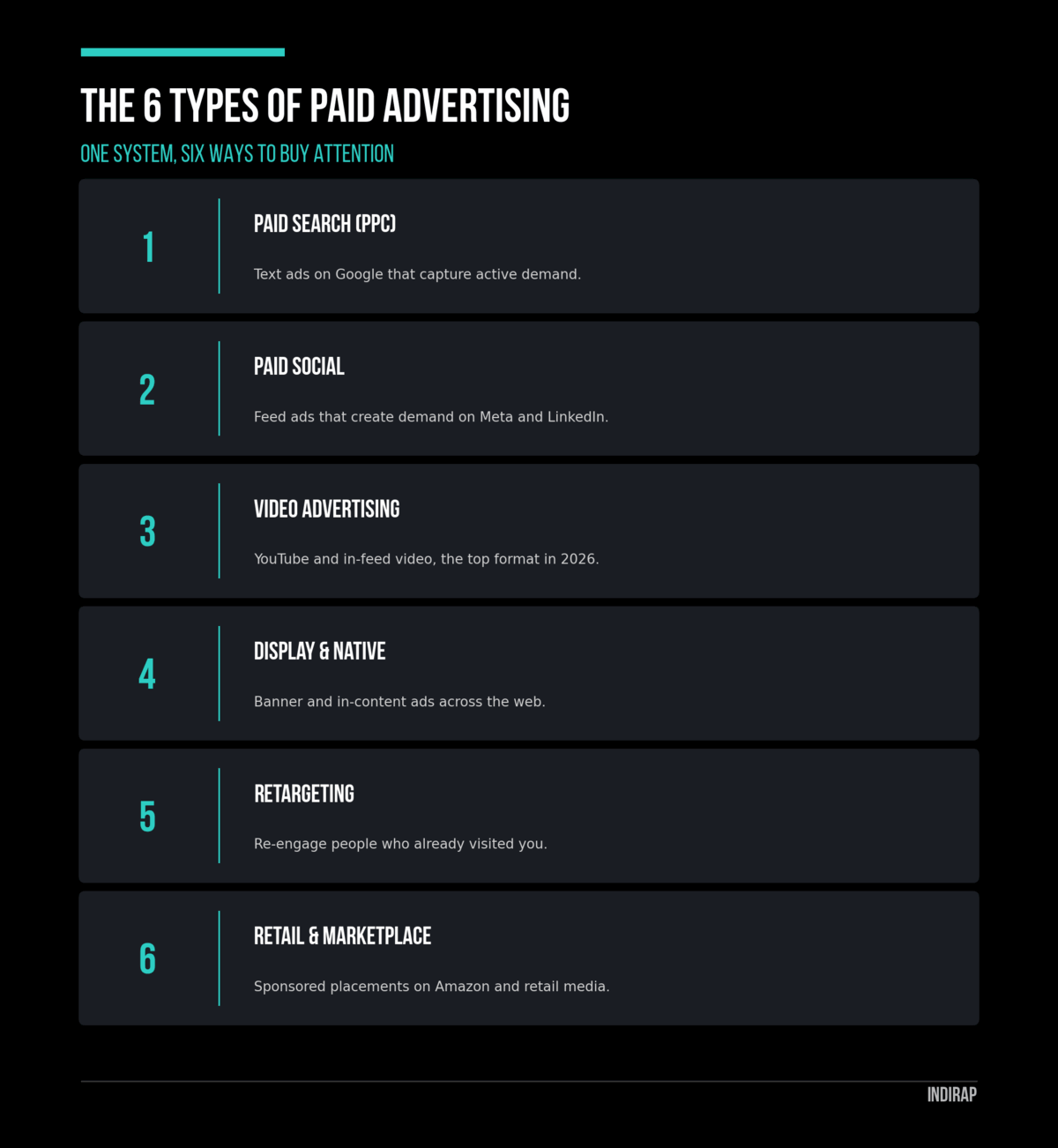
There are six core types of paid advertising, and most successful programs use a few of them together.
Paid search (PPC). Text ads that appear at the top of search results when someone types a query. You bid on keywords and pay per click. Intent is high because the person is actively searching, which makes paid search a workhorse for demand capture.
Paid social. Ads in the feeds and stories of platforms like Facebook, Instagram, and LinkedIn. You target by interest, behavior, job title, and lookalike audiences. Paid social is where you create demand and reach people before they are searching. See our paid social advertising playbook.
Video advertising. Ads on YouTube and in social video feeds. Video carries more information and trust than any other format, and short-form video is the top-performing creative type in 2026. More in UGC and video ads that convert.
Display and native. Banner and in-content ads served across websites and apps through networks like the Google Display Network. Useful for awareness and for staying visible across the web.
Retargeting (remarketing). Ads shown to people who already visited your site or engaged with your content. Because these audiences are warm, retargeting usually returns some of the best numbers in an account.
Retail and marketplace ads. Sponsored product placements on Amazon, marketplaces, and increasingly retail media networks. Essential for ecommerce, growing fast for everyone else.
For the full breakdown of where to run each type, see best paid advertising platforms in 2026.
Paid advertising buys attention; organic marketing earns it. With paid, you get immediate, controllable reach that ends when the budget ends. With organic, such as SEO and content, results build slowly but keep working long after the work is done.
Neither one replaces the other. The most effective programs run them together: paid puts your best content and offers in front of the right people now, while organic lowers your long-term cost per lead by building an audience and a library that compounds. A healthy 2026 plan treats paid and organic as one system, not competing line items.
A paid advertising strategy is the plan that connects your ad spend to a business goal. It defines who you are trying to reach, which platforms and ad types you will use, how much you will spend, what your creative will say, and how you will measure success. Without it, paid advertising becomes a series of disconnected campaigns that spend money without a clear return.
A strong strategy answers five questions before any budget is spent. Who is the audience, described specifically. What action do you want them to take. Which platforms reach that audience at that stage. What will the creative say and show. And which metrics actually prove it worked. We walk through the full process in how to build a paid media strategy.
The biggest shift in 2026 is that the platforms now run the machinery for you. Google's Performance Max and AI Max, and Meta's Advantage+, use AI to handle targeting, bidding, and placement automatically. Most ad spend already flows through these AI-driven campaign types.
That change has a clear consequence: creative is the last real lever you control. When the algorithm decides who sees the ad and what you pay, the thing that separates winners from everyone else is the ad itself, the hook, the message, and the format. This is why short-form video and authentic, creator-style content have become the highest-performing formats, and why the brands winning in 2026 invest in creative volume and quality over fiddling with settings. Our guide to the best ad creative that converts covers what that looks like in practice.
Two other trends matter. First, privacy changes and signal loss have made first-party data and strong creative more important than granular targeting. Second, buyers increasingly research through AI answer engines, so the content behind your ads needs to be findable there too.
The right platform depends on where your audience is and what you are trying to do. A short version:
Google Ads captures existing demand from people already searching. Meta (Facebook and Instagram) creates demand and excels at visual, video-first storytelling to broad and lookalike audiences. LinkedIn reaches professional buyers by job title and company, which makes it the default for B2B. YouTube pairs the reach of video with the targeting of Google. Retargeting across all of them re-engages people who already know you.
Most businesses do not need every platform. They need the two or three where their buyers actually are, run well. For a decision framework, read best paid advertising platforms in 2026 and our head to head on Google Ads vs Facebook Ads. B2B teams should start with B2B paid advertising.
In an AI-run buying world, creative is where campaigns are won or lost. Five things separate ads that convert from ads that get scrolled past.
Clarity in the first three seconds, so the viewer instantly knows what this is and why it matters. Specific proof over vague claims, because concrete detail earns belief. One clear call to action, not three. Captions, because most social video is watched without sound. And the right format for the platform, which in 2026 usually means short, vertical video that feels native to the feed.
Volume matters too. Because platforms fatigue creative quickly, the teams that win test many variations and scale the winners. The full playbook is in best ad creative and UGC and video ads that convert.
Paid advertising cost depends on your platform, industry, and goals, but you control the budget and can start small. Costs are usually measured as cost per click, cost per thousand impressions, or cost per acquisition, and they vary widely: a click can cost under a dollar in a low-competition niche or well over fifty dollars in competitive B2B categories.
What matters more than the raw cost is the return. A higher cost per click can still be a bargain if the resulting customer is worth far more. The real question is not "what does a click cost" but "what does a customer cost, and what is that customer worth." We break down budgets and benchmarks in how much does paid advertising cost.
Measure outcomes tied to revenue, not vanity metrics. Impressions and clicks tell you about activity; leads, cost per acquisition, return on ad spend, and pipeline tell you about impact.
Set your key metrics before you launch, not after. Match the metric to the campaign goal: an awareness campaign is measured on reach and cost per thousand impressions, a lead campaign on cost per lead and lead quality, a sales campaign on return on ad spend. Then give campaigns enough time and data to prove out before you judge them, and let the winners scale while you cut what does not work.
A few patterns quietly waste budget. Spreading a small budget across too many platforms instead of winning on two. Sending paid traffic to a weak landing page. Running ads with no clear next action. Judging campaigns on views instead of revenue. Turning off a campaign before it has enough data. And treating creative as an afterthought when, in 2026, it is the single biggest lever you have.
Paid advertising is at its best when it is not working alone. The strongest programs use paid to amplify content that already earns trust, so every dollar of ad spend rides on top of an asset that keeps working for free. That is the difference between renting attention and building an audience.
INDIRAP helps brands build that system, pairing high-performing video and ad creative with a content strategy that makes paid spend go further. If you want help turning paid advertising into a system that compounds, book a free strategy call.
Paid advertising is marketing where you pay a platform to place your message in front of a chosen audience, instead of earning that attention for free. It includes paid search, paid social, video, display, retargeting, and marketplace ads. You set a budget, define your audience, and pay based on clicks, impressions, or conversions.
The six core types are paid search (PPC), paid social, video advertising, display and native ads, retargeting, and retail or marketplace ads. Most effective programs combine a few of these, using search to capture existing demand and social and video to create it.
Yes, when it is tied to a strategy and measured on revenue rather than views. Paid advertising gives you fast, controllable reach and clear measurement, and it pays off when the value of a customer exceeds the cost to acquire one. It works best paired with organic content that lowers your long-term cost per lead.
It varies by platform, industry, and goal, and you control the budget. Costs are measured as cost per click, cost per thousand impressions, or cost per acquisition, ranging from under a dollar per click in low-competition niches to well over fifty dollars in competitive B2B. Focus on the cost to acquire a customer versus that customer's value.
The best platform is the one where your audience actually is. Google captures active demand, Meta creates demand with visual and video content, LinkedIn reaches professional B2B buyers, and YouTube combines video with Google's targeting. Most businesses should focus on the two or three platforms that reach their buyers, run well, rather than spreading thin.
AI now runs targeting, bidding, and placement through campaign types like Performance Max and Advantage+, which means creative is the main lever you still control. As a result, short-form video and authentic, creator-style content have become the highest-performing formats, and creative quality and volume matter more than manual optimization.
Keep reading: Best Paid Advertising Platforms · How to Build a Paid Media Strategy · Paid Social Advertising Playbook · Best Ad Creative · Google Ads vs Facebook Ads · B2B Paid Advertising · UGC and Video Ads That Convert · How Much Does Paid Advertising Cost?
Work with us: Video Production · Content Strategy · Content Kit · Book a strategy call

Julian Tillotson is the Founder & CEO of INDIRAP, a full-service video production and creative strategy agency based in Chicago, IL. With 10+ years of experience, INDIRAP has delivered 20,000+ videos to 900+ clients across 40+ industries, making it one of North America's leading digital creative agencies.


.png)
.png)