Paid advertising cost depends on your platform, industry, and competition, but most businesses in 2026 can expect to pay somewhere between $1 and $6 per click on search platforms, $5 to $20 per thousand impressions on social platforms, and a monthly budget that starts around $1,500 to $3,000 for a small business just getting started. The honest answer is "it depends," and the ranges below, along with the factors that move them, will help you figure out where your business falls.
Rather than chasing a single "right" number, the goal is to understand the pricing models, know what drives cost up or down, and set a budget tied to what a customer is actually worth to you. That reframe (cost per customer versus customer value) matters more than any individual click price.
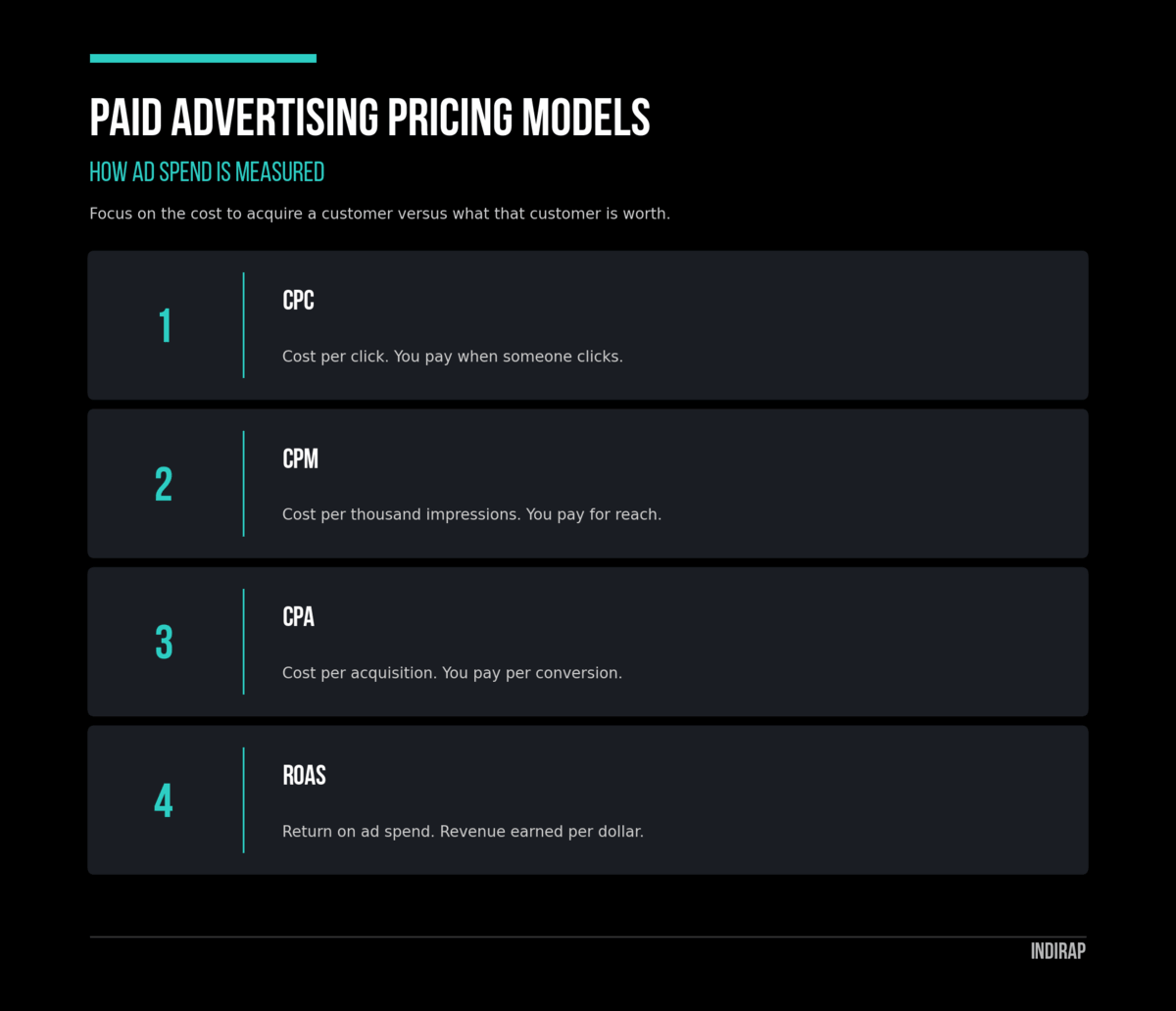
Every paid ad platform charges you using one of a handful of pricing models. Understanding these makes cost ranges much easier to interpret.
Most platforms let you bid or optimize toward any of these, and AI-driven systems like Google's Performance Max and Meta's Advantage+ now handle a lot of the bidding automatically. In 2026, that shift means the quality of your creative (the video, image, or copy the algorithm is testing) plays a bigger role in your final cost per result than manual bid adjustments do.
These are directional ranges based on typical 2026 market conditions. Actual costs vary by industry, location, audience size, and creative quality, so treat them as a planning guide rather than a guarantee.
Google Search Ads Cost per click typically runs $1 to $6 for most industries, with competitive categories like legal, insurance, and home services often landing higher. Search tends to convert well because people are actively looking for a solution.
Meta (Facebook and Instagram) Cost per click typically runs $0.50 to $3.50, with cost per thousand impressions often in the $6 to $15 range. Meta remains one of the more efficient platforms for small business budgets, especially with strong short-form video and UGC-style creative.
LinkedIn Cost per click typically runs $5 to $15 or higher, reflecting LinkedIn's professional, B2B-heavy audience. LinkedIn tends to cost more than Meta or Google Search, but it can be worth it for businesses selling higher-value products or services to a specific job title or industry.
YouTube Cost per view for skippable video ads typically runs $0.05 to $0.30, and cost per thousand impressions for non-skippable formats often falls in the $10 to $30 range. YouTube works well for building awareness and can support both broad reach and tightly targeted retargeting.
Across every platform, short-form vertical video and authentic, UGC-style creative are consistently among the top performers in 2026. Better creative usually lowers your cost per result, since the ad platforms reward content that keeps people watching and engaging.
Budget needs vary by goal, but a few general ranges hold true for most small businesses in 2026.
Starter budget (testing phase): $1,500 to $3,000 per month. This is enough to run one or two platforms, gather early data, and identify which audiences and creative approaches perform best. Expect the first four to six weeks to be a learning period rather than a peak-performance period.
Growth budget (scaling what works): $3,000 to $10,000 per month. At this level, you can run multiple campaigns, expand to a second or third platform, and support enough ad spend for the algorithm to optimize effectively.
Established budget (multi-channel, ongoing): $10,000 and up per month. Businesses at this stage are typically running coordinated campaigns across search, social, and video, often supported by a dedicated content and creative pipeline.
A useful rule of thumb: most platforms need enough budget and conversion volume (roughly 15 to 50 conversions per month per campaign) for their optimization algorithms to work well. Spreading too thin across too many campaigns is one of the most common reasons small business ad accounts underperform.
Several factors influence what you pay, and most of them are within your control.
Competition. Industries where many advertisers are bidding for the same audience (legal, finance, real estate, home services) tend to have higher costs per click. Seasonal demand, like holiday retail or tax season, also pushes costs up temporarily.
Targeting precision. Broad audiences are usually cheaper to reach but less likely to convert. Narrow, well-matched audiences can cost more per click but often deliver a lower cost per acquisition because the people seeing your ad are a better fit.
Quality and relevance. Google, Meta, and LinkedIn all reward ads that people engage with by charging less for the same placement. A high-quality, relevant ad can cost meaningfully less than a generic one targeting the same audience.
Creative quality. This has become one of the biggest cost levers in 2026. With AI systems handling much of the targeting and bidding automatically, the creative itself (the video, the hook, the first three seconds) does more of the work that manual targeting used to do. Strong creative tends to earn lower costs and better results across nearly every platform.
Landing page and offer strength. A clear, fast-loading landing page with a strong offer improves conversion rates, which lowers your effective cost per customer even if the cost per click stays the same.
Each path comes with a different cost structure, and the right choice depends on budget, time, and how much strategic support you need.
DIY. No management fee, but it requires your own time to learn the platforms, build creative, and monitor performance. This can work well for very small budgets or businesses just testing the waters, though the learning curve often costs more in wasted spend than it saves in fees.
In-house team. A dedicated marketer or small team typically costs $50,000 to $90,000+ per year in salary and benefits, plus tools. This gives you full control and institutional knowledge, and it tends to make the most sense once ad spend is large enough to justify a full-time role.
Agency management. Agencies typically charge a flat monthly fee, a percentage of ad spend (commonly 10% to 20%), or a hybrid model. This gives you access to a broader skill set (strategy, creative production, platform expertise) without the overhead of a full in-house team, and it tends to be a strong fit for businesses that want expert management without hiring multiple specialists.
None of these options is inherently better. A growing number of small and mid-size businesses use a hybrid approach: a lean in-house point of contact paired with an agency or freelance creative partner for strategy, video production, and campaign management.
The most reliable way to set a paid advertising budget is to work backward from what a customer is worth to your business, rather than starting with an arbitrary spend number.
Start with customer lifetime value (LTV). If your average customer is worth $500 over the life of the relationship, you have real room to spend on acquisition, since even a $100 cost per customer would leave a healthy return.
Set a target cost per acquisition (CPA). A common starting point is to aim for a target CPA at or below 20% to 30% of your customer's lifetime value, adjusting based on your margins and how quickly you need to see a return.
Reframe the click as a step, not the goal. A $4 click can be a bargain if it regularly leads to a $500 customer, and a $0.50 click can be expensive if it rarely converts. Cost per click and cost per thousand impressions are useful diagnostic numbers, but cost per customer, measured against customer value, is the number that actually determines whether paid advertising is working.
Build in a testing budget. Set aside a portion of spend (often 10% to 20%) specifically for testing new creative, audiences, or platforms. This keeps your core budget focused on what's proven while still leaving room to find the next winning approach.
This reframe (cost per customer versus customer value) is the single most useful lens for deciding whether your paid advertising cost is actually reasonable for your business.
A $1,000 monthly budget can work for a very focused test on a single platform, especially local or niche targeting, but it's often too thin to gather enough data for the platform's algorithm to optimize well. Most small businesses see better early results starting closer to $1,500 to $3,000 per month.
LinkedIn's cost per click tends to run higher because its audience is more narrowly professional, and businesses are often targeting specific job titles, industries, or company sizes. That precision can justify the higher cost for B2B businesses selling higher-value products or services.
Producing video content involves more upfront cost than a static image, but well-made short-form and UGC-style video ads typically perform better on most platforms in 2026, which often lowers the actual cost per result once you factor in the improved engagement and conversion rates.
Cost per lead varies widely by industry, but many small businesses see ranges between $20 and $150 per lead depending on the platform, offer, and competitiveness of their market. The more useful benchmark is whether that cost per lead, combined with your close rate, produces a healthy cost per customer relative to what that customer is worth.
Both models are common and neither is automatically better. A flat fee offers predictable cost regardless of budget size, while a percentage of spend scales with your investment. Many businesses find a flat fee or hybrid model easier to plan around as their budget grows.
Most campaigns need four to six weeks of consistent spend and enough conversion volume before the data is reliable enough to judge performance. Judging results too early, before the platform has had a chance to optimize, is one of the most common reasons businesses give up on a channel that would have worked with more time.
Keep reading: Paid Advertising: The Complete 2026 Guide · How to Build a Paid Media Strategy · Best Paid Advertising Platforms
Work with us: Video Production · Content Strategy · Content Kit · Book a strategy call


Julian Tillotson is the Founder & CEO of INDIRAP, a full-service video production and creative strategy agency based in Chicago, IL. With 10+ years of experience, INDIRAP has delivered 20,000+ videos to 900+ clients across 40+ industries, making it one of North America's leading digital creative agencies.


.png)
.png)