Paid social advertising is the practice of paying to place ads inside social platforms like Meta, LinkedIn, YouTube, Pinterest, and Reddit so a brand's message reaches a chosen audience instead of relying on organic reach alone. Done well in 2026, it means picking the right platform for the goal, feeding the algorithm strong first-party signals, and putting most of the strategic energy into creative, since AI-driven bidding and targeting now handle much of the delivery work automatically.
This guide covers the main platforms, how targeting has changed, why creative carries more weight than ever, and how to structure a funnel, budget, and measurement approach that actually holds up. For the full picture of paid media across search and social, see the pillar guide, Paid Advertising: The Complete 2026 Guide.
Paid social advertising covers any ad placement a brand pays for on a social media platform, from a boosted Instagram Reel to a LinkedIn sponsored post to a YouTube pre-roll spot. It sits alongside paid search (like Google Ads) as one of the two major paid media channels, but it works differently: search ads meet people who are already looking for something, while paid social interrupts a scroll and earns attention through timing, targeting, and creative.
That difference is why paid social lives or dies on the strength of the ad itself. A search ad can be plain text and still convert, because intent is already there. A social ad has to stop the scroll first. For a side-by-side comparison of how the two channels behave, see Google Ads vs Facebook Ads.
Every platform rewards a slightly different kind of content and serves a different part of the funnel. A strong paid social strategy usually draws from more than one, matched to the goal at hand.
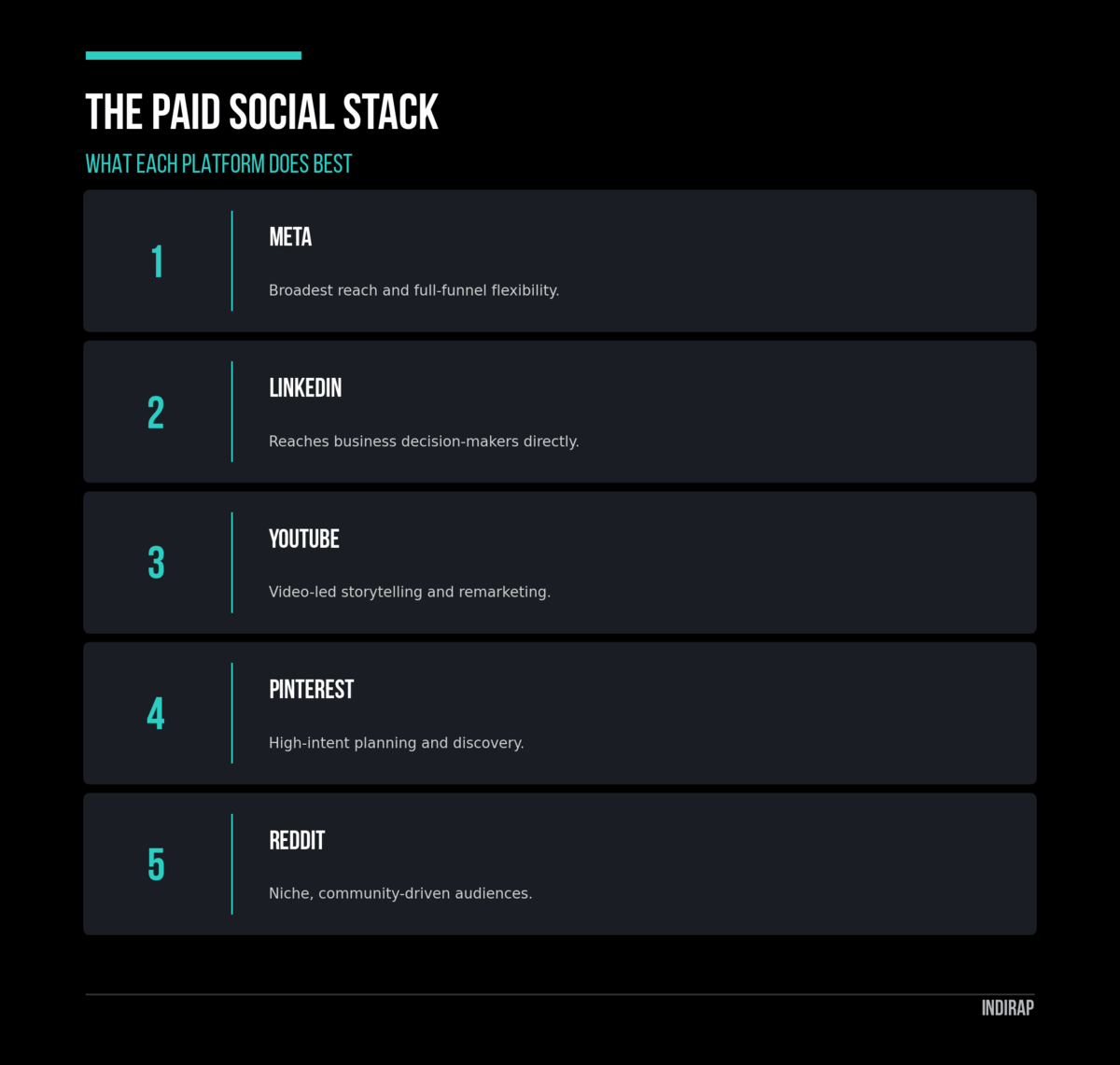
Meta (Facebook and Instagram). Meta remains the broadest paid social platform, with the largest audience pool and the most mature ad system. It is strong across the entire funnel: awareness campaigns can run on Reels and Stories, mid-funnel campaigns can retarget engaged visitors, and bottom-funnel campaigns can drive purchases or leads directly from the feed. Meta's Advantage+ suite now automates much of the targeting and placement decision-making, which shifts the marketer's job toward feeding the system great creative and clean data.
LinkedIn. For B2B brands, LinkedIn offers targeting by job title, company size, industry, and seniority that no consumer platform can match. It costs more per click than Meta, so it works best for higher-value offers: demo requests, gated content, or sales conversations rather than low-ticket purchases. Video and native document ads tend to outperform static image ads because they hold attention longer in a feed built around professional updates.
YouTube. YouTube pairs the reach of a video platform with the targeting and bidding infrastructure of Google Ads. It is well suited to brand awareness, product demonstrations, and remarketing to people who have already visited a website, and it gives longer-form storytelling a home that vertical, short-form platforms cannot. Skippable in-stream ads and short-form Shorts placements can run from the same campaign, covering both a considered pitch and a fast hook.
Pinterest. Pinterest works differently from other social platforms because users arrive with planning intent: home projects, gift ideas, travel, weddings, and similar high-intent categories. Ads blend into a visual feed that people are already treating like a mood board, which makes Pinterest a strong fit for retail, home, and lifestyle brands looking for a lower-pressure, high-intent placement.
Reddit. Reddit ads reach highly engaged, topic-specific communities, which makes the platform valuable for niche products, software, and brands that benefit from credibility inside a specific interest group. Ads that read like a genuine community post, rather than an obvious pitch, tend to perform best here, since Reddit users are quick to recognize and skip anything that feels out of place.
Choosing platforms comes down to matching audience and funnel stage rather than picking a single "best" channel. A B2B software company might lean on LinkedIn and YouTube, while a direct-to-consumer retail brand might lean on Meta and Pinterest. Many brands run a blend and let performance data guide the budget split over time.
Targeting used to mean stacking narrow filters: age range, interest categories, behaviors, and lookalike percentages layered on top of each other. Privacy changes and reduced tracking data have made that kind of granular targeting far less reliable, so the platforms themselves have shifted toward broader, AI-managed targeting.
Three things matter more than granular filters now:
Broad targeting paired with strong creative. Letting the algorithm find an audience within a wide pool, rather than narrowing it manually, often performs as well or better than tight targeting did in years past, because the AI has more signal to work with and more room to optimize delivery.
Lookalike audiences built on first-party data. Audiences modeled on existing customers, email subscribers, or high-value website visitors give the algorithm a strong starting signal, especially compared to interest-based targeting that has grown less precise.
First-party data as the foundation. A brand's own customer list, CRM data, and website behavior are the most reliable inputs available, since they come directly from real interactions rather than inferred interests. Investing in clean data collection (email capture, CRM hygiene, website tracking that respects privacy settings) pays off directly in paid social performance.
The practical takeaway: targeting strategy in 2026 is less about restriction and more about giving the platform good raw material, both in audience data and in creative, and letting automated systems do the matching.
As Meta's Advantage+ campaigns and similar AI-driven tools take over more of the targeting, bidding, and placement decisions, the biggest remaining lever a marketer controls is the ad itself. Creative has become the primary way to differentiate performance between campaigns running on the same platform with the same automated systems underneath.
A few patterns consistently perform well on paid social right now:
Because creative now does the heavy lifting that targeting used to do, testing multiple creative variations (different hooks, formats, and messaging angles) inside the same campaign is one of the highest-leverage things a marketer can do. For a deeper look at what makes an ad perform, see Best Ad Creative, and for a closer look at creator-style formats specifically, see UGC and Video Ads That Convert.
Paid social performs best when campaigns are structured around the funnel rather than treated as a single, undifferentiated push.
Top of funnel: awareness. These campaigns introduce a brand to a broad, relevant audience. The goal is attention and recall, not an immediate conversion, so creative should focus on a clear, memorable message and a strong hook.
Middle of funnel: consideration. These campaigns speak to people who have already shown some interest, whether through an engagement, a video view, or a site visit. Content here can go deeper: product demonstrations, customer stories, or comparisons that help someone move closer to a decision.
Bottom of funnel: conversion. These campaigns target warm audiences, such as past website visitors, cart abandoners, or email subscribers, with a clear, direct call to action. Retargeting tends to deliver the strongest return in this stage because the audience already has context on the brand.
Running all three stages together, with creative built for each one, produces a more efficient system than running a single generic campaign and hoping it converts cold traffic. Budget allocation should follow the same logic: more spend and broader reach at the top, tighter and more direct messaging as the funnel narrows.
Budgeting for paid social starts with a realistic view of the funnel stage each campaign supports. Awareness campaigns typically need broader reach and more impressions to build recognition, while retargeting campaigns can run efficiently on a much smaller budget because the audience is already warm.
A few budgeting principles hold up well in 2026:
Cost per result will vary widely by platform, industry, and offer, so the most useful benchmark is a brand's own historical performance rather than a generic industry average.
Measurement on paid social should map back to the funnel stage a campaign supports, rather than judging every campaign against the same metric.
With signal loss making some tracking less precise than it once was, first-party data and platform-reported results deserve more trust than they might have a few years ago, and blending platform data with CRM and sales data gives the clearest final picture of what paid social is actually driving. Reviewing performance regularly, and letting creative and budget decisions follow the data rather than a fixed plan, keeps a paid social program improving over time.
INDIRAP has produced more than 20,000 videos for 900+ brands across 40 industries, and paid social creative is one of the most common requests we see, since it is the piece of the system that makes the biggest difference to performance.
Paid social refers specifically to paid ad placements on social platforms, while social media marketing is the broader practice that also includes organic posting, community management, and brand presence. Paid social is one tool inside a larger social media marketing strategy.
The best platform depends on the audience and the goal: Meta offers the broadest reach and full-funnel flexibility, LinkedIn excels at reaching business decision-makers, YouTube suits video-led storytelling and remarketing, Pinterest fits high-intent planning categories, and Reddit works well for niche, community-driven products. Many brands run a blend across two or three platforms rather than relying on just one.
Budgets vary by industry, competition, and goal, so the most reliable approach is starting with a modest, consistent budget, giving campaigns time to exit the learning phase, and adjusting based on actual cost per result rather than an industry rule of thumb.
AI-driven systems like Meta's Advantage+ campaigns now manage much of the targeting and bidding automatically, which means creative has become the clearest way for a marketer to influence performance. Strong, well-tested creative consistently outperforms narrow manual targeting on today's platforms.
Shorter, vertical video formats tend to perform best on paid social, with a strong hook in the first three seconds to earn attention before a viewer scrolls past. Since most social video is watched without sound, captions and on-screen text should carry the core message regardless of length.
Paid search reaches people who are already searching for something, so intent is built in. Paid social reaches people while they are browsing, so the ad has to create interest and attention on its own, which is why creative quality plays such a large role in paid social performance.
Keep reading: Paid Advertising: The Complete 2026 Guide · Best Ad Creative · UGC and Video Ads That Convert · Google Ads vs Facebook Ads
Work with us: Video Production · Content Strategy · Content Kit · Book a strategy call

Julian Tillotson is the Founder & CEO of INDIRAP, a full-service video production and creative strategy agency based in Chicago, IL. With 10+ years of experience, INDIRAP has delivered 20,000+ videos to 900+ clients across 40+ industries, making it one of North America's leading digital creative agencies.


.png)
.png)