B2B paid advertising is the practice of using paid channels, primarily LinkedIn, Google, YouTube, and Meta, to reach buying committees and decision-makers with the goal of generating pipeline rather than one-click purchases. The core difference from B2C advertising is the sales cycle: B2B campaigns are built around longer consideration windows, multiple stakeholders, and higher-value deals, so success is measured in opportunities and pipeline value, not just clicks or leads.
B2B paid advertising sells into a process, not a moment. A consumer might see an ad and buy the same day. A B2B buyer sees an ad, researches the category, loops in three or four colleagues, compares vendors, and moves through procurement over weeks or months.
Four differences shape every decision in a B2B paid media plan:
Long sales cycles. Deals can take 60, 90, or 180+ days to close, especially at the enterprise level. A single conversion event rarely tells the whole story, so B2B advertisers have to plan for a series of touches: awareness, research, comparison, and finally a sales conversation.
Buying committees, not individual buyers. A single ad rarely reaches everyone who influences a purchase decision. Most B2B deals involve a mix of end users, budget owners, technical evaluators, and executive sponsors. Effective campaigns are built to reach several roles inside the same target accounts, not just one job title.
Higher deal values. A B2C ad might drive a $40 purchase. A B2B ad might contribute to a $40,000 or $400,000 contract. That changes the math on acceptable cost per lead and cost per click. A $150 cost per lead can be a bargain if the average deal size is six figures.
Lead generation versus demand generation. Lead generation campaigns ask for something now, a form fill, a demo request, a download. Demand generation campaigns build awareness and preference with the audience before they are ready to buy, so that when they do start evaluating vendors, your brand is already familiar. A mature B2B paid media program runs both at the same time, using demand generation to fill the top of the funnel and lead generation to convert the buyers who are ready.
For a broader view of paid channels across B2B and B2C, the pillar guide on paid advertising walks through the fundamentals that apply to every industry.
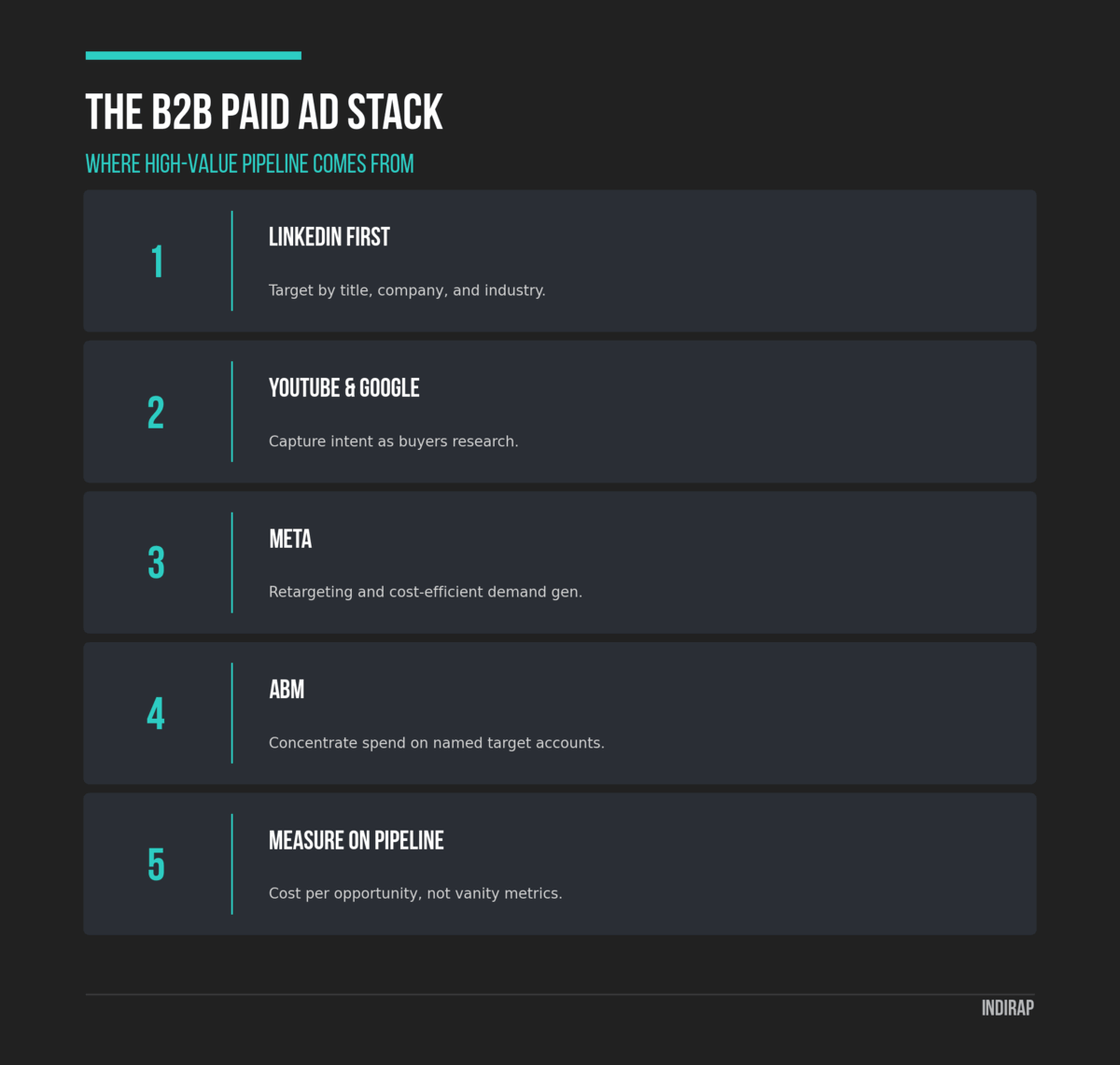
Platform priority in B2B follows buyer behavior, not just audience size. A useful default order for most B2B advertisers in 2026 looks like this.
LinkedIn first. LinkedIn remains the strongest platform for reaching B2B audiences by job title, seniority, company, industry, and company size. No other platform matches its combination of professional targeting and native lead-generation formats. For account-based campaigns in particular, LinkedIn's company and title targeting make it the natural starting point. Sponsored Content, Message Ads, and Lead Gen Forms all work well for different stages of the funnel: Sponsored Content for awareness and thought leadership, Lead Gen Forms for demo requests and content downloads, and Message Ads for high-intent, personalized outreach to named accounts.
YouTube and Google for intent. Search captures buyers who already know they have a problem and are actively looking for a solution. Google Search campaigns built around category and competitor terms tend to produce the highest-intent leads in a B2B mix. YouTube extends that reach earlier in the funnel: buyers research vendors, watch product walkthroughs, and compare options on video well before they fill out a form. A YouTube presence, paired with a strong search program, covers the research phase that LinkedIn alone does not.
Meta for retargeting and demand generation. Meta's granular B2B job-title targeting has narrowed over time, but the platform still performs well for two jobs: retargeting website visitors and known-account audiences, and running broader demand generation content to build brand familiarity at a lower cost per impression than LinkedIn. Layering Meta on top of first-party retargeting lists, rather than relying on cold interest targeting, tends to produce the best results.
For a side-by-side comparison of platform strengths, see the best paid advertising platforms guide.
Account-based marketing (ABM) is a strategy that targets a defined list of named accounts, rather than a broad audience defined only by demographics or interests, with coordinated marketing and sales outreach. Paid media is one of the most efficient ways to execute ABM at scale.
In practice, ABM paid campaigns start with a target account list, usually built from a combination of firmographic fit (industry, company size, revenue) and intent signals (website visits, content downloads, sales conversations already in progress). That list is uploaded to LinkedIn, Google, and Meta as matched audiences, and ads are built to reach multiple roles inside each account: the economic buyer, the technical evaluator, and the day-to-day user.
The advantage of ABM paid media is efficiency. Instead of spending budget on a wide audience where most people will never buy, spend concentrates on accounts that are already a strong fit, and sales teams see familiar company names showing up in their pipeline reports rather than cold leads. ABM works especially well for higher-value deals with a smaller total addressable market, where reaching the right 200 accounts matters more than reaching 200,000 people.
Creative is one of the biggest levers in B2B paid advertising, and it is often underused. The assumption that B2B ads need to be plain, text-heavy, and formal has not matched buyer behavior for a while. B2B buyers are people first: they scroll LinkedIn and YouTube the same way they scroll any other platform, and they respond to the same creative principles that work in consumer advertising.
A few patterns hold up well in 2026:
Video and thought-leadership content perform. Founder-led videos, customer testimonials, and short explainer clips consistently outperform static graphics in B2B feeds, because they build trust faster and hold attention longer. A well-produced case study video can do more to move a buying committee than a data sheet, because it shows real outcomes from a real customer.
Short-form and vertical formats matter, even in B2B. Buyers scroll LinkedIn and YouTube Shorts the same way they scroll everywhere else. A hook in the first three seconds determines whether the rest of the ad gets watched. Most social video is watched without sound, so captions and on-screen text are not optional, they are part of the creative.
AI has automated targeting and bidding, which puts more weight on creative. Performance Max on Google and Advantage+ on Meta now handle much of the targeting, placement, and bid optimization automatically. That shifts the advertiser's job: instead of hand-tuning audiences, the highest-leverage work is producing creative variations that give the algorithm strong signal to optimize against. Accounts running several fresh creative concepts at once tend to outperform accounts running one static ad for months.
Signal loss makes first-party data and creative more valuable. As third-party tracking continues to erode, CRM lists, retargeting audiences, and customer match data have become the most reliable targeting inputs advertisers control directly. Creative becomes the other lever that is fully in the advertiser's control, which is why investing in a steady supply of video and static variations pays off more in 2026 than it did five years ago.
INDIRAP has produced more than 20,000 videos for 900+ brands across 40 industries, and the pattern holds consistently: B2B brands that treat creative as a system, not a one-off project, see stronger and more consistent paid media results. For a deeper look at what makes B2B creative work, see best ad creative.
The right B2B measurement framework looks past vanity metrics like impressions and click-through rate and focuses on pipeline.
Cost per opportunity is the core metric. Instead of stopping at cost per lead, track how many leads convert into sales-qualified opportunities, and divide spend by that number. A campaign that produces cheap leads but few real opportunities is less efficient than one that produces fewer, higher-quality leads that sales can actually work.
Pipeline value and pipeline velocity matter more than lead volume. Total pipeline generated, and how quickly it moves through stages, tells a more complete story than raw lead counts. A channel that produces fewer leads but larger, faster-moving deals can be the better investment even if its top-of-funnel numbers look smaller on a dashboard.
Attribution should span the full cycle, not just the first touch. Because B2B deals involve multiple touches across weeks or months, single-touch attribution models tend to undercount channels that do early-stage work, like YouTube and demand generation content. Multi-touch attribution, or at minimum a first-touch and last-touch comparison, gives a fairer read on which channels are actually contributing.
Sales and marketing alignment closes the loop. Paid media teams need visibility into what happens to leads after the form fill: which ones sales accepted, which ones closed, and at what value. Without that closed-loop reporting, it is easy to optimize for the wrong outcome, more leads, instead of the right one, more revenue.
For a full framework on connecting paid spend to these outcomes, the paid media strategy guide covers planning, budgeting, and reporting in more depth.
Budget requirements in B2B vary widely by deal size, sales cycle length, and platform mix, but a few realistic guardrails help set expectations.
LinkedIn costs more per click and per lead than most other platforms. Its precise targeting comes at a premium, and B2B advertisers should expect a higher cost per click than they would see on Meta or Google Display. That premium is usually justified by lead quality, since LinkedIn reaches buyers by role and company with far more precision than open-audience platforms.
Budgets should scale with deal value, not industry norms. A company selling a $5,000 annual contract needs a very different budget structure than one selling $250,000 enterprise deals. Higher deal values support higher acceptable costs per lead and per opportunity, which in turn support more aggressive testing and larger creative production budgets.
Early months are for learning, not just results. New B2B paid programs typically need a data-gathering period, often 60 to 90 days, before performance stabilizes. This is especially true on LinkedIn, where audience sizes are smaller and algorithms need volume to optimize effectively. Setting realistic expectations for that ramp-up period prevents premature budget cuts that never let a campaign reach steady performance.
A healthy mix spreads budget across the funnel. Rather than pouring the entire budget into bottom-funnel lead generation, a sustainable B2B paid program allocates spend across demand generation (LinkedIn and YouTube), intent capture (Google Search), and retargeting (Meta and LinkedIn), so the pipeline has both a wide top and a strong, well-nurtured bottom.
B2B paid advertising is the use of paid channels, primarily LinkedIn, Google, YouTube, and Meta, to reach business buyers and buying committees with the goal of generating pipeline and revenue, rather than single-click consumer purchases.
Yes, for most B2B companies. LinkedIn's cost per click runs higher than other platforms, but its ability to target by job title, seniority, company, and industry produces leads that are closer to a company's actual buyers, which typically offsets the higher cost through better lead quality and conversion rates.
Most B2B paid programs need 60 to 90 days to gather enough data for algorithms to optimize and for early campaigns to reach stable performance. Because B2B sales cycles often run 60 to 180 days or longer, full pipeline results, closed deals attributable to paid media, can take several months to appear even after campaigns are performing well.
Lead generation asks a prospect to take an immediate action, like filling out a form or requesting a demo. Demand generation builds awareness and trust with an audience before they are ready to buy, so that when they do start evaluating vendors, the brand is already familiar. A well-rounded B2B paid strategy runs both together.
Yes. Video and thought-leadership content, including founder-led clips, customer testimonials, and short explainer videos, consistently perform well in B2B feeds because they build trust and hold attention better than static graphics. Short-form, vertical formats with a strong hook in the first few seconds work in B2B the same way they work in consumer advertising.
The most reliable B2B measurement framework tracks cost per opportunity, pipeline value, and pipeline velocity, not just leads or clicks. Closing the loop with sales data, so marketing can see which leads actually became qualified opportunities and closed deals, is essential for understanding true return on paid spend.
Keep reading: Paid Advertising: The Complete 2026 Guide · Best Paid Advertising Platforms · How to Build a Paid Media Strategy · Best Ad CreativeWork with us: Video Production · Content Strategy · Content Kit · Book a strategy call


Julian Tillotson is the Founder & CEO of INDIRAP, a full-service video production and creative strategy agency based in Chicago, IL. With 10+ years of experience, INDIRAP has delivered 20,000+ videos to 900+ clients across 40+ industries, making it one of North America's leading digital creative agencies.


.png)
.png)