
UGC ads are short, creator-style videos that look and sound like organic social content rather than a traditional commercial, and video ads in general convert better in 2026 because they blend into the feed, build trust faster than polished brand spots, and hold attention in a scroll-first, sound-off environment. Marketers who lean into this format are seeing stronger click-through rates and lower costs per result across Instagram Reels, YouTube Shorts, Facebook, and in-feed video placements.
UGC (user-generated-style) ads are videos filmed to look like they came from a real person's camera roll: handheld or selfie-style footage, natural lighting, casual delivery, and a testimonial or demo feel. Some are genuinely made by customers or fans. Many of the highest-performing ones today are produced by trained creators or in-house teams who understand how to replicate that authentic look on purpose.
The reason UGC-style ads convert is simple. Audiences have spent years scrolling past ads that look like ads. A video that looks like a friend's recommendation earns a beat of trust before the viewer even registers it as paid content. That trust translates into higher click-through rates, lower cost per click, and better retention through the first few seconds, which is exactly where most viewers decide whether to keep watching or scroll on.
Polished, studio-produced ads still have a role. They build brand equity, they work well at the top of a video advertising funnel for awareness, and they perform strongly on connected TV and pre-roll where production value signals credibility. UGC-style ads complement that work by carrying the message into the feed environments where people expect something lower key and more personal. The strongest paid social programs in 2026 run both, matched to where each format performs best.
Short-form vertical video wins the majority of paid social budget in 2026 because it matches how people actually hold their phones and how they actually watch. Instagram Reels, YouTube Shorts, and in-feed video on Facebook all default to a full-screen, vertical, sound-optional experience, and the platforms reward creative that keeps people watching in that format with better delivery and lower costs.
There is also a structural shift happening behind the scenes. Campaign tools like Advantage+ and Performance Max now handle most of the targeting and bidding automatically, using machine learning to find the right audience and the right price. That leaves creative as the biggest lever advertisers can still pull by hand. Two advertisers targeting the same audience with the same budget will see very different results based on the video itself: the hook, the pacing, the format, and how many variations are in rotation.
In practice, this means video advertising success in 2026 depends less on media buying tricks and more on producing video that earns attention in the first three seconds and holds it through the CTA.
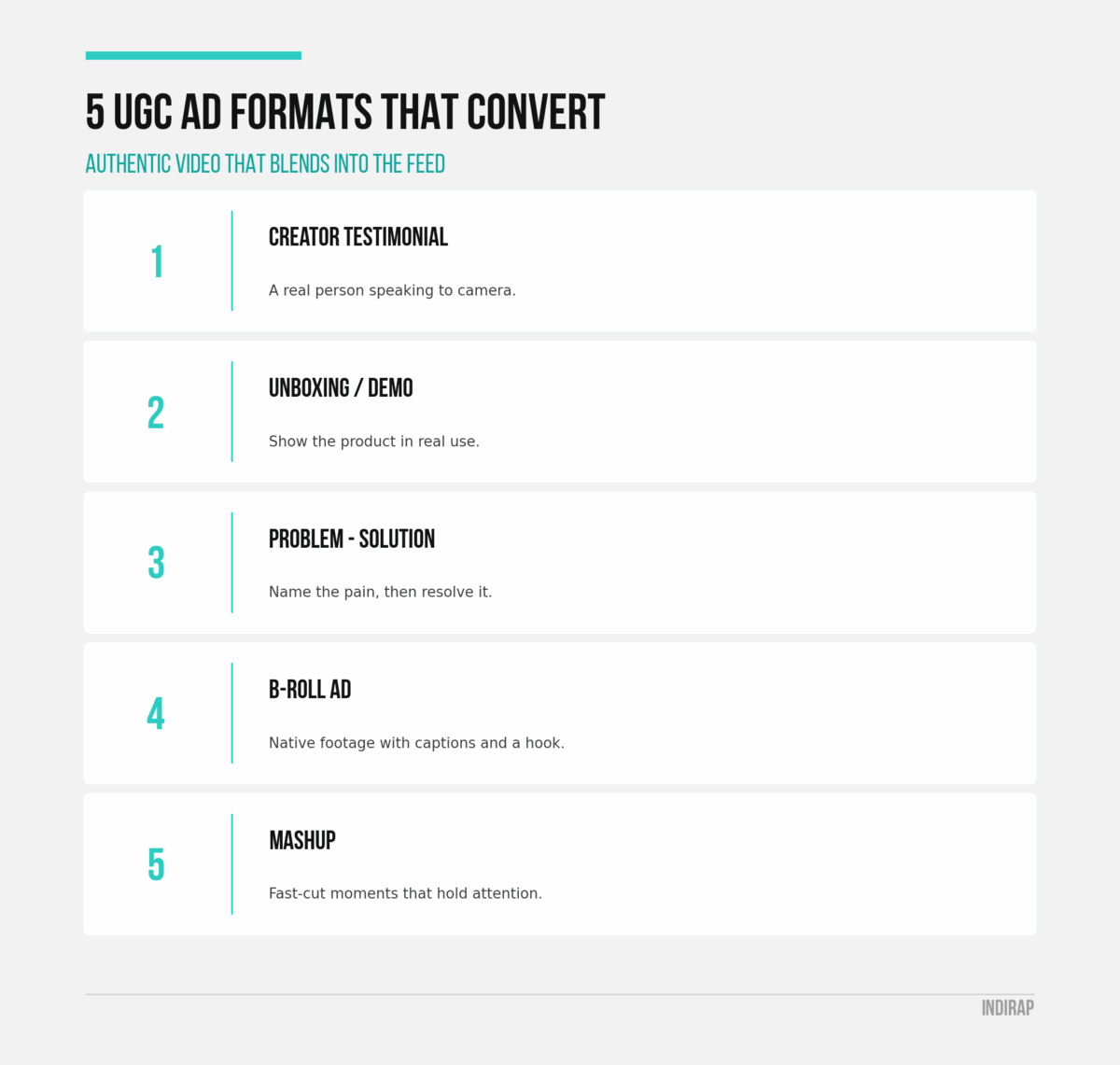
Most UGC and creator-style ads that perform well fall into a handful of repeatable formats. Testing several of these against each other, rather than betting on one, is the fastest way to find what resonates with a given audience.
Rotating across these formats, rather than repeating the same structure, is what keeps a video advertising account from plateauing.
The first three seconds decide whether a UGC or video ad earns a view or gets scrolled past, so the hook needs to work before the viewer has any context about the brand. Strong hooks tend to open with a bold claim, a relatable problem, a question, or an unexpected visual, delivered before any logo or branding appears on screen.
From there, a simple structure keeps the script tight: hook, problem or context, solution or demonstration, and one clear call to action. Trying to fit multiple offers or asks into a single ad tends to dilute performance. One CTA, repeated once or twice, converts better than several competing ones.
Because most social video is watched with the sound off, captions are not optional. Every UGC and video ad should be designed to work fully muted, with burned-in captions, on-screen text for key claims, and visuals that carry the story even if no audio plays. Sound then becomes a bonus for the viewers who do have it on, rather than a requirement for the ad to make sense.
Creative fatigues faster than most advertisers expect, especially in the tight-knit audiences that Advantage+ and Performance Max build around a campaign. A single ad, even a strong one, will start losing efficiency within days or weeks as the same audience sees it repeatedly.
The fix is volume paired with structured testing. Rather than producing one hero ad, the more reliable approach is producing a batch of UGC and video ad variations at once: different hooks on the same core message, different creators delivering the same script, different formats (testimonial, demo, problem-solution) built from the same underlying footage. Launching several variations together, then letting the data show which hook and format combination earns the best click-through and conversion rate, replaces guesswork with evidence.
This is also where producing at scale pays off. A single filming session with a creator can be cut into five or six distinct ads: a full testimonial, a shorter demo cut, a problem-solution edit, and a few B-roll variations with different captions. That approach keeps a steady stream of fresh creative in rotation without a proportional increase in production cost.
UGC and video ads do more than drive a first click. The same creative that earns attention cold also plays a role further down the funnel, and matching the right format to each stage improves results across the board.
Top-of-funnel audiences respond well to broader creator testimonials and problem-solution ads that introduce the brand and build initial trust. Once someone has visited a site, watched a video, or engaged with a post, retargeting audiences respond to more specific formats: a demo that answers a common objection, a mashup of multiple customers describing results, or a direct offer paired with social proof.
Because retargeting audiences have already seen the brand once, the UGC style still matters here. A polished, sales-heavy retargeting ad can feel like a hard pitch. A creator-style follow-up, especially one that addresses a specific hesitation ("here's what I wish I knew before I bought"), tends to move warm audiences toward conversion more comfortably than a generic discount banner.
Instagram Reels, YouTube Shorts, Facebook, and in-feed video placements carry the bulk of high-performing UGC and video advertising in 2026, and each has slightly different strengths worth planning around.
Instagram Reels rewards fast pacing, trend-aware editing, and strong opening hooks, and it works well for both cold prospecting and retargeting. YouTube Shorts benefits from the platform's search and recommendation strength, which means well-captioned, keyword-clear video ads can pick up organic reach alongside paid delivery. Facebook's broader and often older audience responds well to slightly longer demo and testimonial formats, particularly for considered purchases. In-feed video placements across these platforms give advertisers flexibility to run the same creative library across multiple environments and let the data show where each format performs best.
Testing the same core ad across all four placements, then shifting budget toward whichever combination of format and placement earns the strongest results, is a more reliable path to consistent volume than picking one channel and hoping it works everywhere.
UGC ads are styled to look like organic, creator-made content, using handheld footage, casual delivery, and a personal tone, while traditional video ads are typically produced with higher polish, professional lighting, and brand-forward visuals. Both have a place in a video advertising strategy: UGC-style ads tend to perform well for click-through and trust in feed environments, while polished ads support broader brand awareness.
UGC ads earn higher click-through rates because they resemble the organic content people are already scrolling through, which lowers the instinct to skip past them as an obvious ad. That familiarity builds a small amount of trust before the viewer consciously processes the pitch, which improves both watch time and click-through.
No. Many of the best-performing UGC-style ads are produced by trained creators or in-house teams who intentionally recreate the look and feel of organic content. What matters for performance is the format and delivery, not literally sourcing every video from an actual customer, though genuine customer testimonials remain a strong and credible source when available.
Most high-performing UGC and video ads run between 15 and 45 seconds, long enough to deliver a hook, a problem or demonstration, and a clear call to action, without giving the viewer time to lose interest. Shorter cuts of the same footage are worth testing for placements like Instagram Reels and YouTube Shorts, where faster pacing tends to hold attention.
Running several variations at once, rather than a single ad, is the best way to avoid fatigue and let performance data guide spend. A useful starting point is testing multiple hooks against the same core message, multiple creators delivering similar scripts, and a mix of formats like testimonial, demo, and problem-solution, then scaling whichever combinations perform best.
Sound still matters for the audience that has it on, but every UGC and video ad should be built to work fully muted first. That means burned-in captions, on-screen text for key claims and offers, and visuals strong enough to tell the story without relying on narration, with audio treated as an enhancement rather than a requirement.
Keep reading: Paid Advertising: The Complete 2026 Guide · Best Ad Creative · Paid Social Advertising PlaybookWork with us: Video Production · Content Strategy · Content Kit · Book a strategy call


Julian Tillotson is the Founder & CEO of INDIRAP, a full-service video production and creative strategy agency based in Chicago, IL. With 10+ years of experience, INDIRAP has delivered 20,000+ videos to 900+ clients across 40+ industries, making it one of North America's leading digital creative agencies.


.png)
.png)