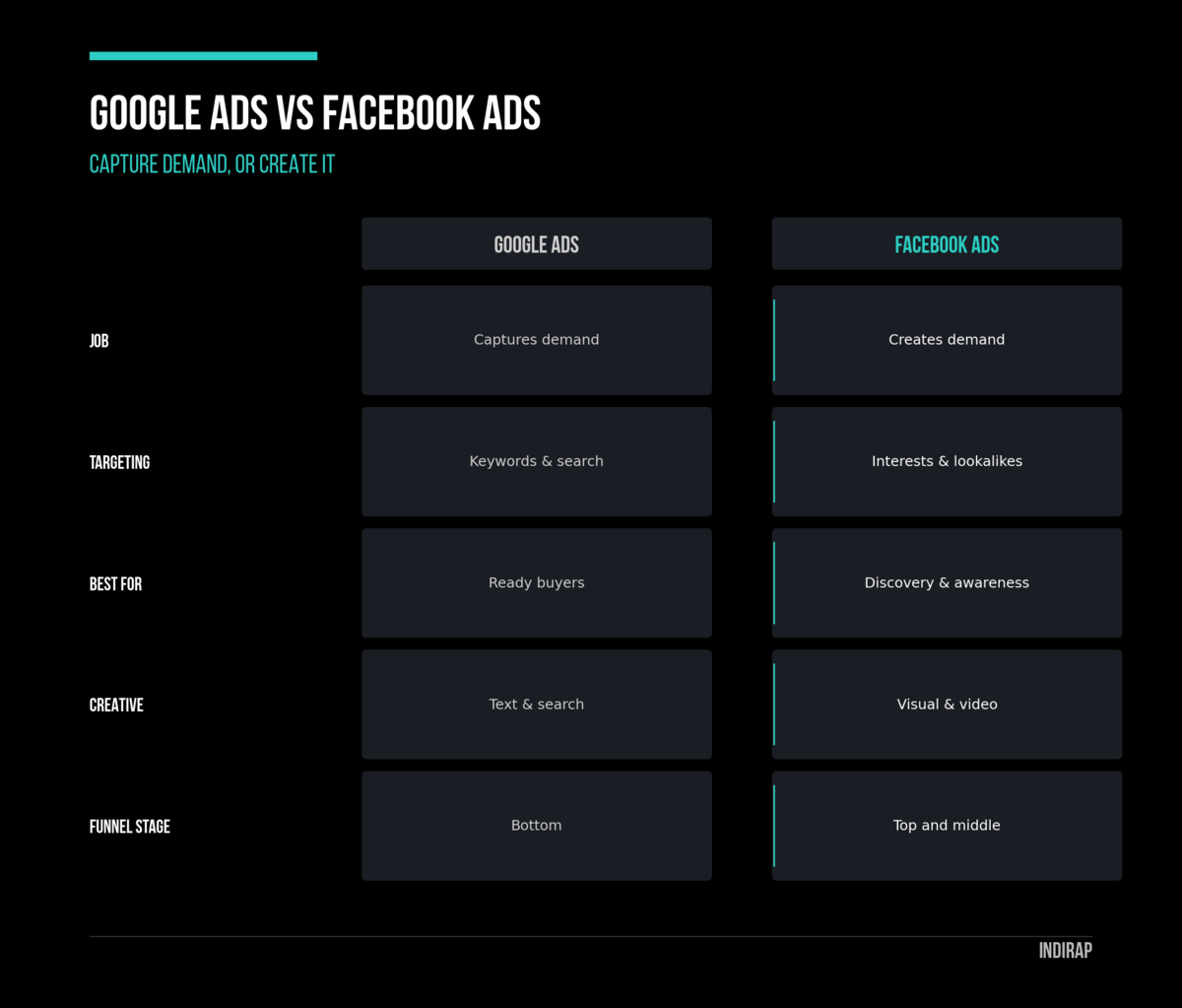
Google Ads captures demand that already exists: people typing a specific need into a search bar, ready to act. Facebook Ads (part of Meta) creates demand by putting your brand in front of people based on their interests and behavior, before they know they are looking. The right platform depends on your sales cycle, budget, and what stage your buyer is in, and for most businesses, the strongest answer is both, used for what each does best.
This guide breaks the decision down across the dimensions that actually matter: intent, targeting, cost, creative demands, funnel stage, speed to results, and the 2026 shift toward AI-run campaigns on both platforms.
Google Ads is a paid search platform. Ads appear on search results pages, YouTube, and the Google Display Network, triggered by keywords a person actively types in. Someone searching "commercial video production Chicago" already knows what they want. Google's job is to be the answer that shows up first.
Facebook Ads (and Instagram, under the same Meta Ads Manager) is a paid social platform. Ads appear in feeds, stories, and reels based on demographics, interests, past behavior, and lookalike audiences built from your existing customers. Nobody searched for you. The ad has to earn attention on its own, usually in the first three seconds, often with the sound off.
Neither approach is better in the abstract. Google answers a question someone already asked. Facebook plants the question in the first place.
Google Ads targeting starts with keywords and intent signals: what someone typed, their location, their device, and increasingly, machine-learning signals layered on top through Performance Max and AI Max for Search. You are reaching people mid-decision, and the targeting logic is built around matching query to offer.
Facebook Ads targeting starts with the person: their age, interests, job title, life events, past purchases, and how closely they resemble your best existing customers through lookalike audiences. Meta's Advantage+ suite now automates much of that targeting and budget allocation, learning from creative performance in near real time.
The practical difference: on Google, you are bidding to be the answer. On Facebook, you are bidding to be the interruption worth stopping for. Both require different research. Google campaigns start with keyword research. Facebook campaigns start with audience and creative research.
Cost per click on Google Ads varies widely by industry and keyword competitiveness. High-intent, high-value keywords (legal, insurance, home services) can run well into double-digit dollars per click, because the person clicking is close to a purchase decision. You are paying for proximity to conversion.
Facebook Ads typically carries a lower cost per click, because you are reaching a colder, broader audience earlier in their decision process. The tradeoff is that a Facebook click does not carry the same built-in intent a Google click does, so more of the conversion work happens after the click, on your landing page and in your creative.
Neither number tells the full story on its own. A $2 Facebook click that never converts costs more than a $12 Google click that closes. The metric that matters is cost per qualified lead or cost per acquisition, not cost per click in isolation. Tracking that requires clean attribution on both platforms, which is worth setting up before scaling spend on either one.
Google Ads, in its classic search form, is mostly text: headlines, descriptions, and extensions built around the keyword someone searched. Performance Max campaigns have expanded that to include images and video assets that Google's AI arranges automatically across Search, YouTube, Display, and Discover, which means even a "search" campaign now benefits from having video creative ready.
Facebook Ads runs almost entirely on visual and video creative. Short-form vertical video and authentic, UGC-style content consistently outperform polished, traditional commercials in feed and reel placements. The hook in the first three seconds decides whether someone keeps watching, and because most social video is watched without sound, on-screen captions and visual storytelling carry the message.
This is where the platforms diverge the most in what they demand from a marketing team. Google rewards precise copy and landing page relevance. Facebook rewards creative volume and testing speed, since Advantage+ needs multiple strong creative variants to find what resonates.
Google Ads performs strongest at the bottom and middle of the funnel, where someone has already identified a need and is comparing options or ready to buy. It is the platform for capturing demand that already exists, which makes it a natural fit for businesses with a clear, searchable service or product.
Facebook Ads performs strongest at the top and middle of the funnel, introducing your brand to people who fit your ideal customer profile before they start actively searching. It is the platform for creating demand, building awareness, and nurturing interest through retargeting once someone has engaged.
A useful way to think about it: Google meets people where they already are. Facebook builds the audience that will eventually show up on Google. Many businesses see their Facebook-driven brand awareness show up later as branded search volume on Google, a sign the two channels are reinforcing each other rather than competing.
Google Ads can produce leads within days of launch, because the demand is already there and the ad simply needs to be relevant and well-targeted. For businesses with an immediate need to fill a pipeline, Google Ads is typically the faster path to a first conversion.
Facebook Ads usually needs a longer runway. Meta's algorithm needs time and data (commonly referred to as the learning phase) to figure out which audience segments and creative variants perform best. Advantage+ has shortened that runway somewhat by automating optimization, but building genuine audience trust and brand recognition still takes weeks, not days.
If speed to first lead is the priority, start with Google. If the goal is building a durable audience and brand presence over the next two to three quarters, Facebook deserves the longer test window it needs to mature.
Businesses with high-intent, well-defined services (legal, medical, home services, B2B software with clear categories) tend to see faster returns on Google Ads, because their customers already know the words to search.
Businesses with visually compelling products, lifestyle brands, newer categories without established search demand, or anything that benefits from storytelling (hospitality, consumer products, emerging services) tend to see stronger returns building the case on Facebook Ads first.
Budget matters too. Smaller budgets often perform better concentrated on one platform, mastered before expanding. Larger budgets can support running both in parallel, using Facebook to build the audience and Google to capture the demand that audience eventually expresses through search.
Both platforms have moved decisively toward AI-managed campaigns. Google's Performance Max and AI Max for Search now handle bidding, placement, and audience expansion automatically, pulling from whatever creative assets you provide across Google's full network. Meta's Advantage+ campaigns do the same on the Facebook and Instagram side, automating budget allocation and audience targeting based on real-time creative performance.
The practical effect is that manual targeting knobs matter less than they did a few years ago on both platforms. What matters more now is creative: the volume, variety, and quality of the video and image assets fed into these AI systems. An algorithm can find the right person to show an ad to, but it cannot make a mediocre ad perform. Creative has become the primary lever advertisers control, on Google and on Facebook alike.
This is also why a consistent supply of short-form video, built for sound-off viewing with a fast hook, has become foundational to paid media performance rather than a nice-to-have. Teams that treat creative production as an ongoing pipeline, not a one-time asset order, tend to see AI campaigns on both platforms improve faster.
Using both together consistently outperforms relying on a single platform, because the two do fundamentally different jobs. Google captures demand that already exists. Facebook creates demand and builds the audience that will eventually search for you. Run them in sequence or in parallel, and each one strengthens the other: Facebook builds familiarity that improves Google click-through and conversion rates, while Google captures the people Facebook warmed up but who searched before converting.
A simple way to start: use Facebook Ads to build awareness and retarget engaged visitors with video, and use Google Ads to capture the branded and high-intent searches that awareness generates. Track both in the same reporting view so you can see the full picture, not just the last click.
Google Ads tends to generate leads faster for services people actively search for, since it captures existing demand. Facebook Ads can generate comparable or larger lead volume over time, especially with strong video creative and retargeting, but it usually needs a longer runway to mature.
Facebook Ads generally has a lower cost per click, but Google Ads clicks carry more built-in intent. The better comparison is cost per qualified lead or cost per acquisition, which depends on your landing page, offer, and creative, not the platform alone.
Yes, though smaller budgets often perform better focused on one platform first. Once that platform is generating consistent, profitable results, adding the second platform tends to compound performance rather than split it.
Video, especially short-form vertical video with a fast hook and captions for sound-off viewing, is the top-performing creative format on Facebook and Instagram feeds and reels. Static images still work for some campaigns, but video typically earns more attention and lower cost per result.
Both platforms now use AI to handle much of the targeting, bidding, and placement decisions, through Google's Performance Max and AI Max for Search and Meta's Advantage+. This shifts the advertiser's job toward supplying strong, varied creative assets, since the algorithms optimize delivery but cannot improve a weak ad.
B2B companies with clearly defined, searchable services often see faster early results on Google Ads, since buyers actively search for solutions. B2C and visually driven brands often see strong results building awareness on Facebook Ads first, then capturing the resulting search demand on Google.
Keep reading: Paid Advertising: The Complete 2026 Guide · Best Paid Advertising Platforms · Paid Social Advertising Playbook · How to Build a Paid Media Strategy
Work with us: Video Production · Content Strategy · Content Kit · Book a strategy call


Julian Tillotson is the Founder & CEO of INDIRAP, a full-service video production and creative strategy agency based in Chicago, IL. With 10+ years of experience, INDIRAP has delivered 20,000+ videos to 900+ clients across 40+ industries, making it one of North America's leading digital creative agencies.


.png)
.png)