The best ad creative in 2026 hooks a viewer in the first three seconds, makes one clear promise, proves it with something specific, and closes with a single obvious next step. Everything downstream, including targeting, bidding, and placement, only works if the creative earns attention first.
That shift matters more than it used to. Automated systems now handle most of the mechanical work that media buyers used to do by hand, which means creative has become the clearest lever a brand can pull to change its results.
Platforms like Google's Performance Max and Meta's Advantage+ now manage audience selection, bidding, and placement automatically. The algorithm decides who sees an ad, when, and for how much. What it cannot decide is what that ad says, how it looks, or whether it earns a second of attention.
That responsibility sits entirely with the advertiser. Two brands can run the exact same automated campaign settings and get very different results, and creative is almost always the reason why. A stronger hook, a clearer message, or a more native format can outperform a bigger budget.
This is one reason a documented paid media strategy matters as much as it ever did. Automation handles delivery. Strategy and creative decide whether that delivery turns into a customer. For a full view of how creative fits into the broader paid channel mix, see the complete 2026 paid advertising guide.
Converting creative does four things in order: it stops the scroll, it says one clear thing, it proves that thing is true, and it tells the viewer exactly what to do next. Skip any one of those steps and the rest of the ad has to work much harder to make up for it.
Most underperforming creative fails at the first step. It never earns the attention needed for the message, proof, or CTA to matter at all.
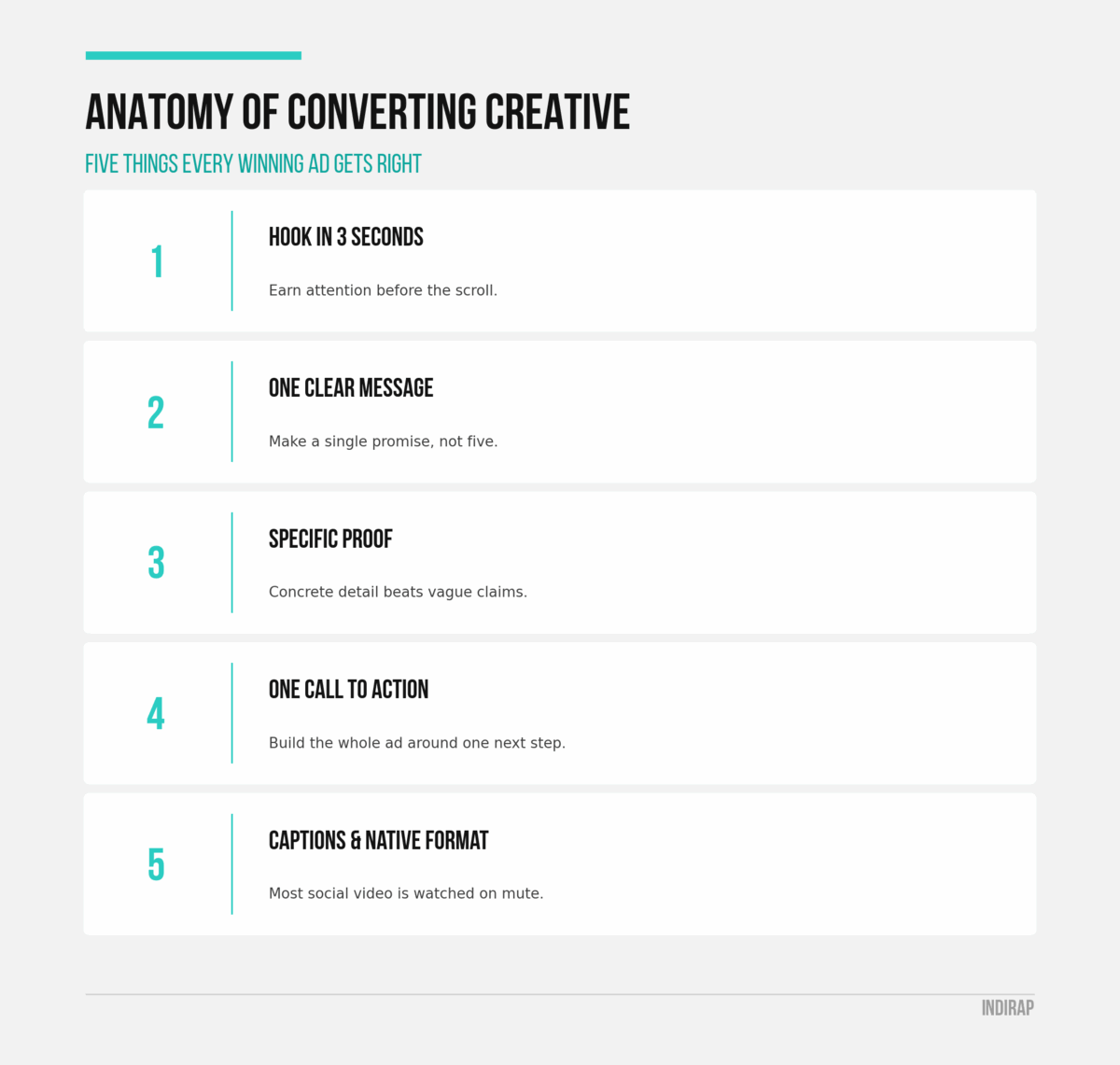
The strongest-performing ads in 2026 share a consistent structure. Use this as a working checklist for any new concept.
A hook in the first three seconds. Open with a question, a bold statement, a surprising visual, or a result, not a logo or a slow build. The first frame decides whether anyone sees the rest of the ad.
One clear message. Every ad should make a single promise. Trying to communicate three benefits at once usually means none of them land.
Specific proof over vague claims. "Grew leads 42% in 60 days" earns more trust than "we help you grow." Numbers, timeframes, and real outcomes carry far more weight than general statements.
One call to action. Give the viewer exactly one next step, stated clearly near the end of the ad. Multiple competing CTAs slow decisions down and reduce completions.
Captions and muted-friendly design. Most social video is watched without sound, at least at first. Captions, on-screen text, and visuals that carry the message alone are now standard, not optional.
A native, feed-first format. Ads that look like the content around them earn more attention than ads that look like ads. Vertical framing, casual lighting, and handheld camera work all help creative blend into the feed instead of interrupting it in an obvious way.
A visual pattern interrupt. A cut, a zoom, a text callout, or a scene change every couple of seconds keeps attention through the full ad rather than losing viewers halfway.
Format choice shapes performance as much as message does. A few formats consistently earn the most attention and the most conversions right now.
Short-form vertical video leads the field. It matches how people hold their phones and how feeds are built, and it gives creative the most room to use motion, sound design, and pacing to hold attention.
UGC-style testimonial video performs especially well because it looks like a recommendation rather than an advertisement. A real person speaking directly to camera about a specific result builds trust quickly, and it tends to earn stronger click-through and conversion rates than polished studio spots. For a deeper look at why this format works and how to plan it, see UGC and Video Ads That Convert.
Static image ads still have a place, particularly for retargeting and for messages that depend on a single strong visual or offer. They are fast to produce and easy to test in high volume.
Carousel ads work well for showing a product line, a process, or a before-and-after sequence, since each card can carry its own hook and proof point.
B-roll and product footage supports the other formats rather than replacing them. Clean, well-lit footage of a product or service in use gives editors raw material to build hooks, proof, and CTAs quickly across many variations.
Across every format, the platform matters as much as the format itself. A guide built specifically for feed behavior, like the paid social advertising playbook, is worth reviewing alongside these creative principles.
Creative fatigue sets in faster in 2026 than it did a few years ago. The same ad shown to the same audience for too long sees its performance decline as people become used to seeing it and stop reacting.
The answer to fatigue is volume paired with testing, not a single perfect ad. Brands that consistently perform well tend to produce many variations of a core concept, hooks especially, and let the data show which ones earn attention. A single message might be tested across five or six different opening hooks, several caption styles, and a couple of pacing edits before the strongest version becomes clear.
Once a winner emerges, the next move is to scale it and build fresh variations around it rather than running it unchanged indefinitely. New hooks, new proof points, and new formats built from the same core message keep performance strong long after a single ad would have worn out.
This is also where a documented creative and paid strategy pays off. Testing at volume works best when it is planned rather than reactive, which is another reason the paid media strategy guide is worth pairing with a creative production plan.
The most useful signals for creative testing show up early, usually within the first day or two of a new variation running. Hook rate, the percentage of viewers who watch past the first three seconds, tells you whether the opening is working before spend adds up. Thumb-stop rate and hold rate through the first several seconds tell a similar story for feed placements.
Click-through rate and conversion rate remain the outcomes that matter most, but they are lagging signals. A hook that earns strong early attention but a weak click-through rate usually points to a mismatch between the promise in the hook and the offer that follows, not a failure of the hook itself. Watching both sets of numbers together, rather than one in isolation, makes it much easier to diagnose why a given ad is or is not converting.
It also helps to test one variable at a time when possible: a new hook against the same body and CTA, or a new CTA against the same hook and body. Changing several elements at once still produces useful results, but it makes it harder to know which change actually moved the number. Over several rounds of testing, this variable-by-variable approach builds a clear picture of what a specific audience responds to, which then becomes the starting point for the next round of creative rather than a guess.
A few habits separate creative that performs from creative that looks good but underdelivers.
Lead with the hook, not the logo. Save branding for after the viewer is already engaged, rather than opening with it.
Design for sound off first, and sound on second. Build the message into the visuals and captions so it works either way, then layer in audio to strengthen it.
Use specific numbers, timeframes, and outcomes. Concrete detail builds trust faster than broad claims about quality or service.
Give every ad one job. Pick a single message and a single CTA, and let the next ad in the sequence carry the next idea.
Refresh creative on a schedule. Rotate in new variations before performance starts to dip, based on frequency and engagement trends, rather than waiting for a clear drop to show up in the numbers.
Match the format to the platform. Vertical framing, native pacing, and platform-appropriate captions consistently outperform a single asset resized to fit everywhere.
Following these habits consistently tends to matter more than any single clever idea. Small, repeatable improvements across many ads compound into a real performance advantage over time.
Short-form vertical video and UGC-style testimonial content are the strongest performers in 2026 because they match how people scroll and because they build trust quickly through a real person and a specific result.
The hook should land within the first three seconds. That is the window most viewers use to decide whether to keep watching, so the opening frame and the first line of dialogue or text carry the most weight in the entire ad.
No. Most social video is watched muted, at least initially, so the strongest ads carry their message through captions and on-screen text. Sound adds to the experience but should never be required to understand the offer.
There is no fixed number, but campaigns that test several hooks, a couple of formats, and a few caption or pacing variations around one core message tend to find a stronger winner, and hold performance longer, than campaigns running a single ad.
Because automated bidding and targeting handle most of the decisions that used to require manual media buying, creative has become the clearest variable advertisers still control directly, and the one most closely tied to how a campaign performs.
Both have a place. UGC-style content tends to build trust quickly and performs well for cold audiences, while produced video works well for brand storytelling and higher-consideration offers. Many of the strongest-performing campaigns use a mix of both across the funnel.
Keep reading: Paid Advertising: The Complete 2026 Guide · UGC and Video Ads That Convert · Paid Social Advertising Playbook · How to Build a Paid Media Strategy
Work with us: Video Production · Content Strategy · Content Kit · Book a strategy call
INDIRAP has produced 20,000+ videos for 900+ brands across 40 industries, including the short-form and UGC-style ad creative covered in this guide. If your team needs a steady supply of tested, high-converting ad creative, book a strategy call to talk through what would work for your funnel.
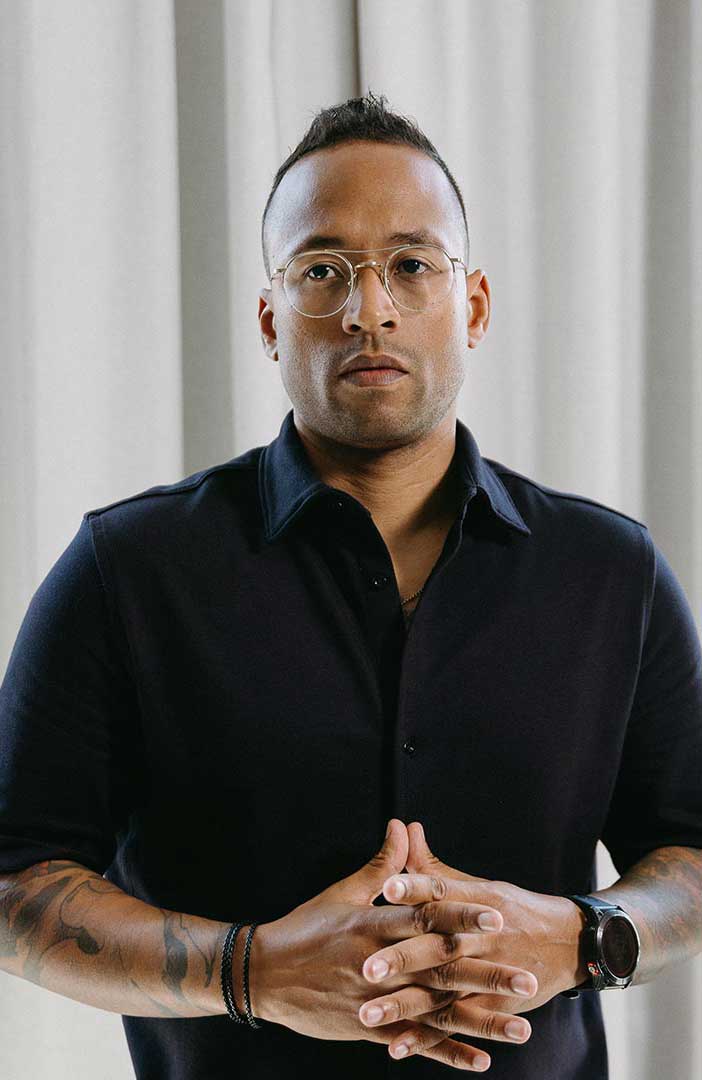

Julian Tillotson is the Founder & CEO of INDIRAP, a full-service video production and creative strategy agency based in Chicago, IL. With 10+ years of experience, INDIRAP has delivered 20,000+ videos to 900+ clients across 40+ industries, making it one of North America's leading digital creative agencies.


.png)
.png)