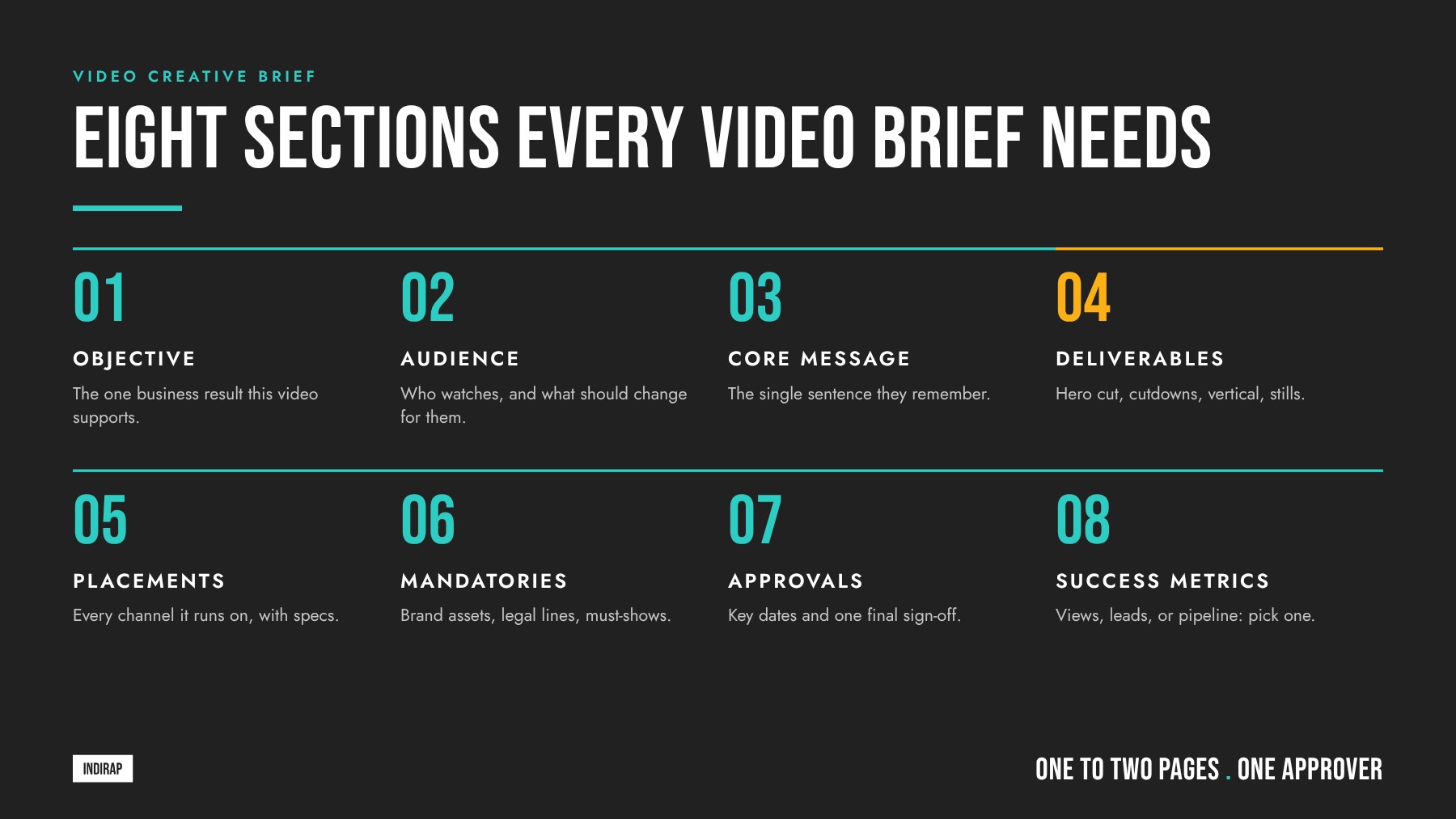
A creative brief for video is a one to two page document that tells your production team what the video must achieve, who it is for, what it must say, and what you need delivered. A strong video brief covers eight sections: objective, audience, core message, deliverables, placements, mandatories, timeline and approvals, and success metrics.
The brief is the cheapest point in a video project to get things right. Every decision it settles before kickoff is a decision nobody has to revisit on set or in the edit. INDIRAP has produced more than 20,000 videos for over 900 brands across 40+ industries since 2013, and the projects that run smoothest almost always start with a clear brief. This guide gives you a fill-in video brief template, explains each section, shows a worked example, and covers how to use the brief to get more from every shoot. If you want help shaping the brief itself, our free content strategy review is a good place to start.
A video creative brief is the document a brand gives its video team at the start of a project. It defines the business problem the video should solve and the boundaries the creative work must respect. The production team uses it to propose a concept, write the script, plan the shoot, and scope the budget and timeline.
A brief is different from a script or a treatment. The brief says what the video must do. The treatment proposes how the video will do it, with a concept, tone, and look. The script spells out exactly what is said and shown. Getting them in that order matters: when a team writes a script before the brief is settled, the script tends to answer the wrong question beautifully.
You will also hear the terms video brief, video production brief, and creative brief used interchangeably. They all describe the same starting document. Agencies sometimes add a separate production brief later with locations, talent, and logistics, but the creative brief comes first. Our guide to defining your video production goals before hiring a company is a helpful warm-up if you are earlier in the process.
Here are the eight sections, what each one answers, and a prompt to help you fill it in.
What business result does this video support? Pick one primary goal: awareness, lead generation, sales enablement, recruiting, training, or a launch. Prompt: "This video exists to [result] by [date], measured by [metric]."
Who is watching, what do they believe today, and what should they believe after? Be specific about role, industry, and buying stage. Prompt: "Our viewer is a [role] at a [company type] who currently thinks [belief]. After watching, they should think [new belief]."
What single sentence should the viewer remember? This is the hardest section and the most valuable. If the team cannot agree on one sentence, the video is trying to do too much. Prompt: "After watching, the viewer should remember that [one sentence]."
What exactly do you need delivered? List every length, aspect ratio, and format: a hero cut, 30 and 15 second versions, vertical 9:16 clips, square cuts for LinkedIn, still photography, captions, and transcripts. This section has the biggest effect on value, because it determines how much one shoot produces.
Where will each version run? Website, YouTube, LinkedIn, Instagram, paid social, connected TV, email, sales outreach, events, or internal channels. Each placement has its own viewing behavior and technical specs, so naming them early shapes how the crew frames and captures every scene. Our guide to video for social media specs and formats is a useful reference here.
What must appear, and what must the team respect? Include brand guidelines, logos, fonts, colors, music rules, legal disclaimers, required products, approved spokespeople, and anything that is off limits. Attach links to your brand assets and any past videos you like.
When does the video need to launch, and who signs off? List key dates (kickoff, script approval, shoot, first cut, final delivery) and name one final approver. Add any reviewers who must see the script, such as legal or compliance in regulated industries like financial services or healthcare.
How will you judge whether the video worked? Match the metric to the objective: view-through rate and reach for awareness, click-through and cost per lead for demand generation, meetings booked and pipeline influenced for sales enablement. Our guide to video marketing analytics explains which metrics fit which goals.
Here is the template as a single table you can copy into a document. Fill in the right column, keep each answer short, and attach supporting files as links.
| Brief section | Your answer |
|---|---|
| Project name and owner | [Project name], [owner name and role] |
| Objective | This video exists to [result], measured by [metric] |
| Audience | [Role, company type, buying stage]; believes [now]; should believe [after] |
| Core message | [One sentence the viewer should remember] |
| Tone and feel | [Three adjectives], plus links to two or three reference videos |
| Deliverables | [Hero length], [cutdowns], [vertical and square versions], [stills], [captions and transcripts] |
| Placements | [Every channel, with any known specs] |
| Mandatories | [Brand assets, legal lines, required people or products, items to avoid] |
| Key dates | Kickoff [date], script [date], shoot [date], first cut [date], launch [date] |
| Approvals | Final approver: [one name]; other reviewers: [names and what they review] |
| Success metrics | [Primary metric and target], [secondary metric] |
| Background and links | [Brand guidelines], [product docs], [past videos], [customer research] |
Notice the "Tone and feel" row. Reference videos communicate tone far faster than adjectives, so include two or three examples you admire, even from other industries, with one line on what you like about each. Our roundups of brand video examples and corporate video examples are good places to find them.
Here is a short example for a fictional B2B software company called Ledgerline, preparing a product launch video. It is illustrative only.
A brief like this one fits on a single page, yet it answers almost every question a production team would otherwise ask in the first two meetings. For more on the launch format specifically, see our guide to product launch videos.
A brief is a communication tool, and these habits make it a strong one.
Write decisions, not wishes. "Fun, engaging, and premium" describes every video. "Calm and practical, like a trusted colleague explaining a shortcut" gives the team a direction to follow.
Choose one audience and one message. Each additional audience or message dilutes the video. If you have three audiences, you likely need three cuts from one shoot, which the brief can plan for.
Bring real customer language. Quotes from sales calls, reviews, and support tickets are gold for scriptwriters. They help the script sound like your buyer and help the finished video get found in search.
Share the business context. Tell the team what a new customer is worth, where the video sits in the funnel, and what has or has not worked before. Context helps a good partner recommend the right scope.
Invite questions. Treat the brief as the start of a conversation. A strong partner will push back on gaps and suggest additions, especially in the deliverables section.
The short video below from HubSpot Marketing walks through how one marketer writes creative briefs quickly using a free template, with four practical tips for better creative projects. It is a useful companion if you are writing your first brief.
The tips apply directly to video. A brief that is quick to read, specific about the goal, and clear about who approves the work gives your production partner what it needs to propose the right concept on the first pass.
The deliverables section is where a brief earns its keep. Production costs are concentrated in the shoot: crew, equipment, locations, and talent time. Once those are in place, capturing more coverage costs relatively little, and every additional asset spreads the investment further.
When the brief lists every deliverable up front, the production team can plan coverage for all of them at once. That means framing key moments both horizontally and vertically, capturing extra B-roll for cutdowns, scheduling a stills photographer alongside the video crew, and recording alternate lines for different placements. INDIRAP calls this capture once, deploy many, and it is the model behind our Content Kit, which turns one production into a library of brand, product, and social assets.
A practical rule: before you send the brief, picture your content calendar for the next 90 days and ask which of those slots this shoot could fill. Add them to the deliverables list. For a deeper look at the model, see how to turn one shoot into 30 pieces of content and our guide to scaling corporate video production.
Send the brief before your first real conversation with a production partner, or alongside the request for a proposal. That lets the partner come to the first meeting with ideas rather than questions, and it makes proposals from different companies easier to compare.
Inside your company, share the brief with every reviewer before it goes out. Agreement on the objective, audience, core message, and approver at this stage prevents the most common source of delays: new opinions arriving after the shoot. If you are comparing partners, our list of questions to ask before hiring a video production company pairs well with the brief.
Once the partner responds, the usual sequence is a treatment or concept, then a script, then pre-production. Our guides to writing a video script and the corporate video production process cover those next steps.
At INDIRAP, the brief is where we start mapping one production to your whole funnel. Our team reviews your objective and audience, recommends the deliverables that will do the most work across your channels, and builds the concept, script, and shoot plan around them. Strategy, production, post-production, and distribution sit under one roof, so the intent of the brief carries through to every finished asset.
Explore our video production services, see our corporate video production and social media video work, or Book A Video Strategy Call and bring your brief, finished or not.
A creative brief for video is a short document that tells a production team what a video must achieve, who it is for, what it must say, and what needs to be delivered. It typically covers the objective, audience, core message, deliverables, placements, mandatories, timeline and approvals, and success metrics, and it guides the concept, script, and shoot.
Include eight sections: the business objective, the target audience, the one core message, every deliverable you need, the placements where the video will run, mandatories such as brand assets and legal lines, the timeline with one named approver, and the metrics you will use to judge success. Add reference videos and links to supporting files.
One to two pages is the right length for most video projects. The brief should record decisions, not background research, so keep each section to a few lines and link to longer documents such as brand guidelines or customer research. A short, specific brief gets read, while a long one tends to get skimmed.
The creative brief defines what the video must do: its goal, audience, message, and deliverables. The script defines exactly what the video says and shows, line by line and shot by shot. The brief comes first and guides the concept and script, so approving it before writing begins prevents rework later in the project.
The brand usually writes the brief, led by the marketing owner of the project with input from sales, product, and any subject matter experts. A strong production partner then reviews it, asks questions, and suggests additions, especially to the deliverables. Naming one final approver in the brief keeps the review process fast.
The brief shapes scope, and scope drives investment. Clear deliverables, placements, and mandatories let a production partner propose an accurate plan the first time and avoid costly changes after the shoot. Listing every asset you need up front also lets one production supply many videos, which lowers the cost of each finished piece.
Yes. Two or three reference videos, with a line about what you like in each, communicate tone, pacing, and style faster than any description. They can come from any industry. References give your production partner a shared starting point and make the first concept far more likely to match what you have in mind.
Send it before the first meeting or with your request for a proposal. That lets the production company arrive with ideas and an informed recommendation on scope, and it makes proposals from different partners easier to compare. Share it internally first so every reviewer agrees on the goal, audience, message, and approver.


Julian Tillotson is the Founder & CEO of INDIRAP, a full-service video production and creative strategy agency based in Chicago, IL. With 10+ years of experience, INDIRAP has delivered 20,000+ videos to 900+ clients across 40+ industries, making it one of North America's leading digital creative agencies.