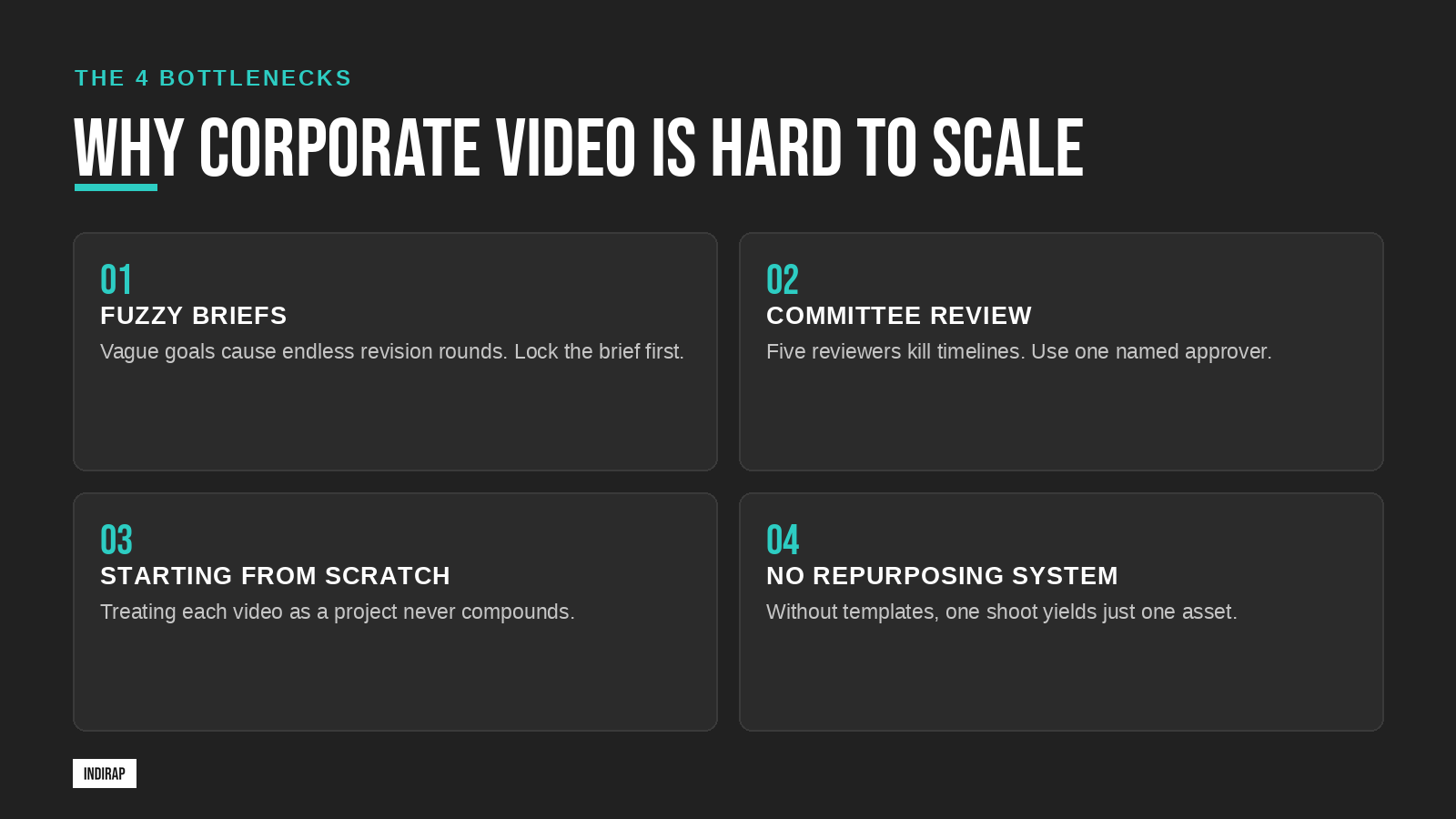
Marketing teams struggle to scale corporate video because of four bottlenecks: unclear briefs, slow committee review, starting every project from scratch, and no repurposing system. Fix those four and output goes up without quality going down. Scaling video is almost never a question of hiring a bigger crew or buying more gear; it is a question of removing the process friction that turns every video into a custom, start-from-zero project. This guide walks through each bottleneck, why it slows teams down, and the specific system that removes it, so corporate video becomes a repeatable engine instead of a recurring scramble.
The reason this matters is that demand for video keeps rising faster than most teams can supply it. Marketing needs brand and campaign video, sales needs enablement and demo content, product needs explainers, and recruiting needs culture video, all on their own timelines. A team that makes each of those as a bespoke project will always be behind. A team that runs a system will keep up and spend less per asset doing it.
Most teams try to scale by doing more of what they already do: book another shoot, brief another vendor, run another round of edits. That approach does not scale because the cost and the calendar time of each video stay roughly constant, so doubling output means doubling spend and doubling the wait. Real scale comes from changing the unit of work, from the single video to the system that produces many videos from shared inputs. The four bottlenecks below are the places where the old unit of work breaks down, and each one has a fix that changes the economics.
Most endless revision rounds trace back to a vague goal at the start. When the brief does not lock the message, the audience, and the single outcome, every reviewer fills the gap with their own interpretation, and the edit becomes a negotiation instead of an execution. The fix is a disciplined brief that is approved before anyone picks up a camera.
A good corporate video brief answers five questions in writing: what is the one message, who is the one buyer, what stage of the journey is this for, what should the viewer do next, and how will we know it worked. When those are locked and signed off, the edit approves itself, because there is a clear standard to measure it against. The brief is not bureaucracy; it is the single highest-leverage thirty minutes in the whole process, because it prevents the three extra revision rounds that a fuzzy start guarantees. Teams that standardize a one-page brief template and refuse to shoot without it cut their revision cycles dramatically. For the strategy behind a tight brief, see our guide to corporate video brand alignment.
Review by five people with equal say is where timelines die. Each reviewer sees the video through their own lens, the notes contradict each other, and the editor is left trying to satisfy everyone, which satisfies no one and takes weeks. The fix is to change the structure of review, not the people in it.
Assign one named approver who owns the final decision. Other stakeholders can give input, but that input flows through the approver, who gathers the notes, resolves the contradictions, and sends one consolidated list per round. Build in two rounds by default and make that the norm, so everyone knows there is a first pass for substantive notes and a second for polish, and the door closes after that. This single change, one approver and a fixed number of rounds, often does more for speed than any production upgrade, because it removes the open-ended negotiation that stretches a two-week edit into two months.
Teams that treat each video as a standalone project never compound. Every shoot reinvents the look, the structure, and the workflow, so the tenth video costs as much and takes as long as the first. The fix is to plan each shoot as infrastructure rather than a deliverable.
That means walking into a production day with a plan to capture enough material for many assets, not one. A single well-planned shoot can yield a hero piece plus explainers, testimonials, product segments, and a stack of short social cuts, because the setups, the interviews, and the b-roll were designed to serve all of them from the start. This is the single biggest unlock in scaling video, and it is the model behind our Content Kit: one production sprint planned to produce a full library, each asset mapped to a buyer and a stage. The shift is from asking what video do we need to asking what system can this shoot feed, and it changes the cost per finished asset dramatically.
Even teams that capture enough material often fail to turn it into finished assets efficiently, because every cutdown is handmade. The fix is to templatize everything downstream of the shoot so repurposing becomes close to assembly-line work.
Build reusable templates for the parts that do not need fresh creativity each time: lower thirds, captions, intros and outros, title cards, aspect-ratio frames for each platform, and brand-consistent motion graphics. With those in place, turning a hero video into a dozen platform-native cuts is a matter of assembly, not invention. The creative judgment lives in the shoot and the hero edit; the derivatives should be fast and consistent. This is where the real volume comes from, and it is the difference between a shoot that produces three assets and one that produces thirty for only a little more effort. Decide the cut list before the shoot so you capture what each derivative needs, and plan the paid and social versions the way the best B2B video agencies for paid social and repurposing do.
Put the four fixes together and you get a loop you can run every time:
Run that loop and corporate video becomes a system instead of a scramble. The first time through takes discipline; by the third or fourth, it is faster, cheaper per asset, and far more predictable. See how we run it for corporate clients.
A well-planned corporate shoot can produce a hero video plus ten to thirty derivative cuts across channels, depending on how much interview and b-roll material is captured and how many platforms you are feeding. That range is what makes scaling cost-effective: the marginal cost of each additional cut, once the footage exists and the templates are built, is a fraction of the cost of a new shoot. Teams that plan to one asset per shoot are leaving most of the value on the table.
Track two things above all. The first is cost per finished asset over a period, not cost per shoot, because that is the number that reveals whether your system is actually compounding. The second is cycle time from brief to published, because speed is the whole point of removing the bottlenecks. As the system matures, cost per asset should fall and cycle time should shrink, even as total output rises. If either is flat while you add volume, one of the four bottlenecks is still in place.
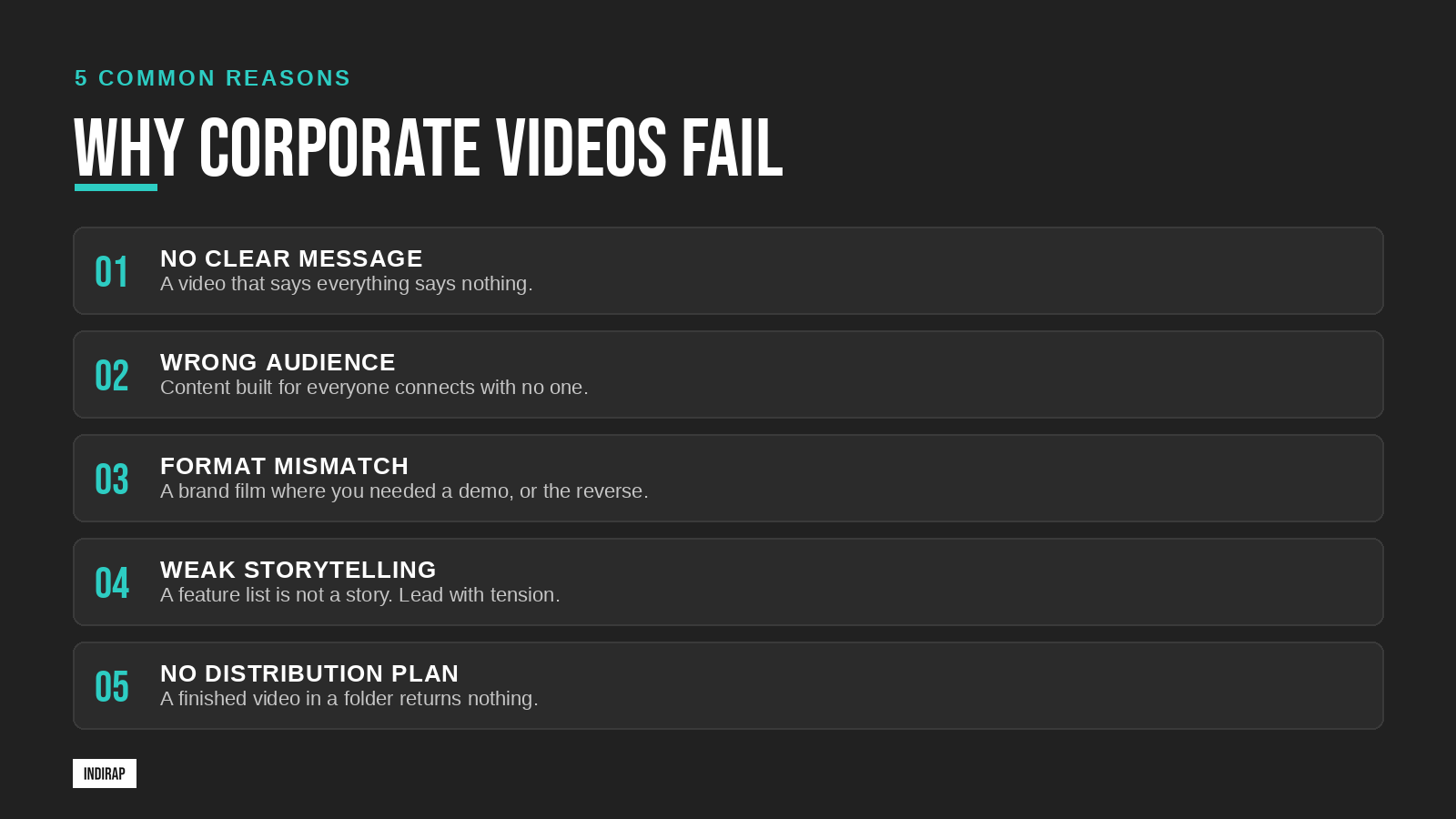
At INDIRAP, we built our process around these four fixes so clients get volume without the quality drop that usually comes with it. We lock the brief, plan each shoot as infrastructure, run review through a single approver, and produce derivatives from templates, which is how one production sprint becomes a full library of on-brand video mapped to your funnel. That is the model behind the Content Kit. To see where scaling tends to break, read our guide to why corporate videos fail, or book a strategy call to map your own video system.
Why is it so hard to scale corporate video?
Four bottlenecks slow teams down: fuzzy briefs, committee review, treating each video as a one-off project, and no repurposing system. Each is a process problem rather than a production problem, and each is fixable with a clear system.
How do you scale video without losing brand consistency?
Templatize everything downstream of the shoot, from lower thirds to platform cuts, and keep one named approver so every asset meets the same standard. Consistency comes from shared templates and a single point of sign-off, not from making each video by hand.
How many assets should one corporate shoot produce?
A well-planned shoot can produce a hero video plus ten to thirty derivative cuts across channels. Planning the full cut list before the shoot is what makes that range achievable and what makes scaling cost-effective.
What is the fastest way to speed up corporate video production?
Fix the brief and the approval process first. Most delays are decisions, not filming, so a locked one-page brief and a single named approver with two review rounds remove the biggest sources of lost time.
What should you measure when scaling video?
Track cost per finished asset over time and cycle time from brief to published. As the system matures both should improve even as output rises; if they do not, one of the four bottlenecks is still in place.
Is it cheaper to make many videos from one shoot?
Yes. Once the footage exists and the templates are built, each additional cut costs a fraction of a new shoot, so the cost per finished asset drops sharply as you produce more from each production.


Julian Tillotson is the Founder & CEO of INDIRAP, a full-service video production and creative strategy agency based in Chicago, IL. With 10+ years of experience, INDIRAP has delivered 20,000+ videos to 900+ clients across 40+ industries, making it one of North America's leading digital creative agencies.