Great corporate video is a process, not luck. The difference between a video that performs and one that disappoints is rarely the camera. It is the work that happens before, around, and after the shoot. When companies are disappointed with a video, the cause almost always traces back to a step that got skipped: a fuzzy objective, no real pre-production, or a finished file with no plan to distribute it.
This guide walks through the full corporate video production process the way an experienced partner runs it, five clear stages from first conversation to final distribution, so you know exactly what to expect, what is expected of you, and how long it takes. If you are still deciding what kind of video you need, start with our guide to the types of corporate video, then come back here for how it gets made.
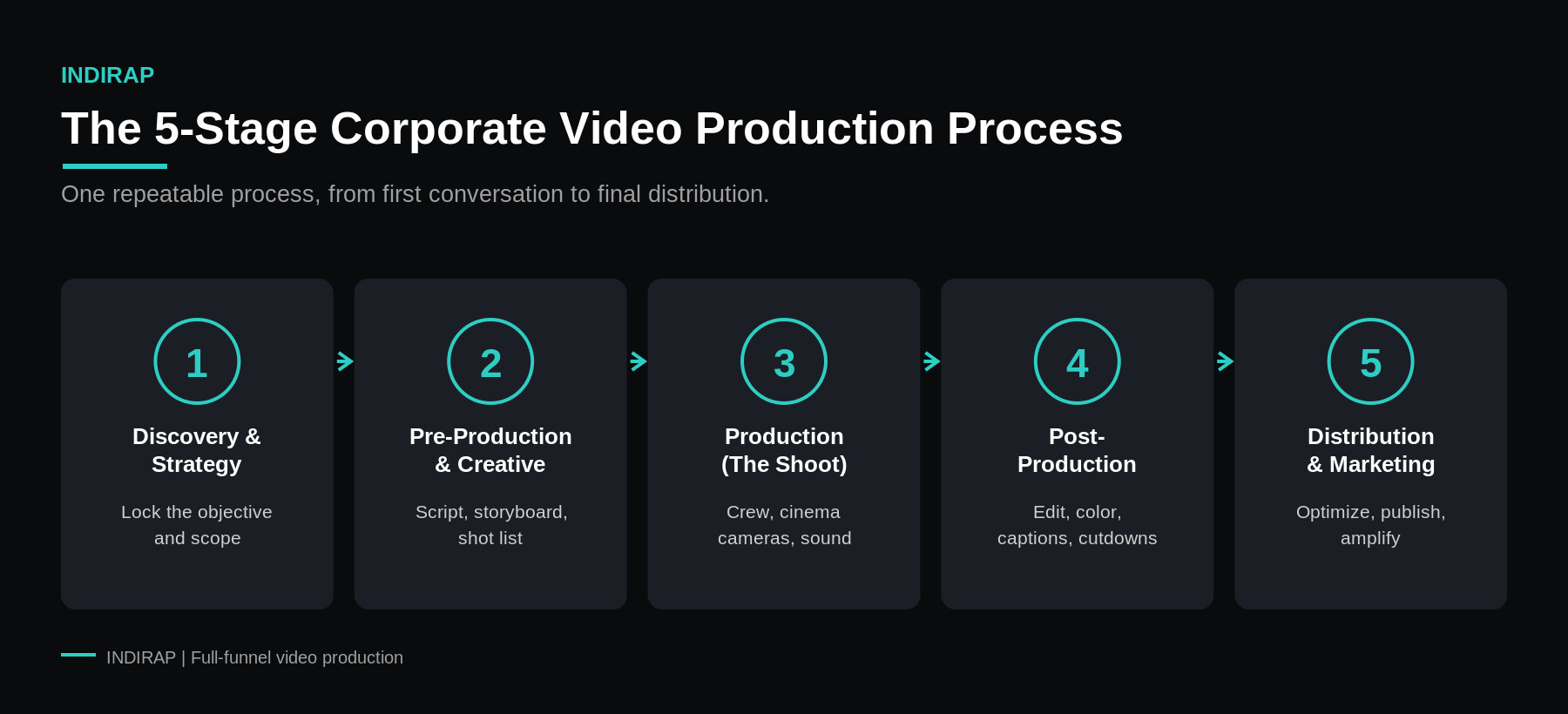
A repeatable process is what lets a production run smoothly, stay on budget, and ship on time, no matter how ambitious the creative. It removes guesswork, keeps everyone aligned, and protects against the most expensive mistakes, the ones discovered after footage is already captured. At INDIRAP, every project runs the same five steps, which is how we deliver consistent results across more than 20,000 videos for 900-plus brands. Here is what each stage involves.
Everything starts with the objective. Before any creative work begins, we learn your business, your audience, and the specific job the video has to do. What does this video need to accomplish? Who is watching it, and what decision do you want them to make? Where will it live, and how will success be measured?
This stage produces a clear creative brief and a defined scope that you sign off on before anything moves forward. Locking the objective and scope here is what prevents the dreaded mid-project pivot and scope creep later. It is also where the strategy gets set: a single shoot can be planned to capture multiple assets at once, which is the foundation of an efficient corporate video production. A well-run discovery phase is the single highest-leverage part of the entire process.
Pre-production is where the video gets built on paper before it gets built on camera. This stage covers the concept, script, storyboard, shot list, casting, location scouting, scheduling, and music direction. By the time the crew arrives on shoot day, everyone, from the client to the camera operator, knows exactly what the finished piece looks like.
This is the stage that most distinguishes a professional production from an amateur one. The most expensive revisions in video happen after footage is captured, when someone realizes the creative direction was not quite right. Thorough pre-production eliminates that risk by making the creative vision tangible and reviewable before a single light is set. Everything is outlined in a detailed creative document that keeps the whole team aligned from start to finish.
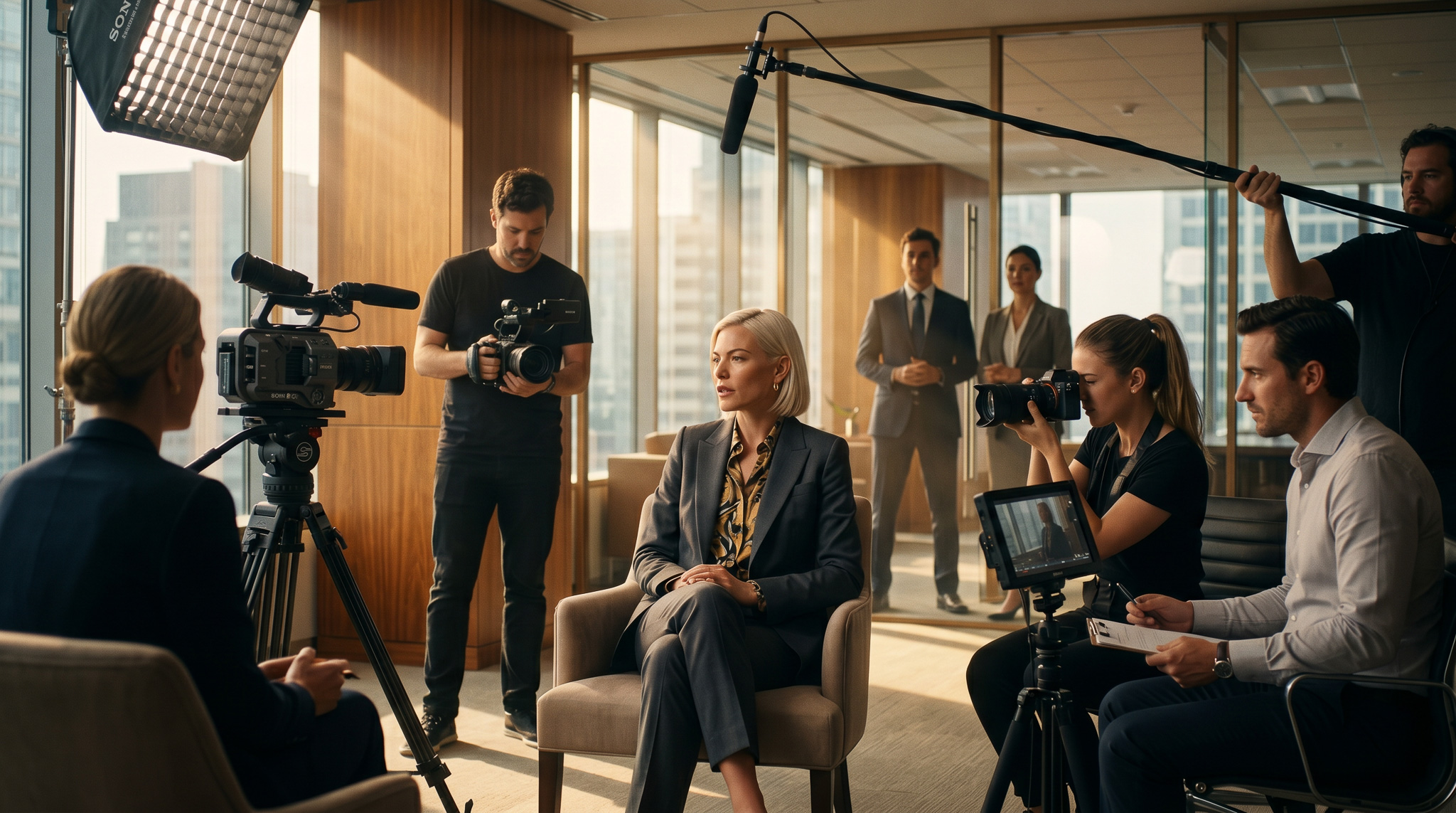
This is the shoot, the part everyone pictures when they think of video production, and because of the preparation in the first two stages, it is also the most controlled. A full crew arrives with cinema cameras, professional lighting, sound equipment, and, when the project calls for it, drone and gimbal setups.
The right team scales to the project. A single-camera founder interview, a multi-day brand campaign, and a national broadcast spot each get the appropriate crew and gear. Experienced creative direction earns its value here in real time: coaching a nervous executive to deliver with confidence, recognizing which take captured genuine emotion rather than a performed version, and adjusting on the fly when conditions change. When the project includes animation or motion graphics, that work runs in parallel so live action and design stay on the same timeline. As a national video production company, we bring this same standard to shoots anywhere in the country.
Post-production is where the footage becomes a finished story. This stage covers professional editing, color grading, sound design, motion graphics, captions, and the platform-ready cutdowns that turn one shoot into many assets, vertical cuts for Reels and Shorts, square versions for feeds, paid variations, and website-ready files.
This is also where a strategy-first partner adds value that a pure production house does not: optimizing every asset for multi-channel distribution and for search. The same footage that becomes a polished brand film also becomes a library of social media content, captioned and formatted for each platform. The output of one well-run production day is not one video. It is a content system.
This is the step most production companies skip, and it is the reason so many videos sit unwatched on a hard drive. A finished video is only valuable if the right people see it. Distribution covers platform-native publishing, optimization for video SEO and AI search through titles, transcripts, and schema markup, and, for marketing assets, paid amplification on YouTube, Meta, LinkedIn, and other channels, plus performance reporting.
Production without distribution is half the job. A partner who owns this stage ensures your video actually drives results rather than just existing. You can see the kind of outcomes that follow when distribution is done right on our client success stories page.
Timelines depend on scope, but here are realistic expectations. A focused live-action project typically runs one to three weeks from kickoff to final delivery. A fully animated explainer usually runs two to three weeks because every frame is built by hand. Larger campaigns, multi-shoot productions, and episodic content run four to eight weeks. Rush timelines are possible when needed, and experienced teams have turned national broadcast spots in 96 hours, but the standard, comfortable cadence for high-quality work is measured in weeks, not months.
One reason a content-sprint model is so efficient is that it compresses this timeline: capturing a full library in one to three production days, as the INDIRAP Content Kit does, means you get an entire content system in the time a traditional approach would produce a single video.
The smoothest projects share a few habits on the client side. Come to discovery with a clear business objective, even if the creative is undecided. Identify your on-camera people early and give them a heads-up, especially executives whose calendars fill fast. Gather brand assets, logos, fonts, and any existing footage, in one place. And empower a single decision-maker on your side to give feedback and approvals, which keeps the project moving and prevents conflicting notes.
A good partner makes the process feel collaborative and low-stress, handling the heavy lifting while keeping you informed at every milestone. You should always know what comes next.
Understanding the process is the first step to a video that actually performs. The next is mapping it to your specific goals. The fastest way to start is a free content strategy review, where we walk through your objective and recommend the right approach and scope. You can also explore the full range of what one production can deliver on our corporate video production page, and for a sense of the budget side, see our guide to corporate video production cost.
Watch + Learn
Go behind the scenes on a real INDIRAP corporate video production and see all five stages in action.
▶ Subscribe on YouTube for full behind-the-scenes production walkthroughs
▶ Instagram Reels for quick looks at shoot-day setups and technique
▶ YouTube Shorts for 60-second breakdowns of each production stage
Corporate video production runs through five stages: discovery and content strategy, pre-production and creative, production and on-site filming, post-production and optimization, and distribution and video marketing. Each stage builds on the last, and skipping any one, especially discovery or distribution, is the most common cause of a video that underperforms.
A focused live-action project typically takes one to three weeks from kickoff to delivery, an animated explainer two to three weeks, and larger campaigns or episodic content four to eight weeks. Rush timelines are possible, but the standard cadence for high-quality work is measured in weeks rather than months.
Pre-production is the planning stage that happens before filming, covering the concept, script, storyboard, shot list, casting, location scouting, scheduling, and music direction. It makes the creative vision tangible and reviewable before the shoot, which prevents the expensive revisions that happen after footage is captured.
Distribution is what makes a finished video valuable, because a video nobody sees delivers no return. It covers platform-native publishing, optimization for video SEO and AI search, paid amplification, and performance reporting. Production without distribution is half the job, and skipping it is why many videos sit unwatched.
Come to the project with a clear business objective, identify and notify your on-camera people early, gather your brand assets in one place, and empower a single decision-maker to give feedback and approvals. These steps keep the production smooth, aligned, and on schedule.
This is Post 4 in INDIRAP's Corporate Video series.

Julian Tillotson is the Founder & CEO of INDIRAP, a full-service video production and creative strategy agency based in Chicago, IL. With 10+ years of experience, INDIRAP has delivered 20,000+ videos to 900+ clients across 40+ industries, making it one of North America's leading digital creative agencies.


.png)
.png)