
A recruitment video is a short film that shows candidates what it is really like to work at your company, told by the people who already do the work. The best recruiting videos answer the questions a strong candidate asks before applying: who will I work with, what will my days look like, and where can this role take me?
A recruitment video is any video built to attract, inform, and convert job candidates. It can be a two-minute careers page film, a 30-second clip of a supervisor explaining her team, or a vertical Reel of a new engineer's first week. The common thread is purpose: every recruiting video exists to help the right person say yes and the wrong-fit person self-select out before either side spends time on interviews.
Recruitment videos sit inside a broader category of corporate video production, and they share the same fundamentals as customer-facing work: a clear audience, a single message per piece, and a distribution plan. The difference is the buyer. Here the "buyer" is a candidate who is weighing a career decision and looking for proof that the culture in your job posting actually exists.
That is why a recruitment video does a job no written posting can do. Text tells candidates what you value. Video shows them the people, the pace, and the workspace. If you want a team to plan and produce this kind of content end to end, our recruitment video production service is built around exactly that process.
These terms overlap. Here is a practical way to separate them. An employer branding video tells the big story of why your company is a great place to build a career, and it serves every open role at once. A company culture video zooms in on how people work together: rituals, values, collaboration, and the moments that make a team feel like a team. A recruitment video is the umbrella term, and it also includes highly specific pieces tied to a single role, location, or hiring campaign. In practice, a strong hiring program uses all three.
There is no single "right" recruiting video. Each format answers a different candidate question at a different stage of the decision. The table below maps the core types to the job each one does, so you can build a library rather than a one-off.
| Video type | Candidate question it answers | Typical length | Best home |
|---|---|---|---|
| Employer brand film | Why should I want to work here at all? | 90 seconds to 3 minutes | Careers page, YouTube, LinkedIn company page |
| Day-in-the-life video | What will my actual days look like? | 60 to 120 seconds | Job postings, Instagram Reels, YouTube Shorts |
| Employee testimonial | Do people like working here, and why? | 30 to 90 seconds | LinkedIn, careers page, email follow-ups |
| Role-specific video | What does this exact job require and offer? | 45 to 90 seconds | Individual job postings, recruiter outreach |
| Company culture video | How do teams work and celebrate together? | 60 to 120 seconds | Instagram, LinkedIn, careers page |
| Leadership message | Where is this company going, and who is leading it? | 60 to 120 seconds | Careers page, LinkedIn, final-round candidate emails |
| Campus or early-career video | Is this a good first career move for me? | 30 to 90 seconds | Instagram Reels, YouTube Shorts, career fairs |
This is your anchor piece. It blends employee interviews, leadership perspective, and real footage of the work to tell one clear story about your employer value proposition. Think of it as the hiring equivalent of a brand video: it sets the tone that every shorter piece borrows from.
Day-in-the-life content follows one employee from arrival to wrap-up. It works especially well for roles that candidates struggle to picture, such as field technicians, plant operators, nurses, account managers, or software engineers on a product team. Show the morning huddle, the tools, the hard parts, and the wins.
A recruiting testimonial is a peer recommendation on camera. The same principles that make a customer story persuasive apply here, and our guide on how to create a testimonial video that converts covers the interview techniques in depth. Specific stories beat general praise every time.
Role-specific videos let a hiring manager speak directly to the next person on the team. Leadership messages give senior candidates confidence in direction and stability. Campus and early-career videos speak to students and recent graduates in a faster, more casual style, often vertical and built for phones. Early-career audiences respond to short, peer-led clips, a theme we explore in our post on creating training videos for Gen Z professionals.
Every effective recruitment video, regardless of format, carries a few essential ingredients. Use this as a checklist when you review a script or a first cut.
If you want inspiration for structure and pacing, our roundup of corporate video examples shows how strong business films open fast and land a single message, which is exactly the discipline a hiring video needs.
Planning is where recruitment videos are won. A strategy-first approach saves time on set, keeps employees comfortable, and makes sure the final library matches your actual hiring needs.
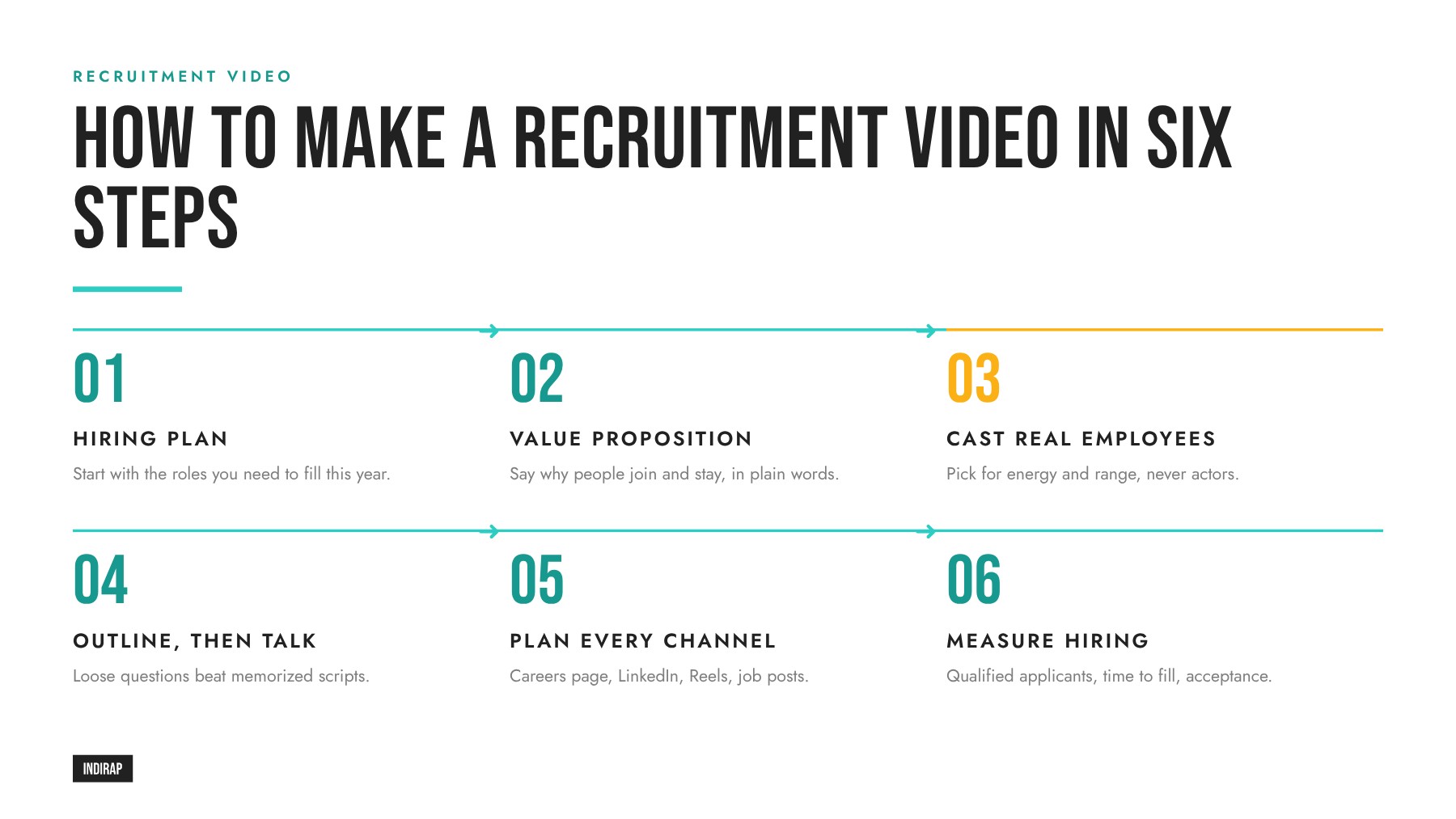
Sit down with talent acquisition and list the roles you need to fill over the next 6 to 12 months. Group them by audience: hourly versus salaried, technical versus customer-facing, experienced versus early-career, by location if you hire in multiple markets. Each group becomes a content track. A manufacturer hiring machinists and a software company hiring product engineers need very different stories, which is why we tailor approaches for sectors like manufacturing, healthcare and medical, and technology and software.
Interview a handful of recent hires and long-tenured employees before you write anything. Ask why they joined, why they stay, and what surprised them. The repeated answers are your real value proposition, and they are usually more specific and more compelling than anything on an internal slide.
Ask managers to nominate people who are articulate, enthusiastic, and representative of the roles you are hiring for. Aim for a mix of tenure, departments, and backgrounds. Volunteers usually deliver better interviews than assignees.
Scripts work for leadership messages and voiceovers. For employees, use an interview guide instead. Strong prompts include:
Ask people to answer in full sentences that include the question, so each clip stands on its own in the edit.
Decide up front where each piece will live, which aspect ratios you need, and how many cutdowns you want. Planning vertical and horizontal framing on the day lets you capture once and deploy everywhere.
Authentic footage comes from comfortable people in real environments. Quality still matters, because it signals that you invest in your people, yet the content should feel like a real Tuesday. Here is how to get both.
This RaffertyWeiss Media video makes a useful companion to this section, covering why real employee testimony outperforms heavily scripted culture pieces and how a modular series of employee stories can serve many roles.
The key idea is modularity. When you shoot every interview and every workspace with a full content library in mind, a single production day can feed months of recruitment marketing. An experienced video production company can plan coverage for several formats at once while keeping the day comfortable for employees who are still doing their real jobs.
Match length to the channel and the stage of the decision. Short clips of 15 to 45 seconds work for social discovery. Role-specific and day-in-the-life videos usually land between 60 and 120 seconds. Your flagship employer brand film can run two to three minutes on a careers page, where candidates have already shown interest. For a deeper breakdown by platform, see our guide on how long business videos should be.
A recruitment video only works when the right candidates see it. Distribution deserves as much planning as production. Here is where hiring videos tend to earn their keep.
| Channel | Best format | Role in the hiring funnel |
|---|---|---|
| Careers page | Employer brand film plus a grid of testimonials | Conversion: reassures candidates who are close to applying |
| Job postings | Role-specific or day-in-the-life clip | Consideration: helps candidates picture the exact role |
| Testimonials, leadership messages, culture moments | Awareness and consideration for professional and salaried roles | |
| Instagram Reels | Vertical culture clips, behind-the-scenes, campus content | Awareness for early-career, hourly, and creative roles |
| YouTube and YouTube Shorts | Full-length films plus vertical cutdowns | Search discovery and a permanent home for your library |
| Recruiter email and outreach | Short personal clips from hiring managers | Engagement with passive candidates and finalists |
| Paid social | 15 to 30 second hooks with a clear apply call to action | Targeted reach in specific locations, skills, and job titles |
Your employees' networks are a powerful distribution channel. When a featured team member shares their own testimonial on LinkedIn, it reaches exactly the peers you want to hire. A consistent social media video content rhythm keeps your employer brand visible between hiring pushes, so candidates already know you when a role opens.
For high-volume or specialized hiring, paid distribution puts your recruiting videos in front of people by location, job title, skills, and interests. Short, hook-first cutdowns tend to perform best, and pairing creative with a focused social media marketing plan lets you test messages, retarget careers page visitors, and shift budget toward the roles that matter most this quarter.
The highest-return way to produce recruitment content is to capture once and deploy many. Instead of commissioning a single film, you plan a production that yields an entire library: a flagship piece, several mid-length videos, and dozens of short clips. This is the content infrastructure approach behind our Content Kit, and it fits recruiting perfectly.
A single well-planned shoot day can typically produce:
The planning work happens before the cameras arrive. You map each video to a role group and a channel, build interview guides that produce standalone soundbites, and frame shots that work in both 16:9 and 9:16. Our post on how to repurpose video content walks through this cutdown process in more detail, and the same logic applies whether the audience is a buyer or a candidate.
A recruitment library also lives alongside the rest of your video program. The interviews you capture for hiring often contain lines that strengthen sales and brand content, and the reverse is true too. Looking across the full range of types of corporate video helps you spot where one production can serve multiple departments. Recruitment footage can also feed onboarding, which is where a dedicated training video program picks up after the offer is signed.
The real test of a recruiting video is whether it helps you hire the right people faster. Set a baseline before launch.
When leadership asks whether recruitment video is worth the investment, frame it the same way you would any growth decision. Every open seat has a cost in slower projects and stretched teams. For client-facing roles especially, the useful question is what one productive hire, and the clients that person serves, is worth to the company. For many of the businesses we work with, a single new client sits between $20,000 and $100,000 in value, so filling a sales, account, or service role even a few weeks sooner quickly outweighs the cost of the content that helped.
Leadership visibility matters here too. Founders and executives who appear on camera help candidates trust the direction of the company, a pattern we cover in the founder video content stack.
Recruitment video works best as a system: clear hiring goals, real employees, authentic footage, and a distribution plan that puts the right clip in front of the right candidate at the right moment. INDIRAP has produced more than 20,000 videos for 900+ clients across 40+ industries, and we bring the same strategy-first, capture once, deploy many approach to employer brand and hiring content as we do to our corporate video production and business video production work.
If you want a second set of eyes on your current careers page and social channels, request a free content strategy review. If you are ready to plan your next hiring campaign, Book A Video Strategy Call and we will map out the formats, channels, and shoot plan that fit your open roles.
The most useful way to budget is to start from the value of a filled role rather than a price list. Consider what an open seat costs in delayed projects and lost revenue, and what one new client served by that hire is worth. For many businesses, that client value sits between $20,000 and $100,000, which makes a well-planned recruiting video library a strong investment.
A recruiting video should be as long as its channel and purpose require, and usually shorter than you expect. Social clips perform well at 15 to 45 seconds. Role-specific and day-in-the-life videos typically run 60 to 120 seconds. A flagship employer brand film on your careers page can stretch to two or three minutes, since viewers there are already interested.
Good recruitment video examples share a few traits: real employees speaking in their own words, footage of the actual work, a specific reason to join, and a clear call to apply. They open with a strong hook, keep one message per video, and feel honest about the role. Look for examples that make you picture yourself on the team.
Real employees are the better choice for recruitment videos almost every time. Candidates want to meet future teammates, and genuine voices build trust that actors cannot replicate. Good interview techniques, a relaxed set, and thoughtful editing help even camera-shy employees come across confidently. Save scripted narration for voiceover and leadership messages.
Yes, and it is one of the highest-impact places for a recruiting video. Many applicant tracking systems and job boards support embedded video or video links, and you can always include a link to the role-specific clip on your careers page. A 60 to 90 second video featuring the hiring manager or a current team member works well.
An employer branding video tells the overall story of why your company is a great place to work and supports every open role. A recruitment video is the broader category, including employer brand films plus role-specific clips, testimonials, campus videos, and paid social ads tied to specific hiring campaigns. Strong programs use both together.
Plan to refresh recruitment videos roughly once a year, or sooner when your offices, leadership, benefits, or featured employees change. Your flagship employer brand film can stay current longer than short social clips, which benefit from a steady stream of new faces and moments. A capture once, deploy many approach makes refreshes faster and more efficient.
Recruitment videos often work especially well for smaller companies, because candidates may not know the brand yet. A short film introducing the founder, the team, and the work gives candidates the context a large company gets from name recognition. Even a compact library of an anchor film and a few testimonials can lift application quality.

Julian Tillotson is the Founder & CEO of INDIRAP, a full-service video production and creative strategy agency based in Chicago, IL. With 10+ years of experience, INDIRAP has delivered 20,000+ videos to 900+ clients across 40+ industries, making it one of North America's leading digital creative agencies.