When most companies say they need a corporate video, they actually need several different kinds of corporate video, each doing a different job. Treating corporate video as a single product is the most common reason a video underperforms: a recruiting reel built like a sales explainer recruits no one, and a product demo cut like a culture film sells nothing. The fix is to know the toolkit.
This guide breaks down the 11 corporate video types that consistently earn their budget, what each one is for, where it fits in the customer or employee journey, and how the smartest brands produce them together instead of one painful project at a time. For the bigger-picture definition and strategy, start with our complete guide on what corporate video production is, then come back here to choose your formats.
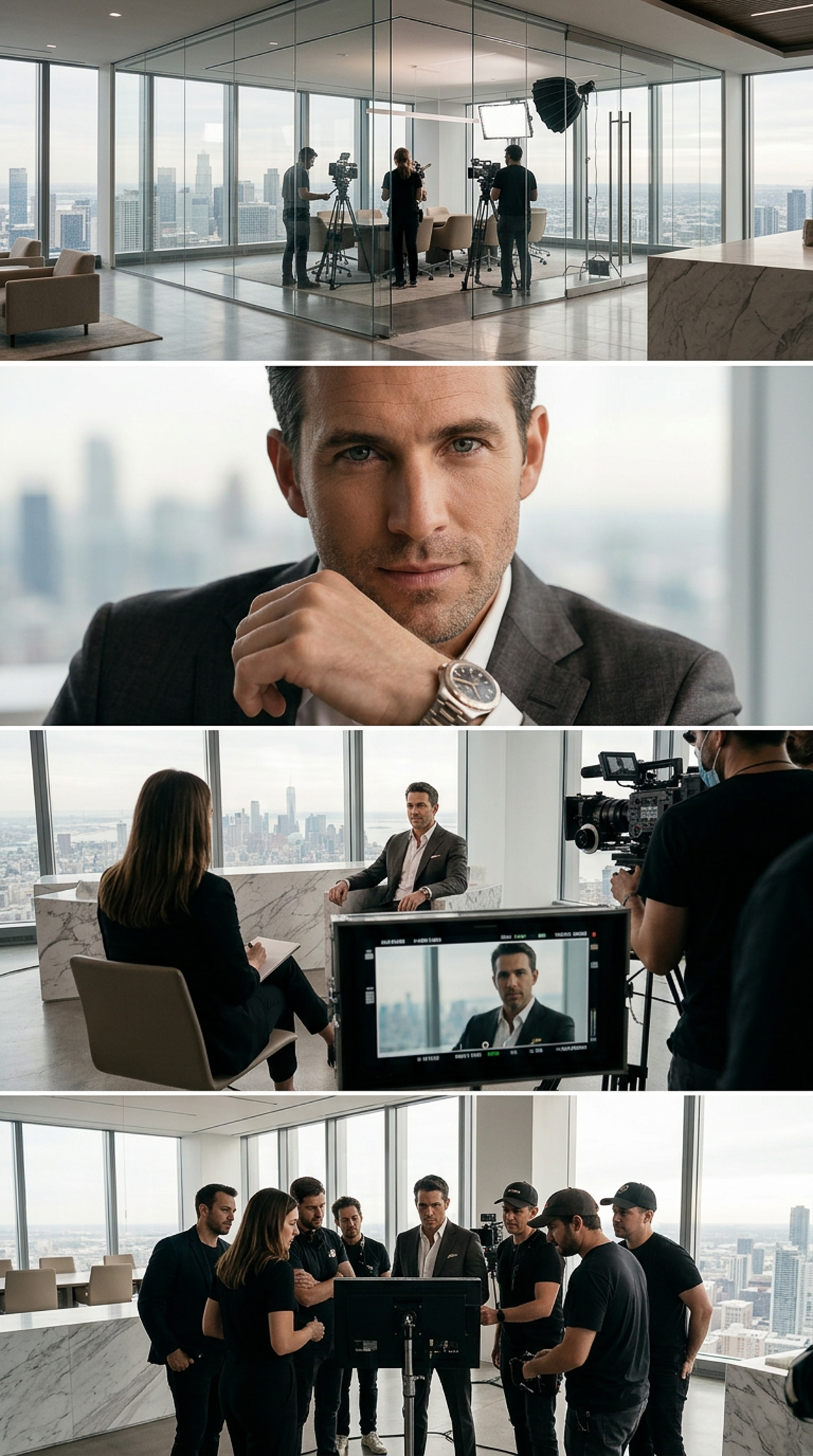
The brand hero video is the foundation of a company's video library. It is the high-production piece that introduces who you are, what you stand for, and why you matter, usually living on your homepage and at the top of your funnel. Its job is first impression and trust at a glance. A strong brand hero video makes a prospect feel the company is credible and worth a closer look before they have read a single word of copy. This is the centerpiece of our corporate video production work.
Putting your leaders on camera turns expertise into authority. Executive thought-leadership video, whether a founder explaining the company's point of view or a subject expert breaking down an industry shift, builds the personal credibility that closes enterprise deals and shortens sales cycles. It also feeds your social and search presence with content only your people can create. The goal here is positioning: making your leadership the trusted voice buyers want to learn from.
The best candidates research you the way buyers do, on video. A recruitment video shows what it is actually like to work at your company, the people, the culture, the mission, so the right candidates self-select in and the wrong ones screen out. Done well, it shortens time-to-hire and raises candidate quality, which is why it is one of the highest-ROI corporate videos a growing company can produce.
Nothing your sales team says carries the weight of a real customer saying it for you. A testimonial video captures a genuine client describing a specific result in their own words, and it does the trust-building your reps cannot do alone. Testimonials are conversion machines: placed on landing pages, in proposals, and in sales follow-ups, they shorten the path from interested to closed. See how ours perform on our client success stories page.
Where a testimonial captures emotion and trust, a case study video tells the full story: the challenge, the approach, and the measurable outcome. It is the proof piece for mid- and bottom-funnel buyers who need evidence before they commit. Case study videos give your sales team a credible, repeatable way to demonstrate exactly how you deliver, and they are some of the most-cited assets in a B2B buying process. For a curated set, see our roundup of corporate video examples that drove real results.
A product video shows your offering in its best light and answers the buyer's most important question: what is it and how does it work? For software, a screen-based demo; for physical products, a cinematic showcase; for services, a clear walkthrough of the experience. The goal is comprehension and desire. A great product video reduces unqualified demo requests while increasing qualified ones, because prospects arrive already understanding the value.
An explainer, often animated, takes something complex and makes it instantly understandable. Animation is ideal when the concept is abstract, the process is intricate, or you need to visualize what a camera cannot show. Explainers earn attention at the top of the funnel and clarify the offer in the middle of it. They are also endlessly repurposable across your website, sales decks, and paid campaigns.
Training video turns tribal knowledge into a scalable asset. A well-built onboarding or training series cuts the time it takes a new hire to become productive, reduces the load on your team, and ensures everyone learns the same thing the same way. For distributed and hybrid teams, video training reaches people far more effectively than a document nobody finishes or a meeting nobody remembers. The library you build once keeps paying off with every new hire.
Event video extends the life and reach of your conferences, launches, and company gatherings far beyond the room. A highlight reel builds momentum and FOMO, captured sessions become evergreen content, and sizzle edits fuel next year's promotion. The goal is amplification: turning a one-day event into months of content that works across marketing, sales, and recruiting.
When leadership needs to communicate a change, a strategy, or a milestone to the whole company, video does it with clarity and humanity that email cannot match. Internal comms video aligns teams, reinforces culture, and makes important messages stick. For larger organizations, a consistent internal video cadence is one of the most underrated tools for keeping a distributed workforce connected and informed.
Culture content humanizes your brand. Behind-the-scenes footage, team spotlights, and day-in-the-life videos show the real people behind the logo, which builds trust with customers and candidates alike. This is also the most natural source of social media content, because authentic, human moments are exactly what performs on the platforms where your audience spends its time.
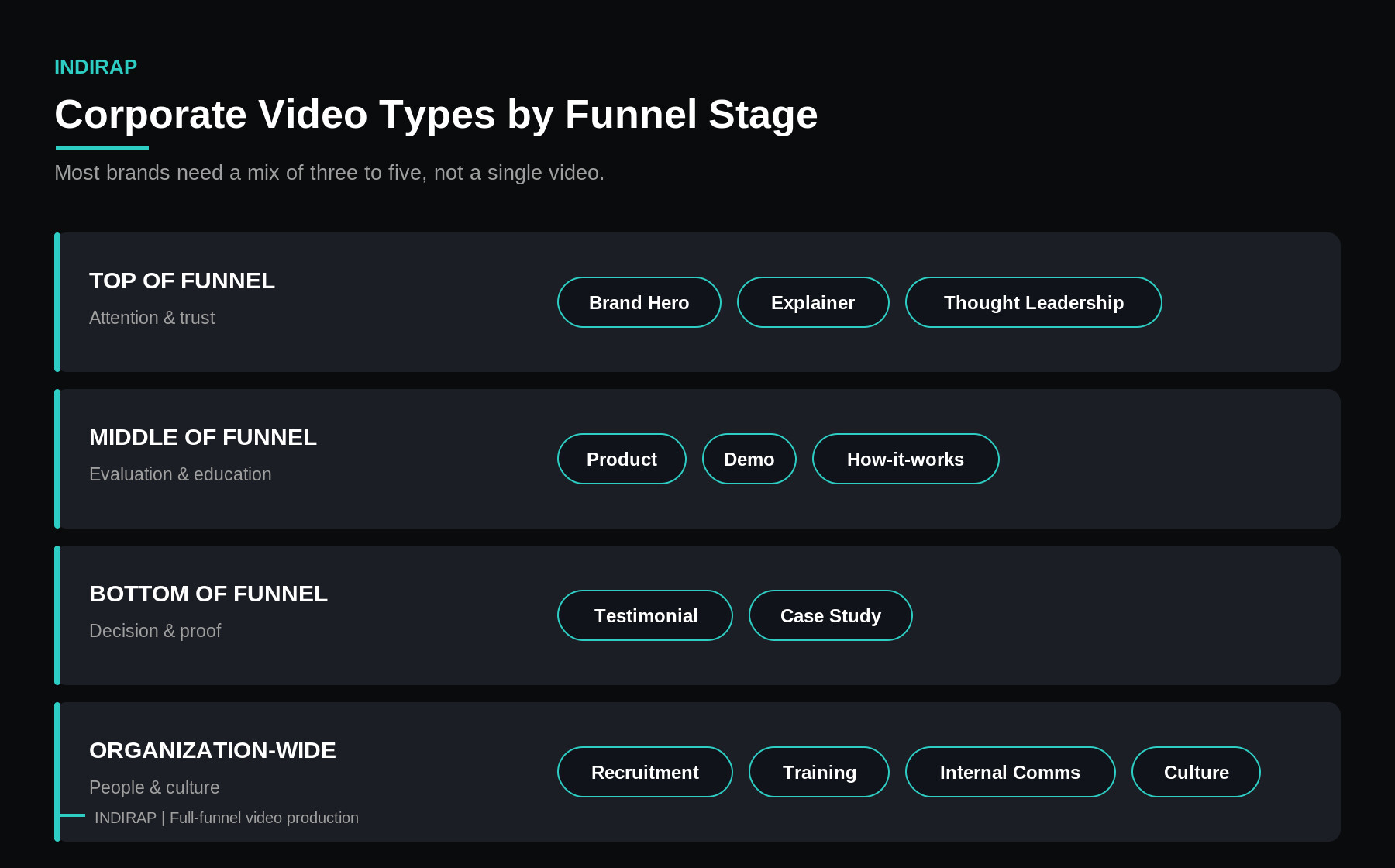
The reason brands need a mix is that each type serves a different moment. Top of funnel, brand hero, explainer, and thought-leadership videos earn attention and trust. Middle of funnel, product, case study, and testimonial videos build the evidence that moves a prospect toward a decision. Bottom of funnel, detailed demos and customer proof close the gap. And running alongside the customer journey, recruitment, training, internal comms, and culture videos build the organization that delivers on the promise.
You do not need all 11 at once. You need the right three to five for your current goals, produced in a way that lets you add the rest over time without starting from scratch. That is the strategic question we work through in our guide to B2B video marketing strategy.
Here is the mistake that drains video budgets: producing each type as a separate project, with a separate kickoff, a separate crew, and a separate invoice. Produced that way, a full library means three vendors and months of overhead.
The better model is to capture a library of assets in a single, well-planned production sprint. With the right pre-production, one to three shoot days can yield a brand hero video, executive content, testimonials, product footage, social cuts, and even brand photography, all cohesive because they came from the same creative direction. That is exactly how the INDIRAP Content Kit works: a complete, multi-format content library built in one sprint, starting at $16,500. It is the difference between buying videos and building a content system. For the full breakdown of what that costs and includes, see our guide on corporate video production cost.
If you are starting from scratch, a reliable opening lineup for most growing companies is a brand hero video to anchor the homepage, two or three customer testimonials to power sales, and a product or explainer video to clarify the offer. From there, you layer in recruitment, training, and social content as your goals expand. The point is to start with intent, map each video to a real objective, and build a foundation you can grow on.
Not sure which types your brand needs first? A free content strategy review will map your goals to the right formats, or explore the full range of what one production can deliver on our video production page.
Watch + Learn
See real examples of each corporate video type and how INDIRAP captures a full library in a single production sprint.
▶ Subscribe on YouTube for full-length examples of every corporate video type
▶ Instagram Reels for short breakdowns of which video type fits which goal
▶ YouTube Shorts for quick before-and-after looks at corporate video formats
The main types of corporate video are brand hero videos, executive and thought-leadership videos, recruitment and employer brand videos, customer testimonials, case study videos, product and demo videos, explainer videos, training and onboarding videos, event videos, internal communications videos, and culture or behind-the-scenes videos. Most companies need a mix of three to five to start.
Most growing companies should start with a brand hero video to anchor the homepage, two or three customer testimonials to support sales, and a product or explainer video to clarify the offer. From there, recruitment, training, and social content can be layered in as goals expand.
A testimonial video captures a real customer describing their experience and results in their own words, built for trust and conversion. A case study video tells the fuller story, the challenge, the approach, and the measurable outcome, built as proof for mid and bottom-funnel buyers who need evidence before committing.
Yes. With proper pre-production, a single one to three day production sprint can capture a brand hero video, executive content, testimonials, product footage, social cutdowns, and brand photography at once. This is the model behind the INDIRAP Content Kit and it dramatically lowers the per-asset cost.
Brand hero, explainer, and thought-leadership videos earn attention at the top of the funnel. Product, case study, and testimonial videos build evidence in the middle. Detailed demos and customer proof close at the bottom. Recruitment, training, internal comms, and culture videos support the organization alongside the customer journey.
This is Post 2 in INDIRAP's Corporate Video series.


Julian Tillotson is the Founder & CEO of INDIRAP, a full-service video production and creative strategy agency based in Chicago, IL. With 10+ years of experience, INDIRAP has delivered 20,000+ videos to 900+ clients across 40+ industries, making it one of North America's leading digital creative agencies.


.png)
.png)