Search is splitting in two. People still type queries into Google, but a fast-growing share now ask a question and read the answer an AI writes back. ChatGPT, Google AI Overviews, Gemini, and Perplexity answer directly, and sometimes they name their sources. Getting your brand named in those answers is the new front page, and it has a name: answer engine optimization.
Here is the part most brands miss. Video is one of the strongest ways to earn those citations, and almost no one is using it that way. This guide shows how answer engines choose what to cite, and how to structure your video so it becomes the source the AI quotes.
For the foundation this sits on, start with our pillar on what content marketing is, and for the strategy that ties it all together, see our content strategy services.
Answer engine optimization, or AEO, is the practice of structuring your content so AI answer engines surface and cite it when someone asks a question. Where traditional SEO works to rank a page in a list of blue links, AEO works to get your content pulled directly into the AI-written answer at the top, ideally with a citation back to you.
You will also see the term generative engine optimization, or GEO. The two are used almost interchangeably. AEO tends to describe optimizing for direct-answer engines, and GEO tends to describe optimizing for generative AI results broadly. The tactics are the same, so we will use AEO throughout.
The shift matters because buyers increasingly research this way. A prospect who asks "what are the best video production companies for B2B brands" or "how do I build a content system that scales" is looking for a recommendation. The brands that show up in that answer win the consideration before a single ad is served.
Most AEO advice is written by text-first tools and agencies, so it treats AEO as a writing exercise. That leaves a wide-open lane for brands that lead with video. Here is why video works so well.
YouTube is a primary AI source. YouTube is owned by Google and deeply woven into search and AI results. Video content is increasingly summarized, quoted, and linked inside AI answers, so a strong YouTube presence feeds the same engines that write those answers.
Video carries trust that AI is trained to weight. Answer engines favor sources that show real expertise. A founder or expert explaining a topic on camera is a strong signal of first-hand authority, and that signal travels through the transcript into the model's understanding.
One video becomes many machine-readable assets. A single recording produces a transcript, captions, a blog post, quote graphics, and short clips. Each one is another structured, quotable piece an AI can pull from. For the mechanics of stretching one shoot into a library, see our video content marketing guide.
The takeaway: video is not a nice-to-have for AEO. Done right, it is the most efficient way to produce the exact kind of authoritative, quotable, multi-format content that AI answers reward.
Answer engines do not rank pages the way classic search does. They assemble an answer from sources that are clear, specific, and trustworthy. Five factors decide whether you are one of them.
1. Answer-first structure. The content that gets pulled answers the question in the first sentence, then adds context. Content that saves the answer for the fifth paragraph rarely gets quoted.
2. Specificity. Named examples, real figures, and concrete detail beat generalities. AI systems extract the sentence that actually answers the question, so give them one.
3. Clear structure. Descriptive headers, short paragraphs, and question-based headings tell the model exactly what each section covers.
4. Demonstrated authority. Answer engines favor sources that show consistent expertise across many pieces, not one optimized page. A coherent cluster of content signals genuine depth.
5. Machine-readable structure. Schema markup, transcripts, and captions make your content easy for a model to parse and cite.
Notice that these are the same qualities that make content genuinely useful to a human reader. AEO is not a trick. It is a discipline of being the clearest, most credible answer, and then making that answer easy for a machine to read.
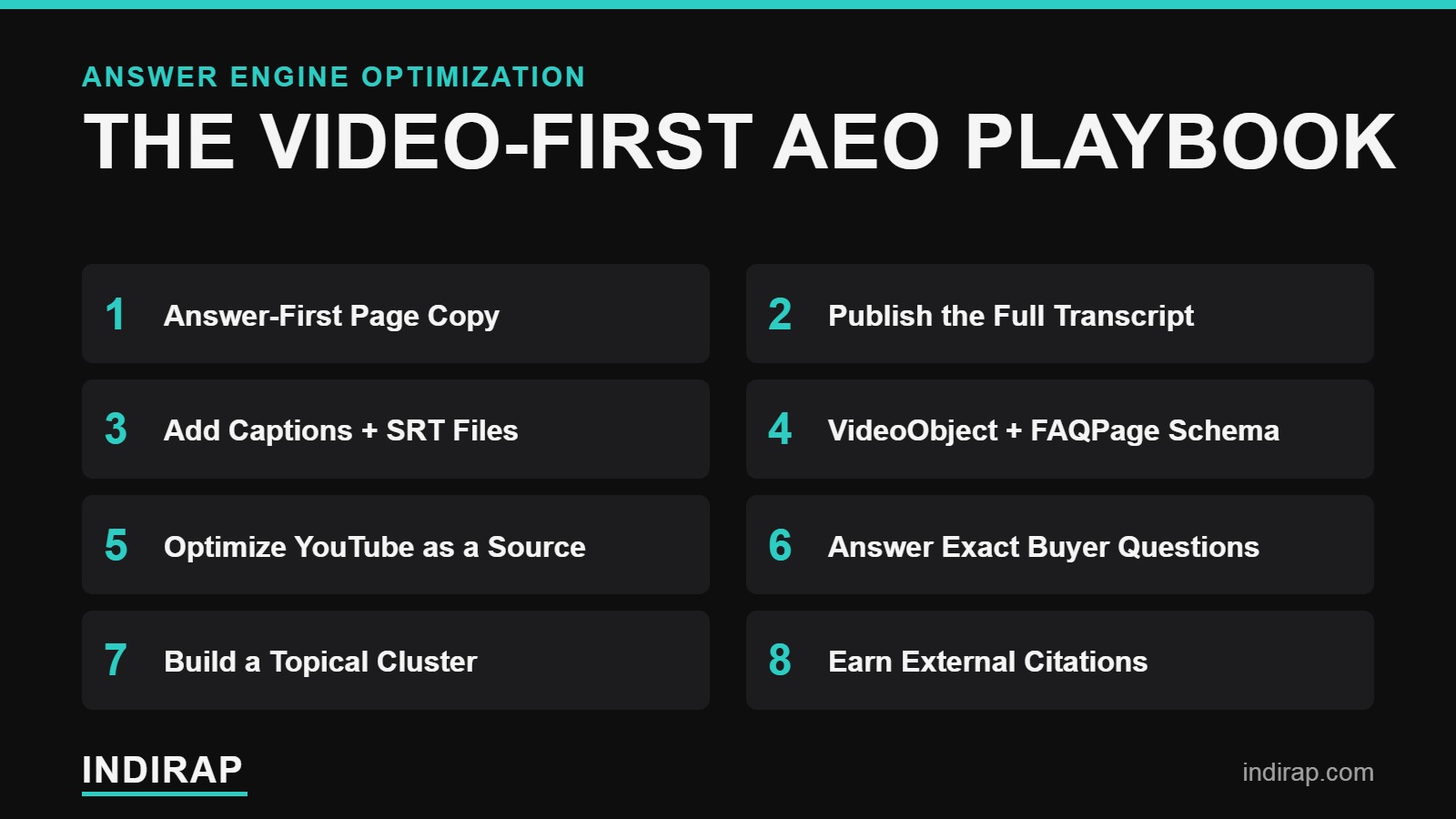
This is the practical part. Eight moves that turn your video into content AI wants to cite.
A video on its own is hard for a text-based model to read. The page around it is not. For every important video, write a page that opens with a direct, one to two sentence answer to the question the video addresses, then expands with the key points. The video earns attention and trust; the page copy earns the citation.
A transcript turns spoken expertise into text an AI can read, quote, and index. Publish the full transcript on the same page as the video, formatted with headers, not as one long block. This single step makes your video content legible to every answer engine at once.
Captions make your video accessible and give platforms a clean, timed text layer. Deliver an SRT file with every video so YouTube and other platforms have accurate text to work from, which improves both accessibility and discoverability.
Schema is code that tells search engines and AI systems exactly what is on the page. For video pages, the highest-value types are VideoObject (name, description, thumbnail, upload date, and transcript), FAQPage (for any question-and-answer section), and Article or Organization for context. Schema does not change a word of your content. It makes the content you already have easier for a machine to parse and cite.
Because YouTube feeds AI results, treat each video's title, description, and chapters as AEO surface area. Write a clear, specific title, a description that answers the core question in the first two lines, and timestamped chapters that label each section. This helps the same engines that write AI answers understand and surface your video.
The most reliable AEO move is to identify the real questions your buyers type and ask AI assistants, then answer each one clearly. Pull them from your sales team's most common discovery questions, the People Also Ask boxes in your category, and what clients say they searched before finding you. Then create a short video and a matching answer-first section for each.
One great video will not establish you as a source. A coherent body of work will. Publish a connected set of videos and pages on a focused topic, all cross-linking to each other and to your service pages. Each piece adds authority to the others. Our content marketing funnel and types of content marketing guides show how a cluster reinforces itself.
Go deeper on video AEO: What Is VideoObject Schema? · How to Get Your Video in AI Overviews · AEO vs GEO vs SEO · How to Write a Video Transcript for SEO · How to Optimize YouTube for AI Search · Do AI Search Engines Use Video?
Being named on authoritative outside sites carries real weight with AI systems. Guest articles, podcast appearances that produce transcripts, and press mentions all tell answer engines that other credible sources recognize your expertise. This is also how you earn the backlinks that lift your whole domain, so the same work pays off twice.
AEO is newer than SEO, so measurement is less mature, but you can track it. Watch for your brand and pages appearing inside AI Overviews for your target questions. Monitor referral traffic from AI assistants and answer engines in your analytics. Track brand mentions and citations across the web. And run your priority questions through ChatGPT, Perplexity, and Google's AI mode periodically to see whether you are named. The goal is simple to state: when a buyer asks the AI about your category, your brand is in the answer.
A few patterns quietly keep brands from getting cited. Burying the answer deep in the page instead of leading with it. Publishing video with no transcript, so the content is invisible to text models. Writing vague, general content with no named examples or figures. Producing one strong piece instead of a connected cluster. And skipping schema, which leaves your content harder to parse than a competitor's. Fixing these is often the fastest path to your first citations.
Getting cited by AI is a production and structure problem as much as a writing one, which is exactly where a video-first partner helps. INDIRAP is an award-winning video production company that builds content designed to be found, in search and in AI answers. We produce the founder-led answer videos, deliver transcripts and captions, structure the pages, and add the schema, so your expertise shows up where buyers are asking. Our Content Kit packages this into a done-for-you system, and our video production work shows the output. Ready to become the answer? Book a strategy call.
Answer engine optimization is the practice of structuring your content so AI answer engines like ChatGPT, Google AI Overviews, and Perplexity surface and cite it when someone asks a question. Where SEO ranks a page in a list of links, AEO gets your content pulled into the AI-written answer, ideally with a citation back to you.
Answer the exact questions your buyers ask, lead with a direct answer in the first sentence, and back it with specific examples and figures. Publish clear, well-structured content across a focused topic, add schema markup, and earn citations on authoritative outside sites. AI engines cite sources that are clear, specific, and demonstrably expert.
Video builds trust and expertise that answer engines weight heavily, and YouTube is a primary source these engines draw from. When you publish a video with an on-page transcript, captions, and VideoObject schema, that expertise becomes machine-readable and quotable, which makes your content easy for an AI to surface and cite.
SEO focuses on ranking a page in the list of search results. AEO focuses on getting your content into the AI-generated answer above or instead of that list. They share many tactics, like clear structure and topical authority, but AEO puts more weight on answer-first writing, specificity, and schema so a model can extract and cite your content directly.
Yes. Schema markup is code that tells search engines and AI systems exactly what your content is. VideoObject, FAQPage, Article, and Organization schema make your pages easier for a model to parse, which improves the odds it selects and cites your content. Schema does not change your content; it makes the content you have machine-readable.
Track whether your brand and pages appear in AI Overviews for your target questions, monitor referral traffic from AI assistants in analytics, watch brand mentions and citations across the web, and periodically ask ChatGPT, Perplexity, and Google's AI mode your priority questions to see if you are named. The measure of success is being in the answer when a buyer asks about your category.
Keep reading: What Is Content Marketing? · Video Content Marketing · Types of Content Marketing · Content Marketing Funnel · How Executives Get Found on Google and AI Search
Work with us: Content Strategy · Content Kit · Video Production · Book a strategy call

Julian Tillotson is the Founder & CEO of INDIRAP, a full-service video production and creative strategy agency based in Chicago, IL. With 10+ years of experience, INDIRAP has delivered 20,000+ videos to 900+ clients across 40+ industries, making it one of North America's leading digital creative agencies.


.png)
.png)