Video prospecting is the practice of sending short, personalized videos to potential buyers to start a sales conversation, in place of or alongside cold emails, calls, and LinkedIn messages. A strong prospecting video runs 60 to 90 seconds, opens with something specific to the prospect, shares one useful insight, and ends with one easy next step.
Buyers receive a steady stream of near-identical outreach. A short video from a real person, made for them, stands out because it shows effort and lets the prospect see and hear who they would be working with. INDIRAP has produced more than 20,000 videos for over 900 brands since 2013, and we see the same pattern in sales video as in marketing video: specific beats polished, and a clear structure beats improvisation. This guide covers what video prospecting is, a five-step sequence, scripts you can adapt, tools, metrics, and how to pair one-to-one videos with produced content. For the broader playbook on using video across a deal, see our guide to using video content to shorten the sales cycle.
Video prospecting is a sales outreach method in which a seller records a short video for a specific prospect and sends it as part of a prospecting sequence. The video usually appears as a thumbnail image in an email or LinkedIn message that links to a landing page where the video plays. Sales video platforms such as Vidyard, Loom, and BombBomb make recording, sharing, and tracking these videos simple.
There are two main forms. One-to-one videos are recorded for a single person and reference their company, role, or recent activity. One-to-many videos are recorded once for a segment, such as finance leaders at mid-sized manufacturers, and personalized lightly with a name in the email or on a thumbnail. Teams often combine both: one-to-many videos for early touches and one-to-one videos for high-value accounts or warm signals.
Video prospecting sits inside a larger sales motion. It works best alongside calls, emails, and social touches, and it gets stronger when the seller can follow up with produced content: a case study, an explainer, or a short founder video. Our guide on how to use video to generate leads covers the marketing side of that system.
Video prospecting works because it delivers what text cannot: a face, a voice, and visible effort. Three effects make the difference.
Trust forms faster. Prospects see who they would be talking to and hear how that person thinks. That lowers the perceived risk of taking a first meeting.
Personalization is visible. Anyone can merge a first name into an email. A video that opens on the prospect's own website or a recent LinkedIn post proves the seller did real research.
It respects attention. A 60 second video delivers more context than a long email in less time, and the prospect can watch whenever it suits them.
Video also creates useful signals. Sales video tools typically show when a prospect opens the email, plays the video, and how much of it they watched. Those signals help sellers prioritize follow-up and tell marketing which messages land.
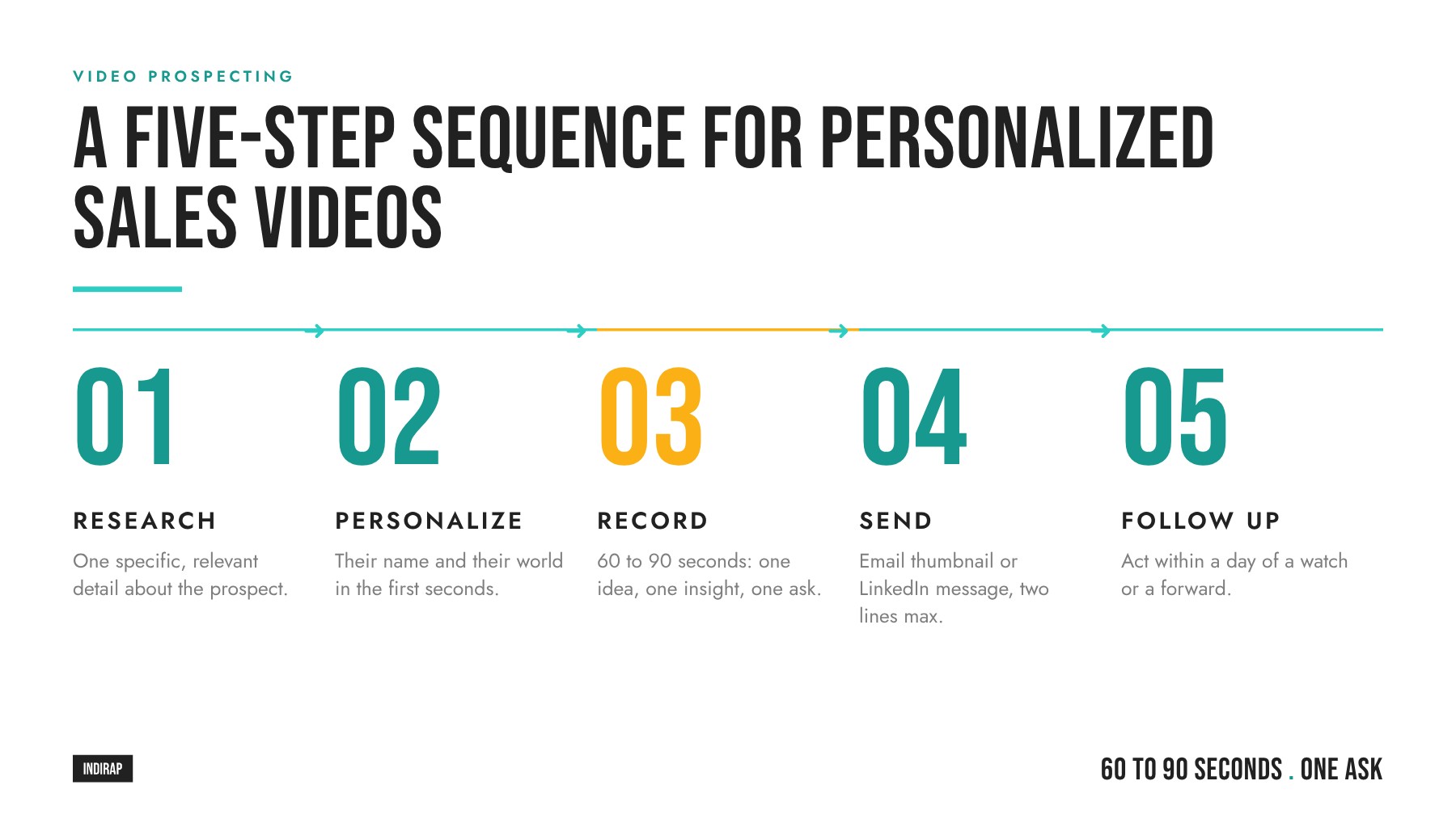
Use this five-step sequence as a starting point, then adapt it to your sales cycle.
Find one specific, relevant detail about the prospect and their company: a recent hire, a new product, a funding announcement, a job posting, an article they wrote, or a problem common in their industry. One strong detail beats five weak ones. Budget a few minutes per one-to-one video.
The first few seconds decide whether the prospect keeps watching. Say their name, and show something from their world on screen, such as their homepage, their LinkedIn post, or a whiteboard with their name written on it. That visual becomes the thumbnail, which also lifts open rates.
Keep it to one idea, one insight, and one ask. Look at the lens rather than the screen, smile, and speak as if you were across a table. Good light from a window or a simple lamp and a clean background are enough. Re-record if you stumble in the first ten seconds; after that, small imperfections add authenticity.
Send by email with an animated or static thumbnail and a short subject line that mentions the video and something specific, such as "Quick video for the Acme ops team." On LinkedIn, send the video in a message or attach it to a connection follow-up. Keep the written message to two or three lines, because the video is the message.
Check who opened and who watched. A prospect who watched most of the video is warm, so follow up within a day with a call, a reply, or a second, shorter video. If someone forwarded the video to a colleague, that colleague is a new lead. If nobody opened it, test a new subject line or thumbnail rather than a new video.
The script matters as much as the camera. Use this simple structure, which fits naturally into 60 to 90 seconds:
| Part | Time | What to say |
|---|---|---|
| Personal opener | 0:00 to 0:10 | Name, plus the specific detail you found: "Hi Jordan, I saw your team just opened a second plant in Ohio." |
| Relevance | 0:10 to 0:25 | Why that detail matters: the challenge companies often face at that moment. |
| Insight | 0:25 to 0:55 | One useful idea, example, or result from similar companies. Teach before you pitch. |
| Credibility | 0:55 to 1:10 | One line on who you are and who you help. |
| Ask | 1:10 to 1:25 | One low-friction next step: "Worth a 15 minute call next week? Reply with a time that works." |
A few ready-to-adapt scenarios:
For more on structuring short scripts, our video script template breaks any business video into six parts, and our guide to video hooks that sell focuses on the opening seconds.
The best way to learn video prospecting is to watch experienced sellers do it. The video below, from Sales Feed, features former Vidyard team members teaching how to use video at every stage of the sales process, from booking first meetings to moving deals forward. It covers recording, personalization, and when video helps most.
Two lessons from experienced practitioners apply to every team. First, video is a tool inside a sequence, so it works alongside calls and emails rather than replacing them. Second, the message matters more than production polish: a clear, specific, human video recorded at a desk can outperform an expensive one that feels generic.
You need a camera, a microphone, decent light, and a platform that records, hosts, shares, and tracks your videos.
Some platforms now offer AI-generated personalization at scale. Use it carefully: buyers value authenticity, and a real person speaking to a real detail is what makes prospecting video work. For a broader view of where AI helps and where human presence matters, see our analysis of AI video versus human-led production for B2B brands.
Track metrics at each step of the sequence so you know what to improve.
Review the numbers weekly at first. Small changes to subject lines, thumbnails, and openers usually move results more than new equipment. Our guide to measuring video marketing ROI explains how to connect video activity to revenue.
One-to-one videos open the door. Produced videos help the prospect walk through it. After the first reply, a prospect usually needs proof: how your solution works, who else uses it, and what results they saw. That is where a library of professional content does the heavy lifting.
The most useful produced assets for sales teams are:
The efficient way to build that library is one well-planned production that captures several of these assets at once. INDIRAP's Content Kit is built on this capture once, deploy many model, and our guide to the B2B YouTube playbook shows how the same assets can work as a public sales channel. Industries with long, considered sales cycles, such as technology and software, manufacturing, and supply chain and logistics, get the most from this combination.
Adoption is the biggest hurdle in video prospecting. These steps help a team start and keep going.
Leaders can model the behavior too. A short video from a founder or executive to a high-value prospect carries real weight, and it shows the team that video is part of how the company sells.
INDIRAP helps B2B brands build the produced side of video-led selling: the case studies, explainers, founder videos, and product content that sales teams send after the first conversation. We plan each production so one shoot supplies a full library mapped to your buyer journey, and we pair it with distribution through social media video and paid campaigns.
Explore our video production services, see our corporate and brand video work and client success stories, or Book A Video Strategy Call to map the videos your sales team needs most.
Video prospecting is a sales outreach method in which a seller sends a short, personalized video to a potential buyer to start a conversation. The video is usually shared as a thumbnail in an email or LinkedIn message and runs 60 to 90 seconds, opening with a detail specific to the prospect and ending with one easy next step.
Aim for 60 to 90 seconds. That is long enough to open personally, share one useful insight, establish who you are, and make a clear ask, and short enough that a busy buyer will watch to the end. If a video needs more time, it usually contains two ideas that work better as two separate touches.
Follow five parts: a personal opener with the prospect's name and a specific detail, why that detail matters, one useful insight, a single line on who you are, and one low-friction ask such as a short call. Teach before you pitch, and keep the language as natural as a conversation across a table.
Popular sales video platforms include Vidyard, Loom, and BombBomb. They let sellers record webcam and screen videos, share them with thumbnails, and track opens and views, and many integrate with CRMs such as HubSpot and Salesforce. A good webcam, a simple microphone, and soft front lighting complete the setup.
Use both, based on where your prospect is most active. Email works well with a thumbnail and a short, specific subject line that mentions the video. LinkedIn works well as a message after connecting or engaging with a post. Keep the written text to two or three lines in either channel, since the video carries the message.
Use a mix of one-to-one and one-to-many videos. Record one-to-one videos for high-value accounts and warm signals, and record one-to-many videos for segments, personalized with a name in the subject line and a tailored thumbnail. A repeatable script structure and a few minutes of focused research per prospect keep quality high as volume grows.
Track open rate, play rate, watch time, reply and meeting rate, and pipeline influenced. Each metric points to a different fix: subject lines and thumbnails for opens and plays, the opener for watch time, and the insight and ask for replies. Logging video activity in your CRM connects prospecting videos to meetings and revenue.
Produced videos supply the proof that follows the first reply. Case study and testimonial videos show results from similar customers, explainers show how the solution works, and founder videos build trust before the first meeting. Planning one production to capture several of these assets gives sales teams a library they can send at every stage.

Julian Tillotson is the Founder & CEO of INDIRAP, a full-service video production and creative strategy agency based in Chicago, IL. With 10+ years of experience, INDIRAP has delivered 20,000+ videos to 900+ clients across 40+ industries, making it one of North America's leading digital creative agencies.