
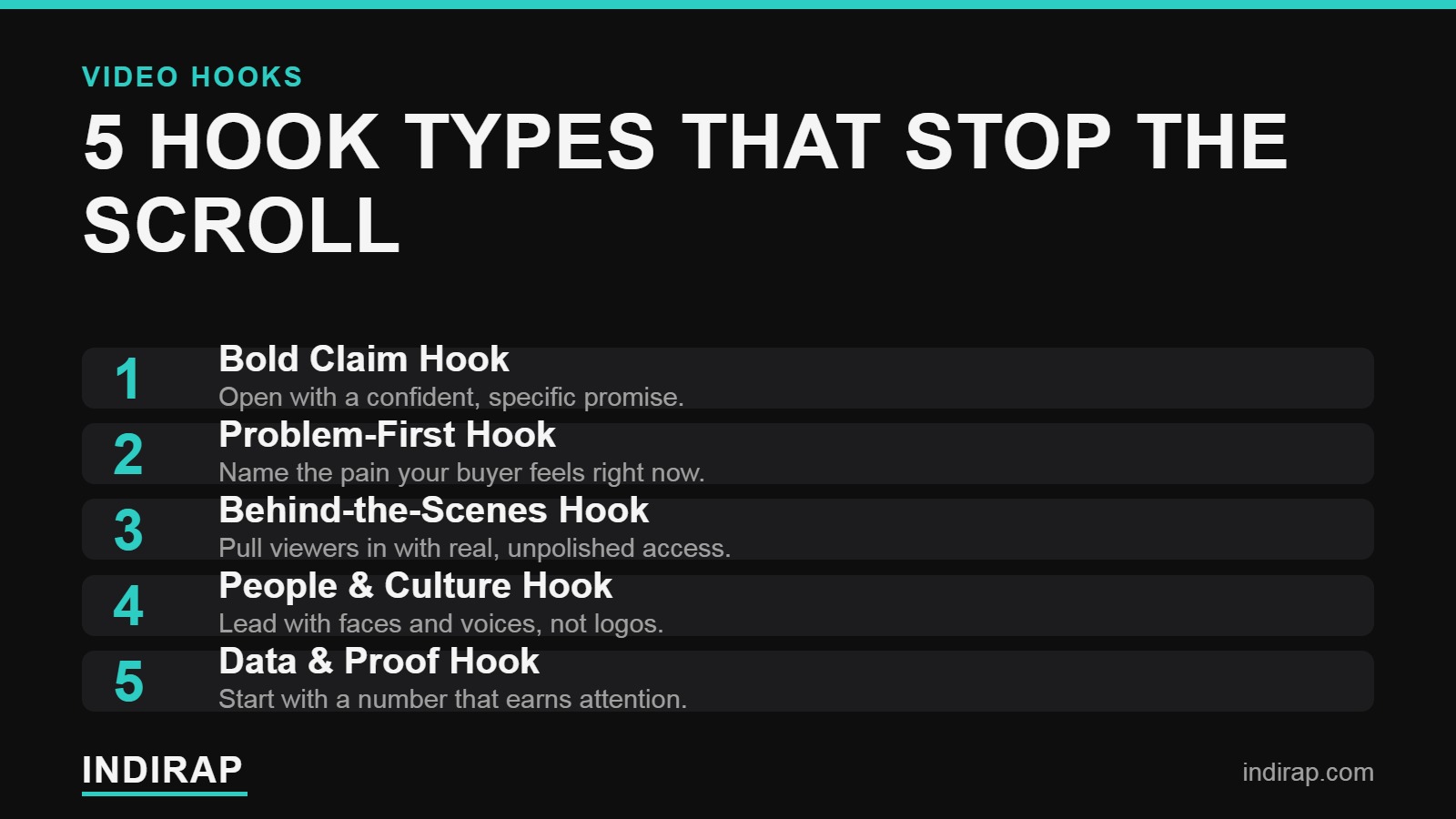
The strongest video hooks earn attention in the first three seconds by leading with one of five things: a bold claim, the viewer's exact problem, behind-the-scenes access, a real human moment, or a specific data point. Opening with a logo, your company name, or a wide shot of your building announces who you are. A hook earns the attention that lets the rest of the video do its job.
You have about three seconds to earn a viewer's attention before they scroll. Over the last decade, INDIRAP has delivered more than 20,000 videos to over 900 brands across 40 industries, and the hook is one of the most leveraged tools we apply to client content. It works the same whether you are shooting your first video or your hundredth. This guide walks through five hook types that consistently perform in B2B and B2C video, when to use each one, how each can backfire, and the meta-move that turns your hook choice into free targeting the algorithm does for you.
What is a video hook? A video hook is the opening few seconds of a video that earns a viewer's attention before they decide whether to keep watching. The five hook types that consistently perform in B2B and B2C video are the bold claim, the problem-first hook, the behind-the-scenes hook, the people and culture hook, and the data and proof hook. The best channels rotate all five.
An opening logo, a company name card, or a slow establishing shot of your building tells the viewer who you are before it gives them a reason to care. That is an announcement, and announcements are the easiest thing in a feed to scroll past. The first three seconds are the most valuable real estate in the entire video, and a hook puts them to work.
The fix is to lead with the moment that earns attention and let your brand arrive a beat later, once the viewer has a reason to stay. Every one of the five hooks below is a different way to spend those first three seconds on the viewer instead of on yourself.
By the end of this framework you will be able to look at the opening of any video you already own and name exactly which hook it is trying to be. If you can name it in five seconds, the hook is doing its job. If you cannot, that is your answer, and it is the first thing to fix.
There are five hook types that consistently perform. You should know all five, and you should use a mix of them across your content. Two of them deserve special attention: the problem-first hook is the one that turns cold audiences warm faster than anything else, and the data and proof hook is the most underused in B2B, which makes it the one worth trying first on your next video.
A bold claim hook leads with authority or scale. You name what you do, who you do it for, or what makes you different, and you say it with absolute confidence. "We build cooling systems for data centers, and we have delivered 4,700 of them in the past three years." "Our software runs payroll for 900,000 employees across 48 states." "We are the production company that built the Air Force's recruiting videos."
This is anchoring rather than bragging. The viewer needs to know in the first three seconds that they are in the right place, and authority earns that attention immediately.
When to use it: the bold claim works best when your brand has genuinely earned the claim and you are talking to a buyer who is already evaluating you against competitors. It performs well as middle-of-funnel content for prospects who are in active evaluation mode and want confirmation they are looking at a serious option.
How it backfires: the bold claim falls flat when the claim is vague or unverifiable. "We are a leading provider of [category]" is not a bold claim; it is filler that a viewer's brain has already learned to tag as marketing language and set aside. Specificity is what makes authority land. A real number, a named client, a concrete outcome. The moment the claim could belong to any company in your category, it stops working.
A problem-first hook leads with the pain, the exact pain your audience is feeling right now, named specifically enough that the viewer feels seen in the first sentence. "If you spent six figures on video and watched it go nowhere, you are not alone." "If your sales team is sending the same email 40 times a week and getting two replies, we should talk." "If the last brand strategy session you sat in lasted four hours and produced zero usable next steps, this is for you."
The goal is to open a tab in the viewer's head. When you name the problem with the specificity of someone who has lived it, the viewer feels understood before you have asked for anything.
When to use it: the problem-first hook is a top-of-funnel workhorse. It reaches buyers who have not started looking for a solution yet but are deep in the problem, and it turns cold viewers into warm ones faster than any other format. This is the hook to reach for with a cold audience.
How it backfires: the problem-first hook loses its power when the pain is generic. "Tired of poor ROI from your marketing investments?" is a leading question everyone has learned to ignore, not a problem-first hook. Name the pain the way someone who has actually felt it would describe it, in their words, with their specifics. The more precise the pain, the stronger the pull.
A behind-the-scenes hook leads with access. You show something people do not usually get to see: a live shoot in progress, a team room mid-strategy, a founder on a call making a real decision, a factory floor at six in the morning. The hook here is exclusivity. The viewer thinks, "I am seeing something I was not supposed to see," and that triggers the part of the brain that does not switch off.
When to use it: behind-the-scenes shines for culture content, brand building, and talent recruitment, anywhere you want to differentiate on personality and process rather than product features.
Production tip: shoot it on a phone, handheld, or on a smaller camera. A rougher look actually helps here, because the whole point is that the viewer feels like they snuck in. A glossy, cinematic open can work against the hook even when the visuals are objectively better, because polish signals "produced" and the behind-the-scenes hook lives on feeling unproduced.
A people and culture hook leads with a human moment. Connection before credentials. A team member laughing about a project that went sideways, a founder talking about why they started the company, a customer reaction caught honestly rather than staged. The moment has to feel real; anything that reads like a casting decision undoes the hook. People and culture hooks live or die on authenticity.
When to use it: reach for this when you are building emotional resonance with a buyer who is going to choose between three vendors that all have similar capabilities. When the capabilities look the same on paper, the vendor whose people the buyer remembers most fondly is the one who wins.
Production tip: the best people and culture hooks are usually captured by accident. Keep the camera rolling between formal takes. Run a B-camera during an interview setup. The genuine moments that make this hook work tend to happen when nobody thinks they are being filmed, so the job is to keep recording long enough to catch them.
A data and proof hook leads with a number: a specific, verifiable, surprising number. "43% of B2B video gets scrolled past in the first six seconds." "Our average client cuts production cost by 61% in year one." "240 companies tried this last quarter, and only three made it work." Specificity stops the scroll. The number has to be real, has to be cited or citable, and has to be interesting on its own.
This is the hook most B2B brands underuse, and that is exactly why it is the highest-leverage one to add. B2B audiences trust numbers over claims, so the data and proof hook punches above its weight. If your brand owns any proprietary data, that data is your single strongest hooking asset.
When to use it: authority building, research-led content, and industry analysis. Any time you want to be seen as the source rather than one more voice.
How it backfires: the data hook breaks when the number feels manufactured. "Over 50% of marketers say [X]" reads as data laundering, because round numbers feel invented. A precise figure like 12.7% feels real; 50% feels made up. Use the exact number, cite where it came from, and let the specificity do the convincing.
The one rule that ties all five together: do not overuse a single hook. If every video on your channel opens the same way, the channel starts to feel formulaic, and viewers learn to skip your first three seconds on sight. Rotate them. One bold claim, one problem-first, one behind-the-scenes, one people moment, one data drop. The variety keeps the opening fresh and keeps your audience from pattern-matching their way to the scroll.
A healthy channel treats the five hooks like a rotation, not a formula. Each video earns attention a different way, and the mix itself signals a brand with range.
Here is the meta-move that turns hook selection into free distribution. The hook you choose tells the algorithm something about who the video is for. A people and culture hook gets shown to culture-curious viewers. A data hook gets shown to research-oriented viewers. A problem-first hook reaches people already searching around that pain. So the hook is not only a retention tool; it is a targeting tool.
Put the right hook on the right video and you get the algorithm to do free distribution work for you, matching each piece of content to the audience most likely to act on it. That is the difference between a hook that holds attention and a hook that also finds the right people to hold it in front of.
Do this now, while it is fresh. Pull up your last video, look at the first three seconds, and name which of the five hooks it was trying to be: bold claim, problem-first, behind-the-scenes, people and culture, or data and proof. If you can name it instantly, you have already started installing the framework. If you cannot name it, that is the signal that the opening needs work, and now you know exactly which five options you are choosing between.
The hook framework is one piece of how INDIRAP builds video that drives predictable, long-term growth rather than one-off projects. We plan each production as the start of a content library, map it to a specific audience and action, and choose the opening hook deliberately so every piece earns attention and reaches the right viewer. If you want the framework applied to your brand, our video production team and our corporate video production work are both built around it, our Content Kit program turns a single shoot into a steady stream of platform-ready, hook-driven clips, and our social media content work carries those hooks into the feeds where buyers scroll. You can also browse client success stories to see the approach in action.
What are the five video hook types?
The five video hook types that consistently perform in B2B and B2C video are the bold claim, which leads with authority or scale; the problem-first hook, which leads with the viewer's exact pain; the behind-the-scenes hook, which leads with exclusive access; the people and culture hook, which leads with a real human moment; and the data and proof hook, which leads with a specific, verifiable number.
Why should you not open a video with your logo?
Opening with a logo, a company name card, or a slow shot of your building announces who you are before giving the viewer a reason to care, which makes it easy to scroll past. The first three seconds are the highest-value part of the video, and a hook spends them on the viewer instead, earning the attention that lets your brand land a moment later.
Which video hook is best for a cold audience?
The problem-first hook works best for a cold audience. By naming the exact pain a viewer is feeling right now, it makes them feel seen in the first sentence and turns cold viewers into warm ones faster than any other format, which is why it is the strongest top-of-funnel opening.
What is the most underused hook in B2B video?
The data and proof hook is the most underused in B2B video. B2B audiences trust numbers over claims, so a specific, verifiable, surprising statistic punches above its weight. If a brand owns any proprietary data, that data is its highest-leverage hooking asset, which makes this the hook worth trying first on your next video.
How does a video hook affect the algorithm?
The hook you choose signals to the algorithm who the video is for. A people and culture hook gets shown to culture-curious viewers, a data hook reaches research-oriented viewers, and a problem-first hook finds people already searching around that pain. The right hook on the right video turns hook selection into free, targeted distribution.
How often should you change your video hook?
Rotate hooks across your content rather than repeating one. If every video opens the same way, the channel feels formulaic and viewers learn to skip the first three seconds. A healthy rotation mixes all five hooks, one bold claim, one problem-first, one behind-the-scenes, one people moment, and one data drop, so each opening stays fresh.
Written by Julian Tillotson, Founder and CEO of INDIRAP. INDIRAP is a video production, social media marketing, and creative strategy agency that has delivered more than 20,000 videos to over 900 brands across 40 industries.


Julian Tillotson is the Founder & CEO of INDIRAP, a full-service video production and creative strategy agency based in Chicago, IL. With 10+ years of experience, INDIRAP has delivered 20,000+ videos to 900+ clients across 40+ industries, making it one of North America's leading digital creative agencies.


.png)
.png)