
The best-performing video ads of 2026 often look nothing like traditional ads. They look like a real person holding a phone, talking straight to camera, showing a product the way a friend would. That is the UGC style, and it has quietly become one of the highest-converting formats in paid social. This guide explains what UGC-style video ads are, why they perform, and how brands produce them at the quality and volume paid channels demand.
It is a format we build often as a full-service video production company, and it plugs directly into our social media video and paid creative work.
UGC stands for user-generated content, the kind of authentic video real customers make. UGC-style video ads are professionally produced videos designed to capture that same authentic, native feel while being built with intent as an ad. They read like a genuine person's recommendation, not a polished brand spot, which is exactly why they work in a feed built for real content.
The distinction matters. True user-generated content comes from customers organically. UGC-style ads are produced by a brand or an agency, often with creators or talent, to look and feel native while carrying a clear message and a call to action. You get the authenticity of UGC with the control, quality, and strategy of a real production. Most UGC-style ads are short-form, vertical video, because that is the native shape of the feed.
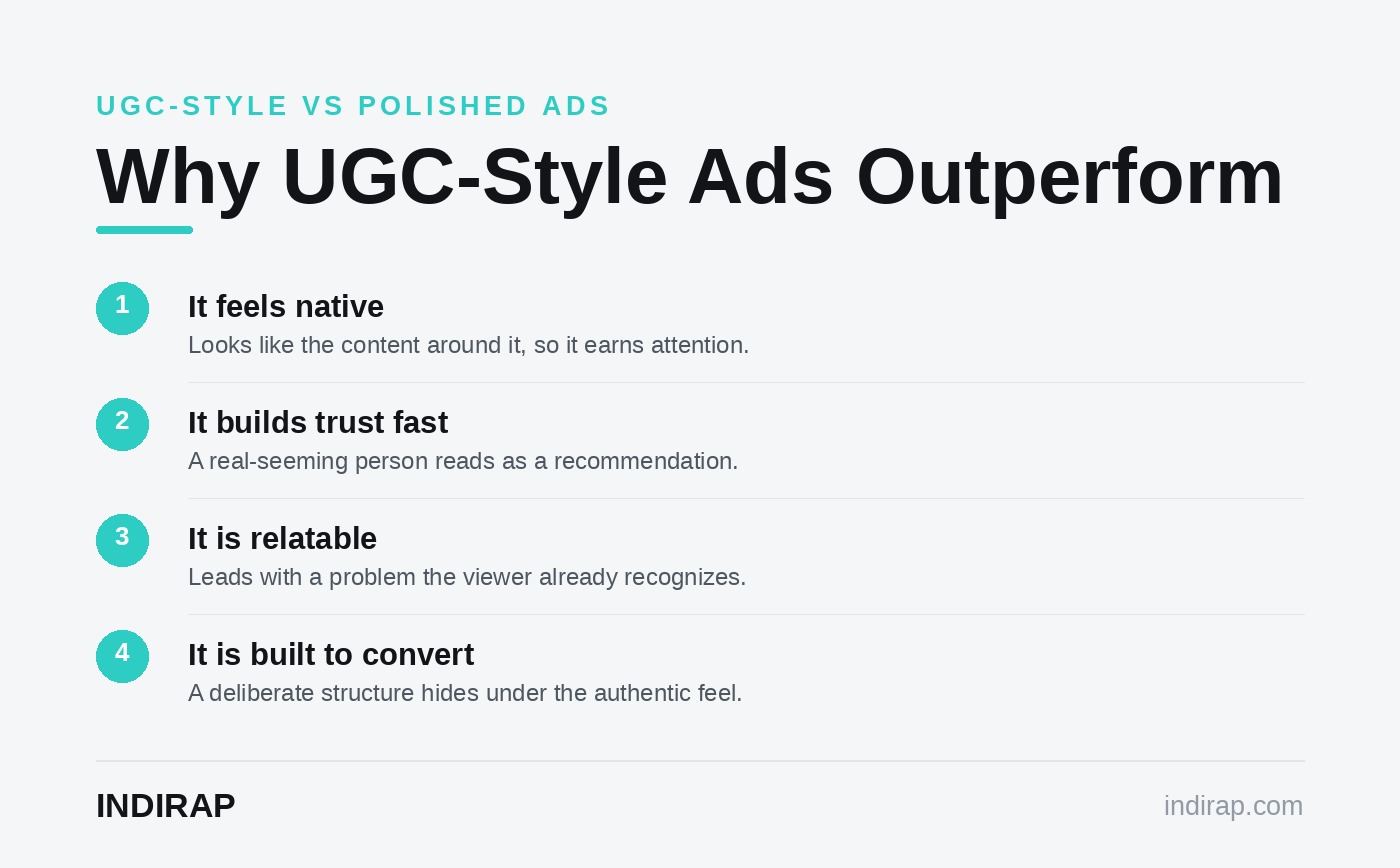
The feed is built for content between friends, so anything that looks like a traditional ad triggers the instinct to scroll. UGC-style video works with that instinct instead of against it, and it performs for a few clear reasons.
It feels native. A UGC-style ad looks like the content around it, so it earns attention rather than interrupting it.
It builds trust fast. A real-seeming person sharing a real-seeming experience reads as a recommendation, and people trust recommendations far more than claims.
It is relatable. UGC-style ads usually lead with a problem the viewer recognizes, which pulls them in before any product appears.
It is built to convert. Underneath the authentic feel is a deliberate structure: a hook, a problem, a product as the answer, and a clear next step.
The result is a format that consistently earns lower costs and higher conversion in paid social than glossy brand films, which is why so many performance teams now lead with it.
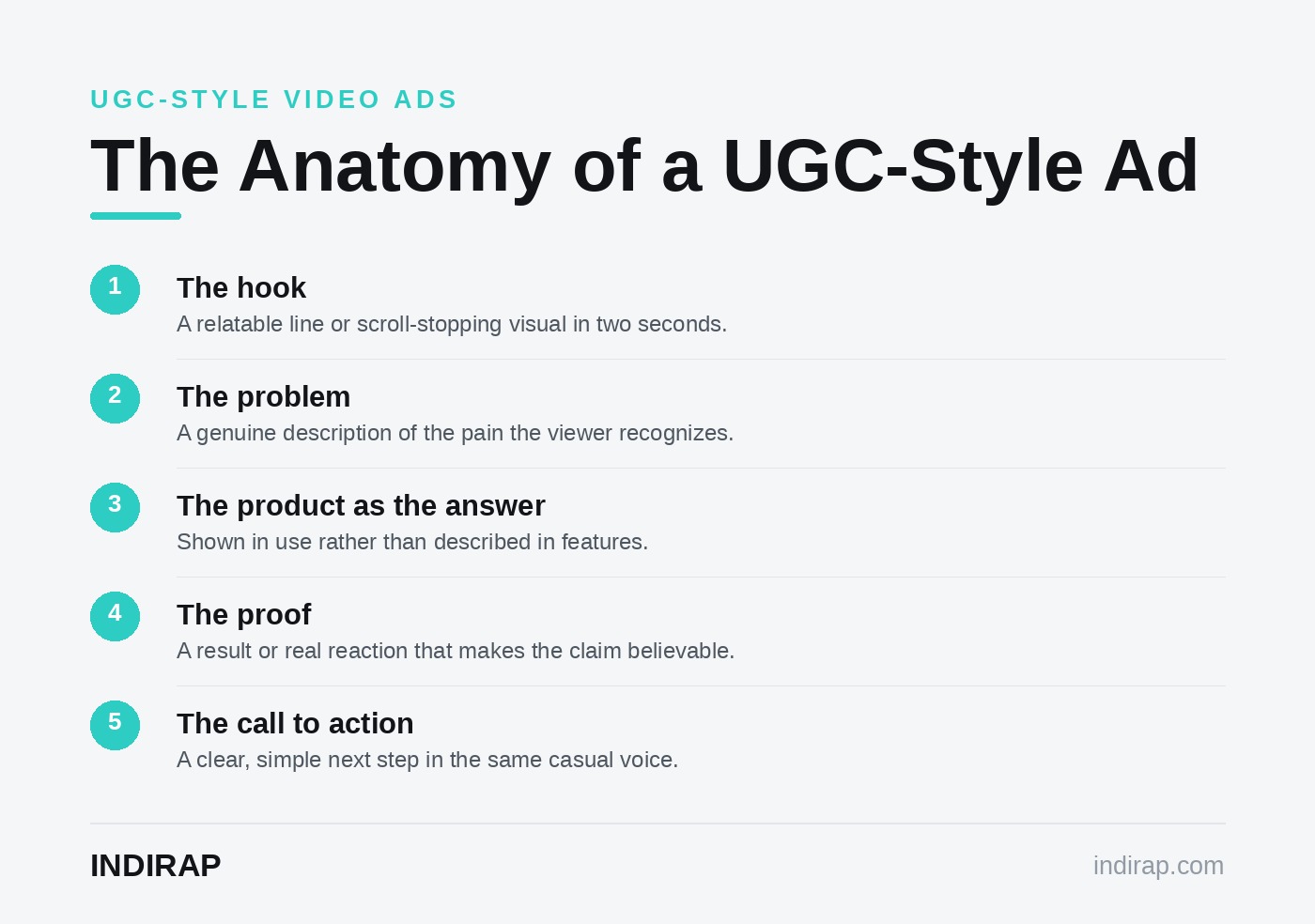
Strong UGC-style ads tend to follow a repeatable structure, even when they feel spontaneous.
The hook. A relatable line or a scroll-stopping visual in the first two seconds. Often it names a problem or makes a surprising claim.
The problem. A quick, genuine description of the pain the viewer recognizes, which builds the case before the product appears.
The product as the answer. The product enters as the natural solution, shown in use rather than described in features.
The proof. A result, a demonstration, or a moment of real reaction that makes the claim believable.
The call to action. A clear, simple next step, delivered in the same casual voice as the rest of the video.
None of this requires a big set or a large crew. It requires a strong script, the right talent, and an edit that keeps the authentic feel intact.
UGC-style ads shine in paid social, where native feel and conversion matter most, on Instagram, Facebook, YouTube, and LinkedIn feeds. They also work as organic content, and they make excellent testing fuel, because you can produce several variations of a hook or angle and let the data show which resonates. The winners then scale as paid creative.
For brands that also need a polished anchor, UGC-style ads pair well with corporate and brand video: the brand film builds authority, and the UGC-style ads do the high-volume converting.
The catch with UGC-style ads is that performance depends on volume. Paid social rewards testing many hooks and angles, then scaling the winners, which means a brand needs a steady supply of fresh creative. Relying on customers to produce it organically is unpredictable, and producing it one video at a time is slow.
The efficient path is to produce UGC-style ads in batches. A single planned production, with the right talent and a bank of scripts, can yield dozens of variations, enough to feed weeks of testing and scaling. That is the idea behind the INDIRAP Content Kit: a library of paid-ready creative captured in a focused sprint, so your ad account never runs dry on fresh angles. It is how brands in competitive categories, from technology and software to medical, keep testing and scaling without a constant scramble for creative. Getting each ad optimized for discovery helps the organic versions too, which our guide to video SEO best practices covers.
UGC-style video ads win because they respect the feed. They look native, build trust fast, lead with a real problem, and convert through a deliberate structure hiding under an authentic feel. The brands getting the most from them treat them as performance creative: produce many variations, test the hooks, and scale the winners. And the way to keep that engine fed is to produce them in batches rather than one at a time.
If you want a steady supply of UGC-style ads built for your brand, get a free content review and we will show you where they can drive the most growth.
UGC-style video ads are professionally produced videos designed to look and feel like authentic user-generated content while being built with intent as ads. They read like a real person's recommendation rather than a polished brand spot, which is why they perform in the feed.
They feel native to the feed, build trust quickly through a real-seeming person, lead with a relatable problem, and convert through a deliberate hook-problem-product-proof-action structure. That combination usually earns lower costs and higher conversion in paid social.
True UGC is made organically by customers. UGC-style ads are produced by a brand or agency, often with creators or talent, to capture that authentic feel while carrying a clear message and call to action, with the control and quality of a real production.
They perform best in paid social feeds on Instagram, Facebook, YouTube, and LinkedIn, and they also work organically. They make excellent testing fuel, because you can produce several variations and scale the winners as paid creative.
Because paid social rewards testing many hooks and angles, brands benefit from a steady supply of variations. Producing them in batches is the most efficient way to keep fresh creative flowing without a constant scramble.
It depends on volume and talent, but the most cost-effective approach is batched production, where a single shoot yields many variations and the cost per usable ad drops sharply compared to producing them one at a time.


Julian Tillotson is the Founder & CEO of INDIRAP, a full-service video production and creative strategy agency based in Chicago, IL. With 10+ years of experience, INDIRAP has delivered 20,000+ videos to 900+ clients across 40+ industries, making it one of North America's leading digital creative agencies.


.png)
.png)