You can produce a brilliant video and still get almost no traffic from it. The difference between a video that ranks and one that disappears is rarely production quality, it is optimization. Video SEO is the repeatable set of steps that makes a video findable: in Google, on YouTube, and now in the AI answer engines that summarize the web. This guide is the practical checklist, the specific best practices we apply to every video so it earns search visibility instead of sitting at a few hundred views.
Video SEO best practices are the on-page and platform signals that tell search engines what a video is about and why it deserves to rank. They fall into two buckets: optimizing the video itself so it earns a thumbnail in search and on YouTube, and optimizing the page the video lives on so the video lifts that page. The brands that win treat these as a checklist applied to every upload, not a one-time setting. For the full strategic picture, start with our pillar guide to video SEO and AEO.
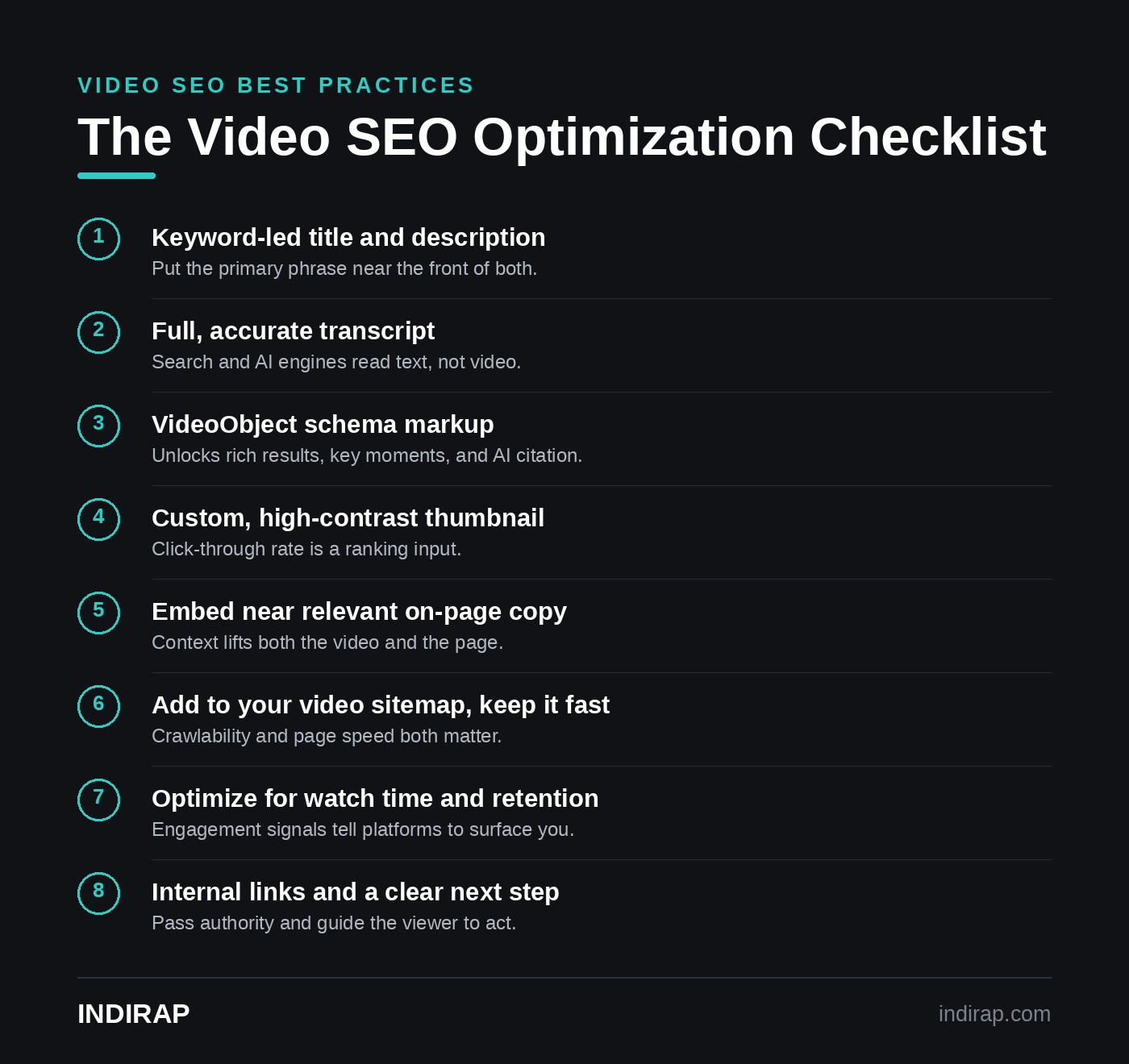
1. Keyword-led title and description. Research the phrase your audience actually searches, then put it near the front of the title and naturally through the description. This is the clearest signal of what the video covers.
2. A full, accurate transcript. Search engines and AI models cannot watch video, they read text. A clean transcript turns spoken content into indexable, quotable text and is the foundation of both ranking and AI citation. Do not rely on auto-captions for important content.
3. VideoObject schema markup. Adding VideoObject structured data (name, description, thumbnail, upload date, duration, embed URL) makes a video eligible for video rich results and key moments, and gives AI engines a clean way to parse it.
4. A custom, high-contrast thumbnail. The thumbnail drives the click, and click-through rate is a ranking input. A purpose-built thumbnail beats an auto-generated frame every time.
5. Embed near relevant on-page copy. Place the video beside text that covers the same topic. The surrounding copy gives the page context that lifts both the video and the page.
6. Add it to your video sitemap and keep the page fast. Make sure video pages are in your sitemap and that the player does not slow the page, since crawlability and page speed both affect ranking.
7. Optimize for watch time and retention. A strong hook and tight edit keep people watching, and watch time tells the platforms your video is worth surfacing. Good creative is SEO, not just production value.
8. Add internal links and a clear next step. Link the page to and from related content so it inherits authority, and give the viewer one obvious action to take when the video ends.
These are related but not identical. YouTube SEO optimizes for YouTube's own search and recommendation engine, where titles, tags, watch time, and session duration drive reach. On-page video SEO optimizes the page your video lives on, where transcripts, schema, surrounding copy, and page authority do the work. A complete approach uses both: YouTube for discovery, your own site for conversion and for owning the search result. One properly optimized video can win in both places.
The most common mistakes are easy to fix once you know them. Publishing with a vague title that names the brand instead of the topic. Skipping the transcript and hoping auto-captions are enough. Embedding the video with no surrounding copy, so the page gives search engines nothing to read. Hosting only on YouTube and linking out from your site, which sends the ranking signals to YouTube instead of your domain. And treating optimization as a launch-day task rather than something you measure and improve over time.
The same transcript-and-schema work that wins traditional video SEO is what makes a video citable in AI search. When someone asks ChatGPT, Google AI Overviews, or Perplexity a question, those systems assemble an answer from sources they trust. A video with a clean, factual transcript, VideoObject and FAQ schema, and content organized around real questions is far easier for them to quote. We cover this answer engine optimization layer in depth in the video SEO pillar guide.
Most teams can handle the basics, but the gap between a video that ranks and one that disappears usually comes down to consistency and the technical layer applied every time. As a full-service video production company, INDIRAP builds SEO and AEO into the production process, so the content we create is engineered to be found, not just watched. It is the same content-system thinking behind our Content Kit: produce once, optimize properly, and get found everywhere.
Watch + Learn
See how we build content engineered to rank and convert.
▶ Subscribe on YouTube for video marketing and SEO breakdowns
▶ Instagram Reels for quick video strategy tips
Video SEO best practices include keyword-led titles and descriptions, a full transcript, VideoObject schema, a custom thumbnail, embedding near relevant copy, inclusion in your video sitemap, optimizing for watch time, and internal linking. Together they make a video both rankable and citable by AI search.
Start with keyword research, then write a keyword-led title and description, add an accurate transcript, implement VideoObject schema, design a custom thumbnail, host the video where it fits your goal, place it next to relevant text, and add it to your sitemap. Finish by tracking impressions, rankings, and watch time so you can improve over time.
A full, accurate transcript is the highest-leverage single factor, because search engines and AI engines read text rather than watching video. The transcript turns your content into indexable, quotable text and underpins both ranking and AI citation.
Yes. The same clean transcript and structured data that win traditional video SEO make a video easier for AI engines like ChatGPT, Google AI Overviews, and Perplexity to understand and cite. Organizing content around real questions with direct answers strengthens this further.
Video SEO compounds rather than spikes. YouTube can surface a video within hours, while on-page ranking and AI citation build over weeks as transcripts get indexed, schema is trusted, and engagement signals accumulate. Consistent optimization across every video is what drives durable results.
This is part of INDIRAP's video marketing and SEO guide series.

Julian Tillotson is the Founder & CEO of INDIRAP, a full-service video production and creative strategy agency based in Chicago, IL. With 10+ years of experience, INDIRAP has delivered 20,000+ videos to 900+ clients across 40+ industries, making it one of North America's leading digital creative agencies.


.png)
.png)