
Short-form video is the format the entire social internet now runs on. It is the first thing your audience sees when they open an app, the content the platforms push hardest, and the format buyers increasingly use to decide who to trust. For brands, the question is no longer whether to invest in short-form video. It is how to produce enough of it, at a quality that earns attention, without a shoot every single week.
This guide breaks down short-form video production the practical way: what short-form video actually is, the formats that perform in 2026, what it costs, and how to produce it at the volume social demands. It is the same approach we bring as a full-service video production company that builds social-first content for brands across the country.
Short-form video is video built to be watched quickly, usually under 60 seconds, and designed for the feed. The length is the obvious part. The more important part is the intent: short-form is made to stop a scroll, deliver one clear idea, and earn a reaction in seconds.
That intent changes everything about how it is produced. A short-form video leads with a hook, carries a single message, uses captions because most people watch on mute, and is framed vertically for a full mobile screen. It is closely related to vertical video, which describes the 9:16 frame, while short-form describes the length and pace. In practice, the highest-performing social content is almost always both at once.
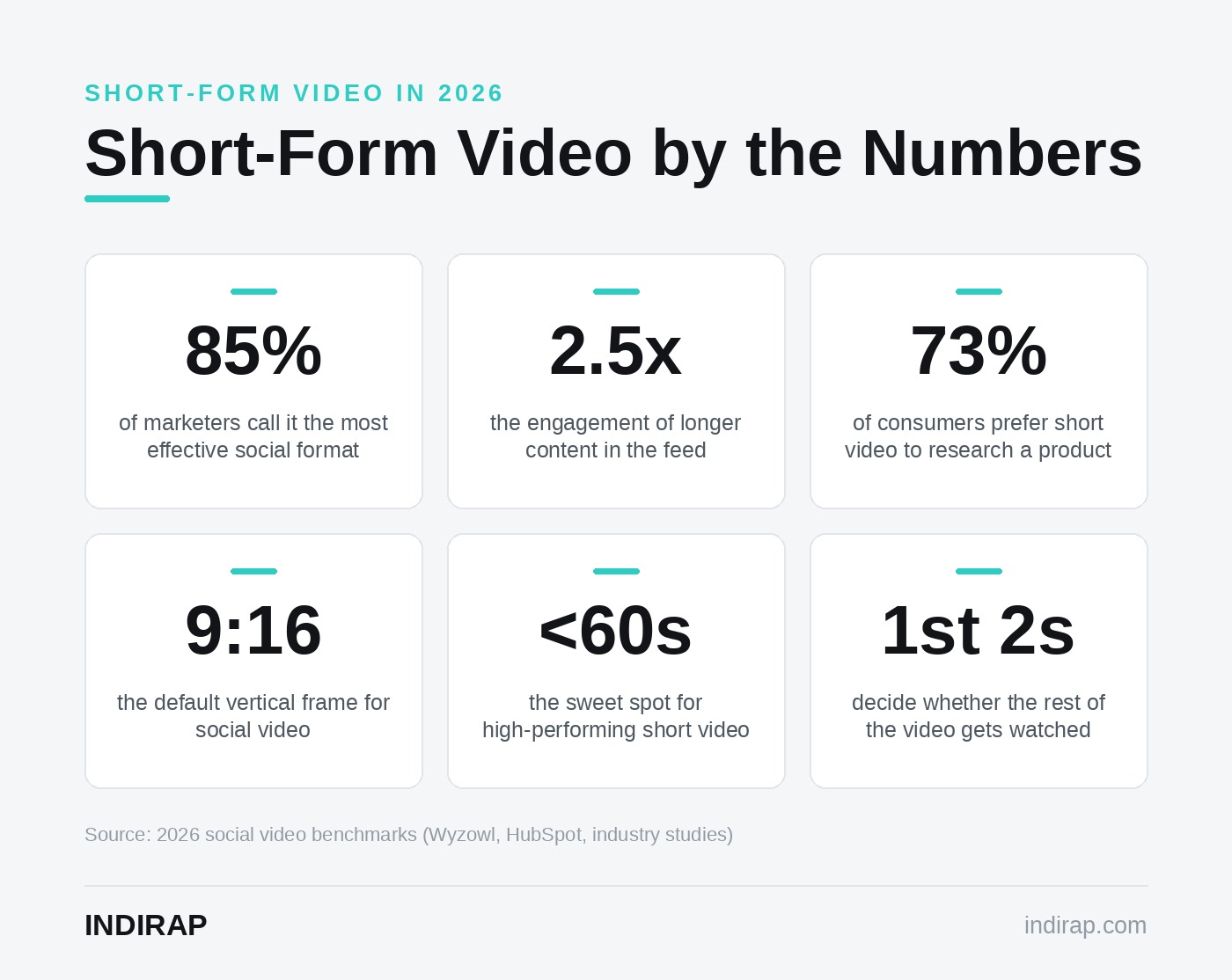
The case for short-form is now a numbers case. 85% of marketers call short-form video the single most effective social format. Short videos earn roughly two and a half times the engagement of longer content in the feed. 73% of consumers say they prefer short video when they are researching a product or service. And spending is following behavior, with short-form ad budgets climbing fast.
What that means for a brand is simple. Short-form video is where discovery, consideration, and trust are increasingly happening. The brands that show up consistently with strong short video are the ones getting found, and the ones that treat it as an occasional experiment are quietly ceding the feed. Short-form sits at the center of any serious social media video program for exactly this reason.
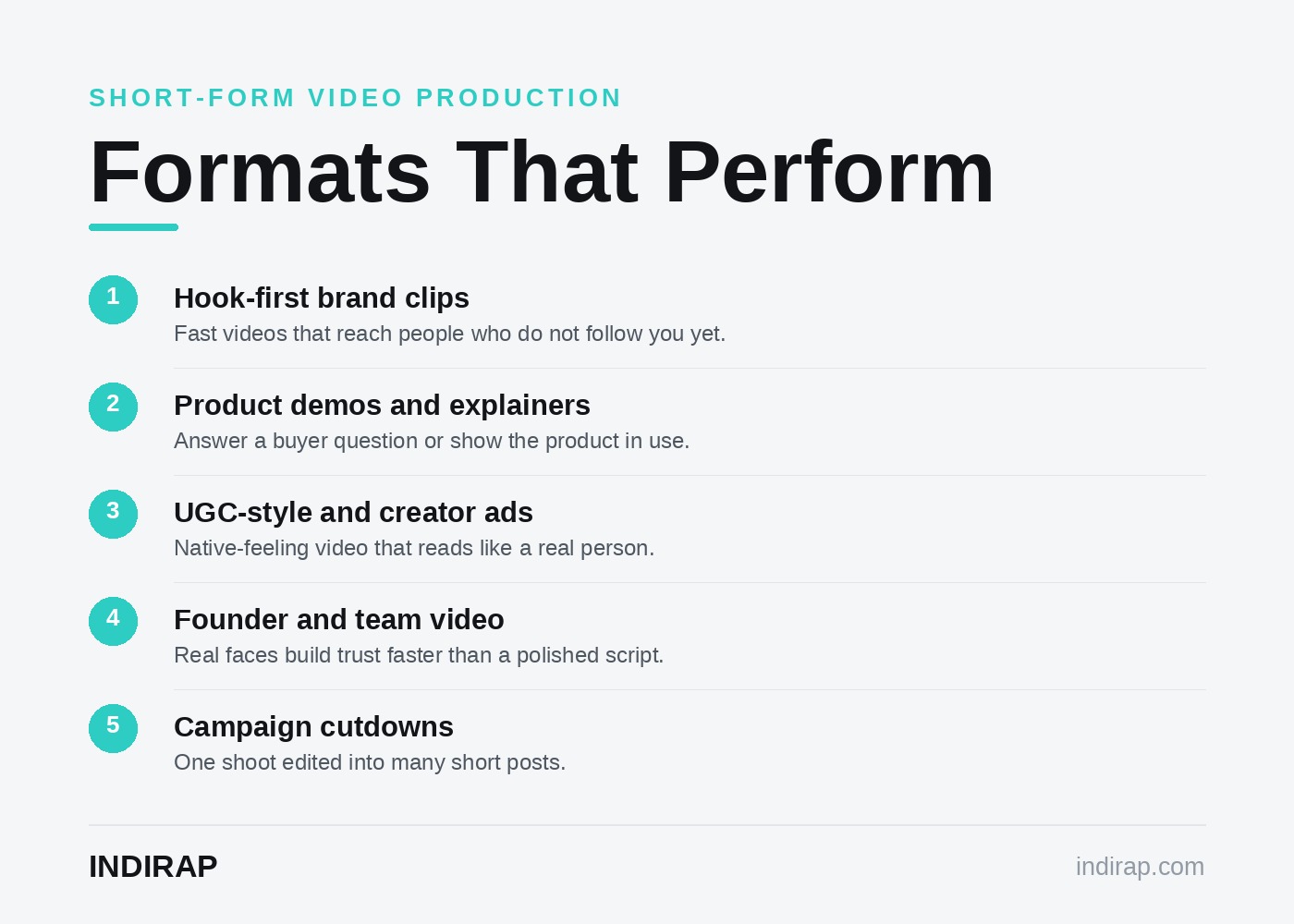
Short-form is a family of formats, not a single template. The strongest programs use a mix.
The right mix depends on your audience and your goals, but nearly every brand benefits from running several of these at once rather than betting on one.
Cost is the question every marketing lead asks, and the honest answer is that it depends on how you produce it. There are three broad models.
One-off freelance clips. Hiring a freelancer for a single video is the cheapest entry point per project, often a few hundred to a couple thousand dollars per video, but it is the most expensive way to produce at volume. Every video restarts the process, quality varies, and there is no strategy connecting the pieces.
In-house creation. Building an internal team gives you control and speed once it is running, but it carries real fixed cost in salaries, equipment, and management, and most teams struggle to keep quality high while producing enough.
Batched production with an agency. The most cost-effective way to produce short-form at volume is to capture a large batch of content in one planned production, then edit it into many cuts. This spreads the cost of a shoot day across dozens of videos, which lowers your real cost per post sharply while keeping quality and strategy consistent.
That batched model is the idea behind the INDIRAP Content Kit: one to three production days that yield a full library of short-form video, so your feed stays active for months without a shoot every week. For a brand comparing options, the number that matters is not the price of a single video, it is the cost per usable post across a quarter, and batching wins that comparison almost every time.
Producing short-form well is a repeatable process, not a scramble. The path we use looks like this.
Strategy and hooks. Before anything is filmed, we align on the audience, the goals, and a bank of hooks and angles worth producing. This is where volume becomes possible, because a clear plan lets one shoot serve many videos.
Scripting and shot planning. Short does not mean unscripted. The best short videos are tightly planned so the shoot day is efficient and every setup earns its place.
Production. In a focused shoot, we capture a batch of content, often enough for weeks of posts, rather than filming one video at a time.
Editing into cuts. This is where a shoot becomes a library. Footage is edited into platform-ready vertical cuts with captions, sound design, and pacing tuned for each platform.
Delivery and optimization. You receive a full set of versioned, ready-to-post videos, optimized with titles, descriptions, and thumbnails that help them get found.
The hardest part of short-form is not making one video, it is making enough of them, consistently, without burning out. The brands that win treat production as a supply problem and solve it with batching. A single well-planned production day, edited into dozens of cuts, keeps a feed alive for months and takes the weekly content scramble off the team's plate. It is how brands in demanding fields, from technology and software to financial and wealth management, stay consistent while still running the rest of their business.
Short-form video is the format your audience already watches and the one the platforms reward. Producing it well comes down to three things: strong creative in the first few seconds, the right mix of formats for your goals, and a production model that lets you stay consistent without a shoot every week. Brands that get those three right turn short-form from an occasional experiment into a reliable growth engine.
If you want that engine working for your brand, get a free content review and we will show you where short-form video can drive the most growth.
Short-form video is video built to be watched quickly, usually under 60 seconds, and designed for social feeds. It leads with a hook, carries one clear idea, uses captions for silent viewing, and is framed vertically for a full mobile screen.
It depends on the production model. One-off freelance clips can run a few hundred to a couple thousand dollars each, but the most cost-effective way to produce at volume is batched production, where one to three shoot days yield a full library of videos and the cost per usable post drops sharply.
Most high-performing short videos run well under a minute, often 15 to 45 seconds, with a strong hook in the first two seconds. The right length depends on the platform and the message, but shorter and tighter usually wins.
Consistency matters more than any single video, so the goal is a steady stream rather than an occasional big piece. Capturing content in batches is the most reliable way to keep a full calendar without a weekly shoot.
Short-form describes the length and fast pace, while vertical describes the 9:16 frame. Most high-performing social video is both at once, but they are separate creative choices.
Yes. A single well-planned production day can be edited into dozens of platform-ready cuts. This batched approach is the most efficient way to keep a feed active and keep your cost per post low.


Julian Tillotson is the Founder & CEO of INDIRAP, a full-service video production and creative strategy agency based in Chicago, IL. With 10+ years of experience, INDIRAP has delivered 20,000+ videos to 900+ clients across 40+ industries, making it one of North America's leading digital creative agencies.


.png)
.png)