B2B video marketing has a strategy problem, not a production problem. Most enterprise brands can get a video made. What they struggle with is making video that actually moves pipeline, because B2B buying is nothing like B2C buying, and a strategy borrowed from consumer marketing falls flat. A long, considered, multi-stakeholder decision needs a different kind of video at each stage, distributed in different places, measured against different metrics.
This guide lays out a B2B video marketing strategy that fits how enterprise buyers actually decide: how video works across the funnel, the formats that drive results, where to distribute for B2B specifically, and how to measure return. It is the strategic layer beneath the formats we cover in our guide to the types of corporate video.
The B2B buying process is long, self-directed, and made by a committee. A typical enterprise purchase involves multiple stakeholders, months of research, and a heavy emphasis on risk reduction. Buyers are not looking to be entertained into an impulse purchase. They are building a case, internally, that your company is the credible, low-risk choice.
That changes what video has to do. In B2C, video often aims for reach and emotion. In B2B, video earns trust, demonstrates competence, and equips an internal champion to sell your solution to the rest of the buying committee when you are not in the room. The most effective B2B video does not just attract attention. It de-risks the decision. This is why credibility-driven formats, executive thought leadership, customer proof, clear demonstrations, outperform flashy creative that says nothing.
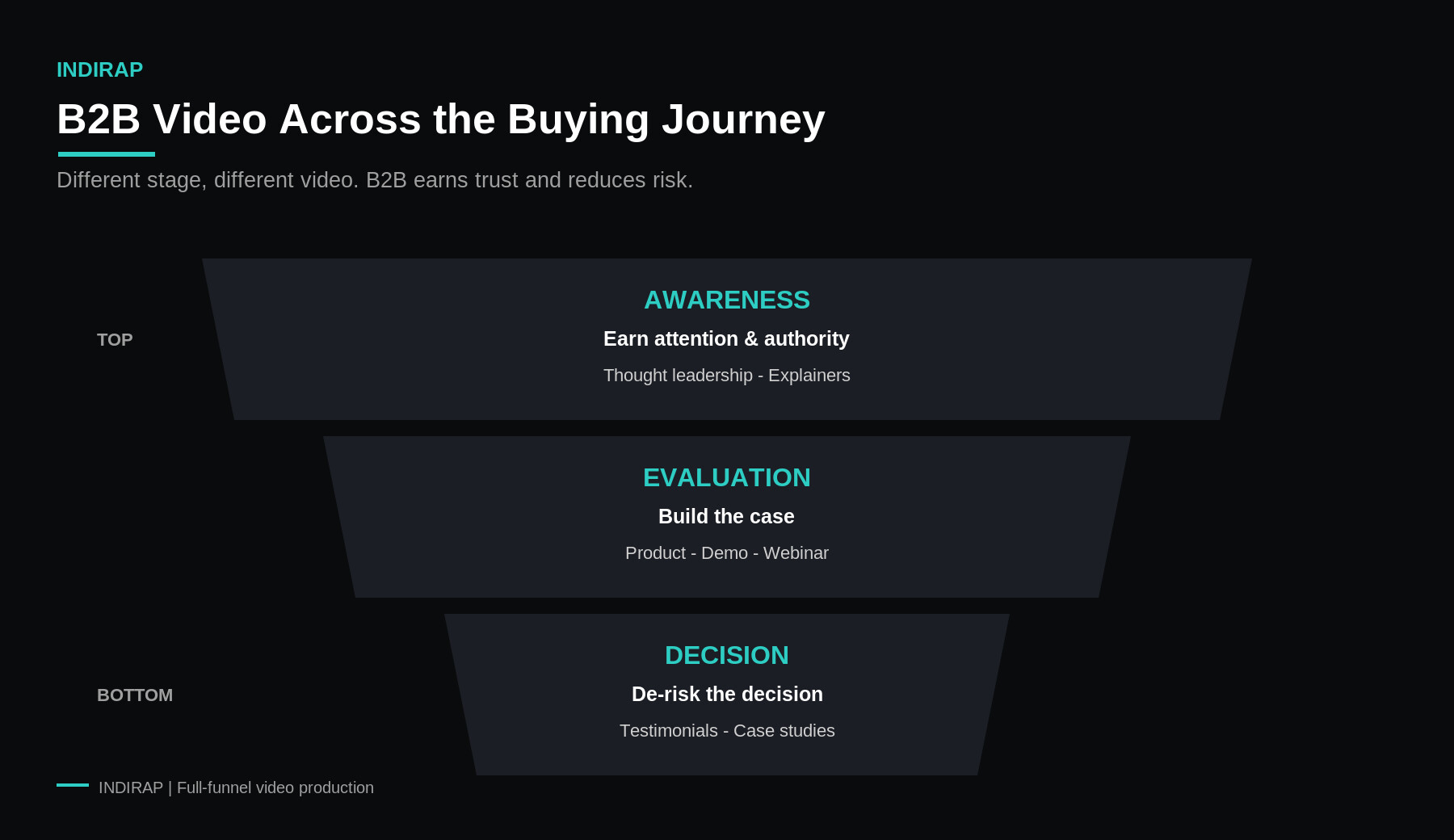
At the awareness stage, your buyer is learning about a problem, often before they know your company exists. Thought-leadership video, educational explainers, and point-of-view content from your executives establish your brand as a credible authority on the problem. The goal is not a hard sell. It is to be the brand that taught them something useful, so you are top of mind when they move to evaluation.
Once a buyer is actively evaluating options, they need evidence. This is where product and demo videos, deeper explainers, and webinar content do their work, answering the practical questions a committee asks: what exactly does this do, how does it work, and is it a fit for our situation? Middle-funnel video is the substance behind the awareness, and it is what an internal champion shares with colleagues to build consensus.
At the decision stage, the dominant emotion is risk. Customer testimonial and case study videos are the most powerful assets here, because nothing reduces perceived risk like a peer describing a real, successful outcome. A bottom-funnel video that shows a company much like the buyer's getting a measurable result does more to close a deal than any feature list. You can see how this plays out in our client success stories.
A few formats consistently earn their place in an enterprise video strategy. Executive thought leadership builds the authority that opens doors at the top of the funnel. Customer testimonials and case studies provide the peer proof that closes at the bottom. Product and explainer videos do the educating in the middle. Recruitment and culture videos support the talent side of the business, which for many enterprises is as strategic as demand generation. And short-form social video, cut from your longer assets, keeps your brand visible between buying cycles. The key is that these are not separate campaigns. They are one connected system, which is exactly how our corporate video production approach builds them.
Distribution is where most B2B video strategies fall apart, because producing the video is treated as the finish line. For enterprise brands, four channels matter most.
LinkedIn is the center of gravity for B2B. Native video, executive posts, and short clips reach decision-makers where they already spend professional attention. YouTube is the second-largest search engine and the home for your longer educational and demonstration content, where buyers actively search for answers. Your website is where video does conversion work, on the homepage, product pages, and landing pages. And sales enablement is the underrated channel: equipping your reps with the right video to send at the right moment in a deal often produces more pipeline impact than any public campaign. Short-form cuts repurposed into social media content keep the whole system visible between purchases.
B2B video should be measured against pipeline and revenue, not vanity views. The metrics that matter map to the funnel: at the top, reach and engagement with the right audience; in the middle, video-influenced leads and content engagement from target accounts; at the bottom, the influence of video on deals that closed. The most sophisticated B2B teams track which videos appear in the buying journeys of won deals, then double down on those formats.
The honest framing is that video in B2B is rarely the single touch that closes a deal. It is the trust-building, risk-reducing layer that makes every other touch more effective. Measured that way, against influence on pipeline rather than direct attribution, B2B video consistently earns its budget.

The brands that win with B2B video do not commission videos as occasional projects. They build an engine: a consistent stream of content that keeps the funnel fed at every stage. The challenge is that doing this in-house requires a team most companies do not have, and doing it project by project is slow and expensive.
The efficient model is to capture a library of assets in a single production sprint, then maintain a steady cadence over time. A Content Kit sprint builds the foundational library, thought leadership, testimonials, product content, and social cuts, in one to three days, and an ongoing retainer keeps the engine running so your content calendar never goes quiet. Together they turn B2B video from a series of fire drills into reliable infrastructure. Explore the full scope on our video production page.
Three mistakes account for most underperforming B2B video. The first is leading with production value instead of substance, a beautiful video that says nothing convinces no one in a B2B evaluation. The second is producing a single hero video and stopping, when B2B requires content across the whole journey. The third is skipping distribution and measurement, treating the finished file as the goal rather than the start. Avoid those three, build for the funnel, and distribute where your buyers actually are, and B2B video becomes one of your most reliable growth channels.
A strong B2B video strategy starts with mapping your buying journey to the right formats and a realistic distribution and measurement plan. The fastest way to build that map is a free content strategy review, where we connect your pipeline goals to a concrete video plan. For the foundational concepts, revisit our overview of corporate video production, and for proof of what these strategies produce, see our roundup of corporate video examples that drove real results.
Watch + Learn
See how INDIRAP builds B2B video that maps to the enterprise buying journey and actually moves pipeline.
▶ Subscribe on YouTube for B2B video strategy breakdowns and examples
▶ Instagram Reels for quick takes on B2B video distribution
▶ YouTube Shorts for 60-second B2B video marketing tips
B2B video marketing is the use of video to attract, educate, and convert business buyers across a long, multi-stakeholder buying journey. Unlike consumer video that often aims for reach and emotion, B2B video focuses on building trust, demonstrating competence, and reducing the perceived risk of a complex purchase decision.
B2B buying is longer, self-directed, and made by a committee focused on risk reduction, while B2C is often shorter and more emotional. As a result, B2B video emphasizes credibility formats like thought leadership, customer proof, and clear demonstrations, and it is measured against pipeline influence rather than direct response.
The highest-impact B2B video formats are executive thought leadership for authority at the top of the funnel, product and explainer videos for evaluation in the middle, and customer testimonials and case studies for de-risking the decision at the bottom. Short-form social cuts keep the brand visible between buying cycles.
The four channels that matter most for B2B are LinkedIn for reaching decision-makers, YouTube for searchable educational content, the company website for conversion, and sales enablement for equipping reps to send the right video at the right moment in a deal. Skipping distribution is the most common reason B2B video underperforms.
Measure B2B video against pipeline and revenue rather than views: audience reach and engagement at the top of the funnel, video-influenced leads and target-account engagement in the middle, and video influence on closed deals at the bottom. The strongest teams track which videos appear in the buying journeys of won deals.
This is Post 5 in INDIRAP's Corporate Video series.


Julian Tillotson is the Founder & CEO of INDIRAP, a full-service video production and creative strategy agency based in Chicago, IL. With 10+ years of experience, INDIRAP has delivered 20,000+ videos to 900+ clients across 40+ industries, making it one of North America's leading digital creative agencies.


.png)
.png)