
Social media video content is the fuel that keeps a brand visible in the feed. It is the reason some brands feel everywhere at once while others post twice a month and wonder why nothing moves. This guide explains what social media video content actually is, the main types with clear examples, and how brands use each to grow an audience and drive results.
It is the practical overview we share with brands before we build their programs as a full-service video production company, and it connects directly to our social media video service.
Social media video content is any video made specifically to be watched, shared, and acted on inside social platforms. It is built from the first frame for a vertical screen, silent autoplay, and a fast hook, and it is designed to do a job in the feed: earn attention, build trust, or drive an action.
The important word, again, is specifically. Content built for social is not a repurposed TV spot. It is short, usually vertical, captioned for silent viewing, and paced for a scroll. Most high-performing social video is also short-form and vertical, because those two qualities match how people actually watch.
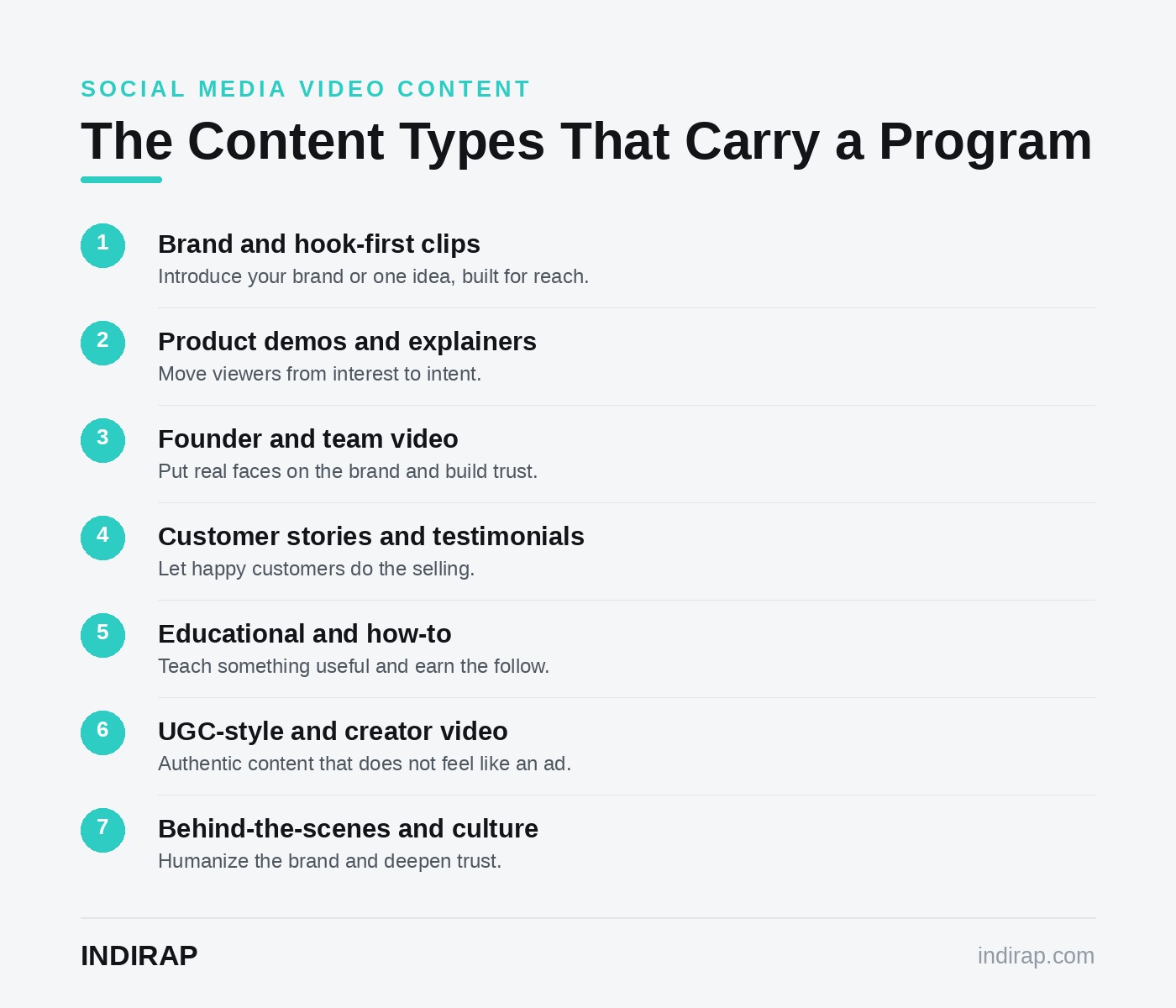
Social video is a family of formats. Here are the types that carry most brand programs, and what each looks like in practice.
Brand and hook-first clips. Short, punchy videos that introduce your brand or a single idea. Example: a five-second pattern interrupt that opens with a surprising claim, then delivers a quick payoff. Built for reach at the top of the funnel.
Product demos and explainers. Videos that show a product in action or explain how something works. Example: a 30-second walkthrough of a feature, shot vertically, captioned, with a clear before-and-after. These quietly move viewers from interest to intent.
Founder and team video. Real people, real points of view. Example: a founder talking straight to camera about why they started the company, or a quick team introduction. This builds trust faster than any polished script, and for B2B it pairs naturally with corporate and brand video.
Customer stories and testimonials. Happy customers doing your selling for you. Example: a short cut of a client describing a result, intercut with footage of the work. Nothing converts a skeptical buyer like a peer's experience.
Educational and how-to video. Content that teaches something useful. Example: a quick tip series where each video answers one common question in your industry. This builds authority and gives people a reason to follow.
UGC-style and creator-style video. Authentic, native-feeling content that reads like a real person rather than an ad. Example: a creator-style unboxing or a day-in-the-life clip. It converts because it does not feel like marketing. We cover this in depth in our guide to UGC-style video ads.
Behind-the-scenes and culture video. A look inside the brand. Example: a fast montage of a shoot day or a product being made. It humanizes the brand and feeds the trust stage of the journey.
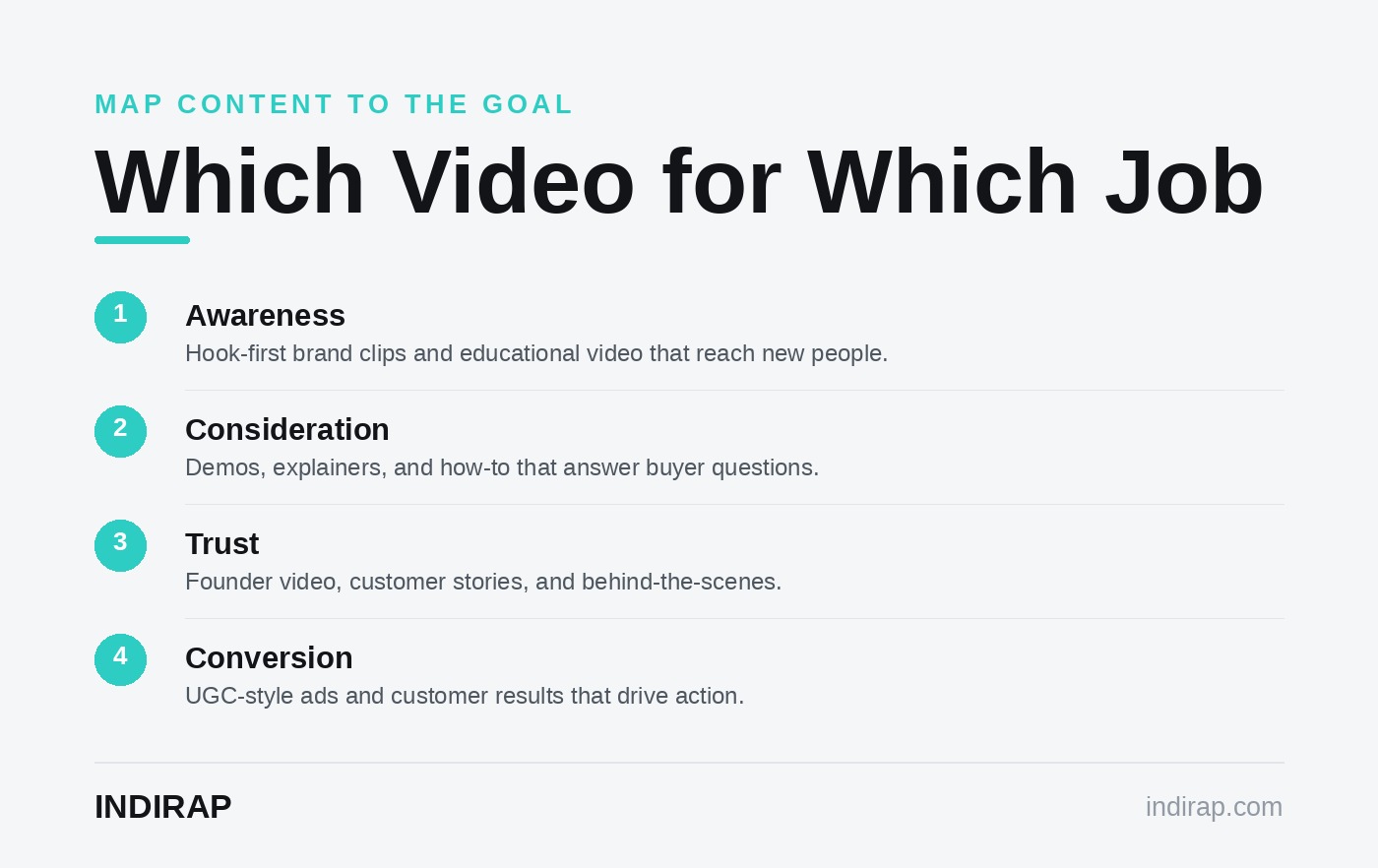
Choosing content types is easier when you tie them to goals rather than trends.
For awareness, lead with hook-first brand clips and educational video that reach new people. For consideration, use demos, explainers, and how-to content that answer buyer questions. For trust, lean on founder video, customer stories, and behind-the-scenes content. For conversion, use UGC-style ads and customer results that drive action. A healthy feed runs a mix across all four, because a brand needs to be found, understood, trusted, and chosen.
The teams that never run out of ideas are not more creative, they are more systematic. The most reliable sources of content are the questions your buyers already ask, the objections your sales team already hears, the results your customers already talk about, and the expertise your team already has. Turn each of those into a short video and you have weeks of content that is useful rather than filler. Keeping a running bank of these angles is what makes a shoot day productive.
Knowing the types is the easy part. Producing enough of them, consistently, is where most brands stall. The answer is to stop making content one video at a time and start capturing it in batches. A single planned production day, edited into many cuts, can cover weeks of brand clips, demos, founder videos, and customer stories.
That batched approach is the idea behind the INDIRAP Content Kit: a full library of social video captured in one to three production days, so your feed stays active for months without a weekly shoot. It is how brands across industries, from manufacturing to medical, keep a steady, varied content mix without burning out.
Social media video content is the short, vertical, feed-native video that keeps a brand visible and trusted. The brands that grow use a mix of types, brand clips, demos, founder video, customer stories, education, and UGC-style content, each mapped to a goal. And they produce enough of it by capturing content in batches rather than one video at a time.
If you want a steady, varied content mix built for your brand, get a free content review and we will show you which types will drive the most growth.
Social media video content is any video made specifically to be watched, shared, and acted on inside social platforms. It is short, usually vertical, captioned for silent viewing, and designed to earn attention, build trust, or drive an action in the feed.
The main types are brand and hook-first clips, product demos and explainers, founder and team video, customer stories, educational and how-to video, UGC-style content, and behind-the-scenes video. Most brands run a mix across their goals.
Start with the content that answers your buyers' most common questions and the customer stories you already have, because both are useful and easy to produce. From there, add hook-first brand clips for reach and founder video for trust.
Consistency matters more than any single video. A steady, sustainable cadence beats occasional bursts, which is why capturing content in batches and scheduling it out is the most reliable approach.
The best sources are the questions buyers ask, the objections sales hears, the results customers describe, and the expertise your team already has. Turning each into a short video produces useful content rather than filler.
By capturing content in batches rather than one video at a time. A single planned production day can be edited into dozens of platform-ready cuts across formats, which keeps a feed active for months.


Julian Tillotson is the Founder & CEO of INDIRAP, a full-service video production and creative strategy agency based in Chicago, IL. With 10+ years of experience, INDIRAP has delivered 20,000+ videos to 900+ clients across 40+ industries, making it one of North America's leading digital creative agencies.


.png)
.png)