
If you spent real money on a brand video and watched it land at two hundred views and then quietly disappear, the video is rarely the problem. The system around it is. Brands that turn video into pipeline treat each shoot as infrastructure, where every asset is mapped to a specific buyer at a specific stage and every shoot day extends a library that keeps working. Brands that lose money treat video as a one-off project that starts, ends, and resets to zero. Fix the system and the same footage starts producing results.
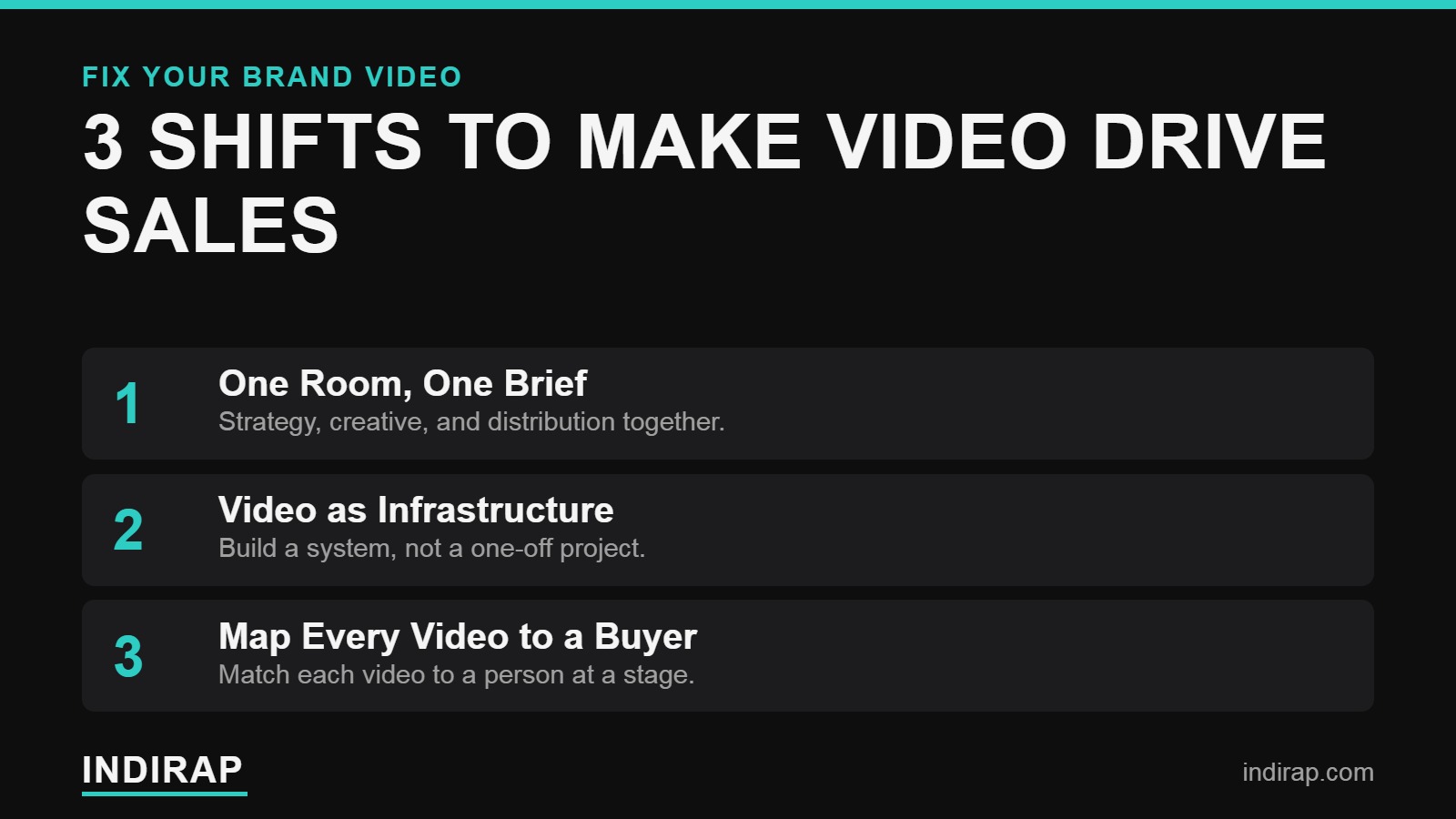
In the video below, INDIRAP founder and CEO Julian Tillotson breaks down the three things that separate the brands compounding pipeline from video and the ones quietly losing six figures a year on content that goes nowhere. You will also get a thirty-second test you can run on any video in your library tonight.
Most brand videos stall for one reason: they were built as a deliverable instead of a system. A beautiful film gets produced, posted to LinkedIn and the homepage, and then nothing pushes it, nothing follows it, and nothing connects it to a buyer. The view count climbs for a week and flatlines.
The brands winning with video right now are not making better videos. They are operating inside a content system where every shoot day extends a library, every asset feeds the next, and nothing dies after one campaign. Over the last decade INDIRAP has delivered more than 20,000 videos to over 900 brands across 40 industries, and the same three patterns explain almost every video that underperforms. Here they are, with the fix for each.
The most common failure mode is not a talent problem. It is an org chart problem. Creative makes a beautiful video, but strategy never shaped the brief, so it is not pointed at a specific buyer or a specific stage. Distribution did not know it was coming, so when it lands there is no plan to put it in front of the right audience at the right moment. The result is a great-looking video that exists in isolation, collects views for a week, and then gets quietly replaced by next quarter's "we should do another video."
Here is a real example. A brand came to INDIRAP about three weeks after finishing a corporate brand film with another agency. The production was genuinely one of the better brand films of the year. When the question came up of who had planned the rollout, the answer was nobody. The film had been delivered to the marketing team, posted to LinkedIn and the homepage, and that was the whole plan. There was no email sequence, no paid amplification, no sales enablement, no CRM integration, and no follow-up content. Two hundred views in the first month, and then it was done.
The fix is not a bigger budget. It is one conversation about strategy, creative, and distribution before the production brief is written. Three people in a room for an hour. That hour is worth far more than the next fifteen thousand dollars of production.
If your team is small enough that these are not separate departments, the silo can still exist between weeks. Strategy in week one, brief in week three, edit in week six, distribution in week eight. By the time the video ships, the original intent has drifted. The cure is the same: align the plan before anyone books a crew.
This is the shift that decides whether you end up owning a content library or spending half a million dollars nobody can trace.
A project starts, ends, delivers, and resets to zero. That is how most brands think about video. Each shoot is its own thing, each campaign is its own thing, and when the campaign ends the video stops working. Infrastructure is different. It gets built once, generates value continuously, and gets extended over time.
Consider two clients. The first did twenty-two video shoots in two years and spent close to a million dollars. When the question came up of which video was their best performer, nobody could answer. The content was scattered, the assets were not tagged, and some of it lived on the hard drive of someone who had already left the company. The second client did six shoot days in two years. Every shoot was planned as content infrastructure for the whole brand ecosystem rather than a one-off project. They walked away with 237 deliverable assets: a brand video, original social content, paid ad creative, photography, B-roll libraries, and long-form YouTube content. All organized, all mapped, all working. Same time horizon, less than half the production budget, and a library that keeps growing the business around the clock.
Neither team was smarter than the other. One treated the work as a project and the other treated it as infrastructure. This is why it is a CFO conversation, not only a marketing one. If you have spent half a million dollars on video over three years and cannot point to a single line in your pipeline that connects back to it, that is an asset structure problem. Real infrastructure builds equity. Project work evaporates.
One red flag to watch for: the meeting where someone shares the year's "video numbers" and everyone nods along even though the numbers do not mean anything. Views, impressions, vague engagement. The useful follow-up questions are simple. How many new customers? How much did inbound increase? How many new hires came from the campaign? When the numbers connect to a buyer, a stage, or a dollar, you have a system. When they do not, you have project numbers.
When the question is "who is this video for" and the answer is "everyone" or "the marketing team" or "potential customers," that is not a target. A real target sounds like this: "a VP of Sales at a mid-market B2B company who has done one video shoot before that did not perform, and is trying to decide whether to run it back or hire differently this time." When the target is that specific, the script writes itself, the platform decision writes itself, and the call to action writes itself.
The second half of the question is the one most teams skip: what do you want them to do after watching? Not "consider us." Not "be aware of us." A real next action. Book a call. Download the worksheet. Reply to the email. Forward it to their boss. If you cannot name that next action in one sentence, the video is decoration rather than content.
Here is the test you can run tonight. It is called the swap test. Pull up your best-performing video and imagine dropping a competitor's logo onto it. If the video would still work for their brand, you do not have a mapped video. You have a category video, and category videos do not move pipeline.
A truly mapped video has language, examples, and a call to action so specific to your business that no competitor could swap their logo in without it falling apart immediately. That is the bar. Most brand videos fail the swap test. The ones that pass are the ones that quietly outperform everyone else's library. Run it on your top video, and whatever fails is the first thing to fix, and you found it for free.
Then ask the harder version for your whole library: if you stopped making videos tomorrow, what would keep working? If the answer is nothing, you do not have a content problem. You have a content infrastructure problem. And systems are fixable.
Turning video into pipeline is a production and structure challenge as much as a creative one, which is exactly where a video-first partner helps. INDIRAP is an award-winning video production company that treats each shoot as infrastructure: one production sprint, a complete content library, every asset connected to a buyer and a stage. We align strategy, creative, and distribution before the brief, plan the shoot day to produce a library instead of a single film, and map each asset to the funnel so your team can measure what it returns.
For the strategy that ties it together, see our content strategy services. For the mechanics of stretching one shoot into a full library, read video content marketing, and for the foundation underneath it all, start with what content marketing is. When you are ready to build a system, our Content Kit packages it into a done-for-you engine. Ready to make your next video actually pay off? Book a strategy call.
Most brand videos stall because they were built as a one-off deliverable rather than part of a system. The video gets produced and posted, but nothing maps it to a specific buyer, nothing distributes it beyond one channel, and nothing connects it to a next action. When you align strategy, creative, and distribution before the shoot and map every asset to a buyer and a stage, the same footage starts producing pipeline.
A project starts, ends, delivers a file, and resets to zero, so the video stops working when the campaign ends. Infrastructure is built once, generates value continuously, and gets extended over time. One client did twenty-two shoots in two years for close to a million dollars and could not name their best video, while another did six planned shoot days and walked away with 237 organized, mapped assets for less than half the budget. The difference was structure, not talent.
The swap test is a thirty-second check: pull up your best-performing video and imagine dropping a competitor's logo onto it. If it would still work for their brand, you have a generic category video that will not move pipeline. A mapped video uses language, examples, and a call to action so specific to your business that no competitor could use it. Whatever fails the test is the first thing to fix.
A mapped video answers two questions clearly. First, who is it for, described specifically enough that you could pick that person out of a room, such as a VP of Sales at a mid-market B2B company deciding whether to invest in video again. Second, what should they do after watching, named as one concrete next action like book a call or reply to the email. If either answer is vague, the video is not mapped yet.
It is less about the number of videos and more about how the shoot is planned. A single shoot day planned as infrastructure can produce dozens of mapped assets that power your funnel for months, while twenty-two unplanned shoots can produce scattered files no one can trace. Plan the day around the full library you want to walk away with, and a few shoots can outperform many.
Measure outcomes tied to a buyer, a stage, or a dollar rather than views and impressions alone. Useful questions include how many new customers, leads, or hires the video contributed to, how much inbound moved, and whether specific pipeline traces back to it. If the numbers connect to revenue, you have a system. If they only describe reach, you have project numbers.
Below is the full transcript of Julian's breakdown, published here so the framework is easy to search, quote, and reference.
Why Your Brand Video Isn't Driving Sales (And How To Fix It)
If you have spent a good chunk of money on a brand video, watched it land at two hundred views, then quietly disappear into the content abyss never to see a dollar back on your investment, I am here to give you the video marketing framework that is going to save you from that ever happening again.
In the next ten minutes I am going to walk you through three things that separate the brands compounding pipeline from video and the ones quietly losing six figures a year on content that goes nowhere. I will tell you about a client who had done twenty-two shoots in two years and could not name their best-performing video. I will give you a thirty-second test you can run on any video in your library tonight to know whether it is actually mapped to a buyer or just expensive decoration. And the third thing is the move almost every marketing leader nods along to and completely fails to apply. Stay with me through that one.
Quick context on who I am and why I am telling you this. I am Julian Tillotson, Founder and CEO here at INDIRAP. Over the last decade, we have delivered over 20,000 videos to 900+ brands across 40 industries. And here is what I have learned: most companies think about video all wrong. They treat it like a one-off project, shoot, edit, post, and cross their fingers. But that is not how content actually works. Today I am going to show you how to create content for your brand that not only looks great, but drives long-term, predictable business growth.
What sets INDIRAP apart is that we do not treat a shoot as a project. We treat it as infrastructure. One production sprint, a complete content library, every asset connected to a buyer and a stage.
So when I tell you the system is broken, I am not theorizing. The brands actually winning with video right now are not making better videos. They are operating inside a content system where every shoot day extends a library, every asset feeds the next, and nothing dies after one campaign. There are three things that separate those systems from the ones that stall.
Here is the first one. Creative, strategy, and distribution living in different silos.
This is the most common failure mode I see, and it is not a personality problem. It is an org chart problem. Creative makes the video. Beautiful work. They are focused on craft. Strategy did not shape the brief, so the video is not pointed at a specific buyer or a specific stage. Distribution did not know it was coming, so when it lands there is no plan to push it to the right audience at the right moment.
The result is a great-looking video that exists in isolation. It gets posted. It collects dust. And next quarter someone says "we should do another video," and the cycle starts again.
Real-life example. We had a client who had just created a brand film with another agency about three weeks before our first call. Beautiful production. Genuinely one of the better corporate brand films I had seen that year. They were proud of it. When I asked who had planned the rollout, the answer was nobody. The agency had delivered the video to the marketing team. The marketing team had posted it to LinkedIn and their homepage. There was no email plan. No paid amplification. No sales enablement assets. No integration into their CRM. No follow-up content. The video was the deliverable. The video was also the rollout. Two hundred views in the first month and it was basically dead in the water after that.
The fix is not bigger budgets. The fix is one conversation about content strategy, creative, and distribution before the production brief is put together. Three brains in a room for an hour. That hour will be worth way more than the next fifteen thousand dollars you spend on production.
And if you are thinking "but our team is small, we do not have those silos," let me push back. The silo does not have to be between departments. It can be between weeks. Strategy in week one, brief in week three, edit in week six, distribution in week eight. By the time the video ships, the original intent has drifted. Same outcome, different cause.
Now this next one is the thing that turns "we keep doing video" into either "we own a content library" or "we burned half a million dollars and nobody can tell what we got." Video gets treated as a project. It should be treated as infrastructure.
A project starts, ends, gets a deliverable, and resets to zero. That is how most brands think about video. Each shoot is its own thing. Each campaign is its own thing. When the campaign ends, the video stops working.
Infrastructure is different. Infrastructure is built once, generates value continuously, and gets extended over time.
This is the client example I mentioned earlier. I worked with a client a couple of years ago who had done twenty-two video shoots in two years. Twenty-two. Spent close to a million bucks. When I asked what their best-performing video was, nobody could answer. The content was living all over the place. The assets were not tagged. Half of them were sitting on someone's hard drive that had left the company.
Compare that to another client. Six shoot days in two years. But every shoot was planned as content infrastructure for their entire brand ecosystem, not a one-off project. They came out of those six days with 237 deliverable assets. Brand video, original social content, paid ad creative, photography, B-roll libraries, and long-form YouTube content. All organized, all mapped, all working.
Same time horizon. Less than half the production budget of the first example, and infinitely more powerful and effective for the brand as a whole. Sales, marketing, HR, and ops all locked and loaded with content that grows the business around the clock.
That is not because one team is smarter. It is because one team treated the work as a project and the other team treated it as infrastructure.
Here is what makes this a CFO conversation, not just a marketing conversation. If you have spent half a million dollars on video over the last three years and you cannot point to a single line in your pipeline that connects back to it, that is not bad luck. That is an asset structure problem. Real infrastructure builds equity. Project work evaporates.
Here is a content red flag you need to watch out for. Have you ever sat in a meeting where someone shared the year's "video numbers" and everyone in the room nodded along even though the numbers did not actually mean anything? Views. Impressions. Vague engagement metrics. Nobody asks the follow-up question, because the follow-up question makes the whole conversation uncomfortable. How many new customers? How much did inbound increase? How many new hires from the campaign? That meeting is a tell. That is the meeting where you find out whether your team has the right perspective when it comes to video strategy. If the numbers do not connect to a buyer, a stage, or a dollar, they are one-off project numbers. Watch for that meeting at your company.
Third thing. The one I told you most marketing leaders nod along to and do not actually fix. The content is not mapped to a specific buyer at a specific stage.
When I ask "who is this video for" and I hear "everyone" or "the marketing team" or "potential customers," that is not a target. That is an excuse.
A real target sounds like this. "A VP of Sales at a mid-market B2B company, who has done one video shoot before that did not perform, and is trying to figure out if they should run it back or hire differently this time." That is specific enough that the script writes itself. The platform decision writes itself. The call to action writes itself.
And then the second half of the question, which most teams skip entirely. What do we want them to do after watching? Not "consider us." Not "be aware of us." A real next action. Book a call. Download the worksheet. Reply to the email. Forward this to their boss. If you cannot name that next action in one sentence, you are not making content. You are just making videos for fun.
Here is the test I promised you at the start. I call it the swap test. If I could take your competitor's logo, drop it into your video, and the video would still work for their brand, you do not have a mapped video. You have a category video. And category videos do not move pipeline.
A truly mapped video has language, examples, and a call to action so specific to your business that no competitor could swap their logo in without it falling apart immediately. That is the bar. Most brand videos fail the swap test. The ones that pass are the ones that quietly outperform everyone else's library. Pull up your best-performing video tonight. Run it through the swap test. If a competitor could use it tomorrow, you know what to fix first.
Here is what I would do tonight. Pull up your best-performing video and run the swap test. Thirty seconds. If a competitor could drop their logo on it and it still works, you have found the first thing to fix, and you found it for free.
Then ask the harder version of the question for your whole library: if we stopped making videos tomorrow, what would keep working? If the answer is nothing, you do not have a content problem. You have a content infrastructure problem. And systems are fixable.
If this was useful, subscribe. I will keep putting out new frameworks that will transform your business into a content powerhouse. And drop a comment with your swap test result. I want to know how it goes.
Keep reading: What Is Content Marketing? · Video Content Marketing · Types of Content Marketing · How to Get Cited by AI With Video
Work with us: Content Strategy · Content Kit · Video Production · Book a strategy call


Julian Tillotson is the Founder & CEO of INDIRAP, a full-service video production and creative strategy agency based in Chicago, IL. With 10+ years of experience, INDIRAP has delivered 20,000+ videos to 900+ clients across 40+ industries, making it one of North America's leading digital creative agencies.


.png)
.png)