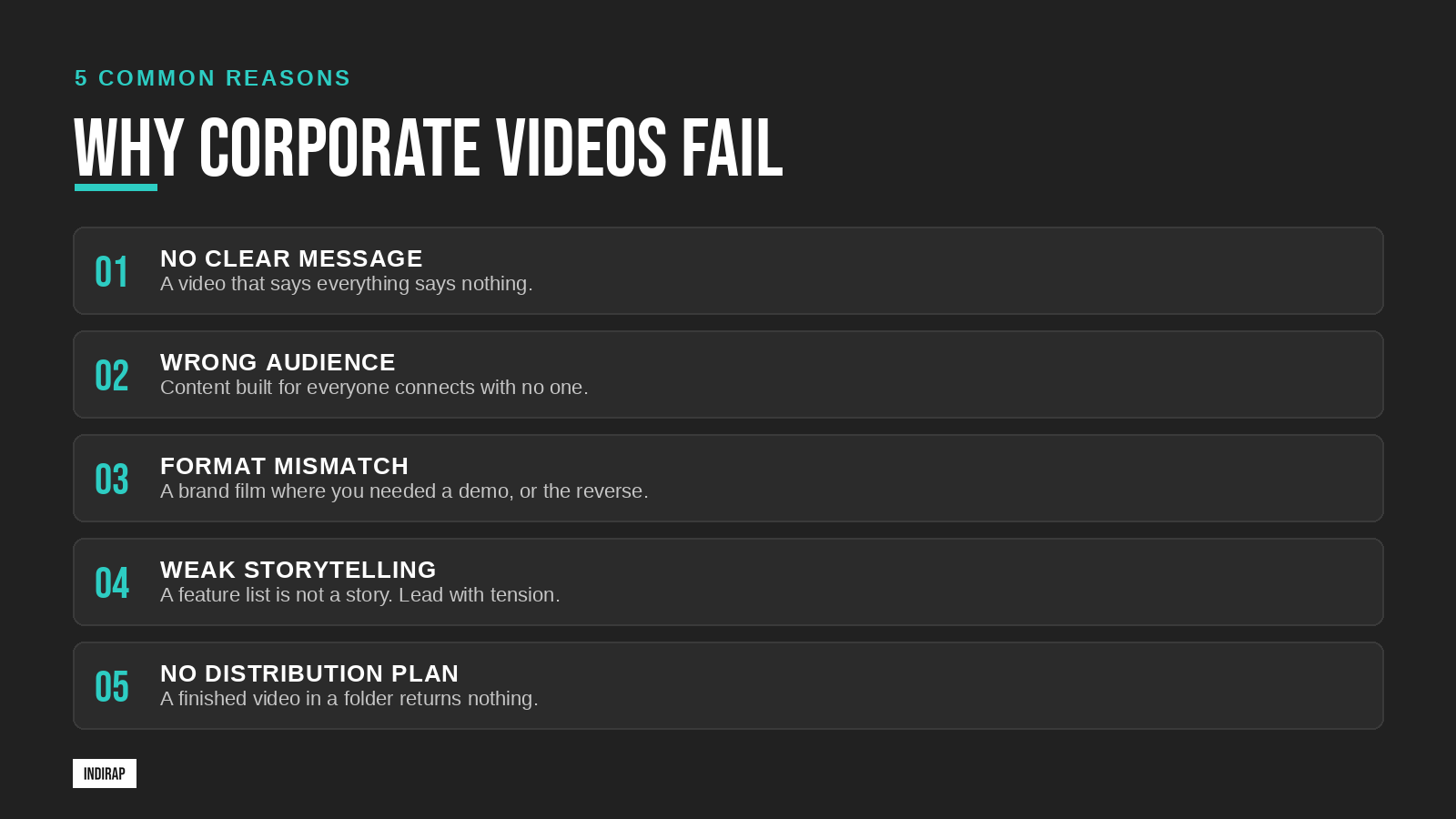
Most corporate videos fail for the same handful of reasons: no clear message, the wrong audience, a mismatched format, weak storytelling, and no distribution plan. None of these are production problems, which is why a more expensive camera, a bigger crew, or a slicker edit almost never fixes a video that is not working. The failure is decided long before the shoot, in the choices about what the video is supposed to say, who it is for, and what happens to it after it is finished. This guide walks through the five reasons corporate video misses, what each one looks like in practice, and the specific fix for each, so you can catch the problem while it is still cheap to fix.
The encouraging part is that every one of these failures is a decision, not a talent gap. A mid-size marketing team with a modest budget and a clear plan will beat a huge budget with a fuzzy plan almost every time. Get the five things below right and corporate video stops being a cost center and starts behaving like a growth asset that compounds.
Failure is rarely dramatic. The video gets made, everyone signs off, it goes on the website or the YouTube channel, and then nothing happens. Views are low, the ones that come in do not finish, and no one can point to a single lead, deal, or hire that the video influenced. Six months later it is quietly replaced. The team concludes that video does not work for them, when what actually happened is that one or more of the five foundations below was missing. Recognizing the pattern is the first step to breaking it.
The most common reason a corporate video fails is that it tries to say everything at once. It opens with the company history, pivots to the product, lists every feature, mentions the mission, and closes with three different calls to action. A video that tries to say everything says nothing, because the viewer has nothing to hold onto and nothing to remember.
The fix is one message per video. Before anything else, write a single sentence that captures the one thing the viewer should believe or feel after watching. Not three things, one. If you cannot say it in a sentence, the video is not ready to make. Everything in the script, the visuals, and the edit should support that one sentence, and anything that does not support it comes out, however good it looks. A useful test: if you removed a scene and the core message still lands, that scene was decoration, not message. Most failing videos are ninety percent decoration.
This discipline also makes approval faster. When a stakeholder asks to add a point, you can hold it against the one message and decide together whether it belongs, instead of saying yes to every request and ending up with a video that pleases the committee and moves no one.
The second failure is building a video for everyone, which means building it for no one. Content aimed at the entire market speaks in generalities, and generalities do not persuade. A chief financial officer, a procurement lead, and an end user all care about different things, and a video that tries to reassure all three at once reassures none of them.
The fix is to define one buyer and the exact moment they are in. Name the person: their role, the problem on their desk this week, and what they are secretly worried about. Then decide which stage of the journey the video serves, because awareness, consideration, and decision each call for a different video. An awareness video earns attention from someone who does not yet know they have a problem. A consideration video makes the case to someone comparing options. A decision video removes the last doubt for someone ready to act. Trying to collapse all three into one video is why so many corporate videos feel generic. Pick the buyer, pick the moment, and speak only to them. Paradoxically, the more specific you get, the more people it resonates with, because specificity reads as understanding.
The third failure is a mismatch between what the video needs to do and the format chosen to do it. A sweeping brand film is the wrong tool when the buyer needed to see the product work, and a dry screen recording is the wrong tool when the buyer needed to feel something about the brand. Teams often default to whatever format is in fashion rather than the one the job requires.
The fix is to match the format to the message and the stage. A short menu of corporate video formats and when each one earns its place:
The format should serve the message, never the other way around. When you start from the job to be done and work backward to the format, the mismatch disappears.
The fourth failure is treating a video as a list of information rather than a story. A feature list set to music is not a story, and the viewer feels the difference immediately even if they cannot name it. Without tension, there is nothing to pull them through, and they leave.
The fix is to lead with a tension the viewer actually feels, then resolve it. Every strong corporate video, whatever the format, follows a simple arc: here is a real problem you recognize, here is what becomes possible when it is solved, here is how. Open on the problem, not on your logo. Make the viewer nod before you make your case. Then show the shift, and let your product or service be the thing that causes it, rather than the hero of every frame. The brand that wins is the one that makes the customer the hero and positions itself as the guide. Concretely, that means cutting the thirty-second company intro, starting in the middle of the problem, and earning the right to talk about yourself by first proving you understand the viewer.
The fifth failure is the quietest and the most common: a good video is finished, saved to a folder, posted once, and then left to fend for itself. A finished video that no one sees returns nothing, no matter how good it is. Teams routinely spend the entire budget on production and nothing on getting the video in front of the right people.
The fix is to plan distribution before the shoot, and to budget for it. A practical rule is to reserve thirty to forty percent of the total budget for distribution, because a strong video with real distribution beats a bigger video with none. Decide up front which channels the video will run on, which paid campaigns will carry it, and how it will be cut for each platform. Plan the native versions for LinkedIn and paid social, the short hooks that drive to the full piece, and the places it will live on your own site and in your sales process. For the full approach to turning one shoot into paid and social cuts, see our guide to B2B video for paid social and repurposing. Distribution is not an afterthought you bolt on when the edit is done; it is a decision that shapes how the video is shot and cut in the first place.
Read the five back to back and the pattern is clear: every one of them is a strategy or distribution decision, and none of them is a camera. That is why a more expensive production so rarely rescues a weak video, and why a disciplined plan so often rescues a modest one. The teams that win with corporate video are not the ones making the most videos or spending the most money. They are the ones treating each video as part of a system, with a clear message, a defined buyer, the right format, a real story, and a distribution plan in place before anyone picks up a camera. If volume is your challenge, our guide to scaling corporate video covers how to keep quality high as output rises.
Before you greenlight the next corporate video, run it against this short list. If you cannot answer all six, the video is not ready to shoot:
Most failing videos would have been caught by question one or question five. Answering all six before the shoot is far cheaper than discovering the gap after the edit is locked.
Rarely. A larger budget spent on an unaligned video just produces a more expensive miss, because production value cannot carry a video that has no clear message, no defined audience, and no distribution. The better investment is to spend on strategy and distribution first, and to let the production scale to match a plan that is already sound. A clear, well-distributed video at a modest budget will outperform a beautiful, aimless one almost every time.
At INDIRAP, we start every corporate video with the five foundations above, then plan the shoot as infrastructure rather than a one-off, so a single production yields a hero piece plus the explainer, testimonial, and social cuts your funnel needs, each mapped to a buyer and a stage, with distribution planned from the start. That is the difference between a video that sits in a folder and one that drives leads and trust for months. For the strategy side of this, see our guide to corporate video brand alignment, explore our corporate video production work and the full-funnel content engine, or book a strategy call to pressure-test your next video before you shoot it.
Why do most corporate videos fail?
Most corporate videos fail because of no clear message, the wrong audience, a mismatched format, weak storytelling, or no distribution plan. These are strategy and distribution problems decided before the shoot, not production problems, which is why a bigger budget rarely fixes them.
Does a bigger budget fix a failing corporate video?
Rarely. A larger budget on an unaligned video just produces a more expensive miss. Fix the message, the audience, and the distribution first, then scale the production to match a plan that already works.
How do you know if a corporate video will fail before you shoot it?
Run it against a short checklist: can you state the one message in a sentence, name the one buyer and their moment, match the format to the job, open on a real tension, and name the channels and budget for distribution. If you cannot answer all of those, the video is not ready.
What is the most common corporate video mistake?
Trying to say everything to everyone in one video, which produces a polished piece with no single message and no defined audience, so it looks good but moves no one.
How much of a video budget should go to distribution?
Reserve roughly thirty to forty percent for distribution. A strong video with real distribution outperforms a larger production that no one sees, because reach is what turns a finished file into results.
How do you make a corporate video that performs?
Align the message, audience, format, and business goal, tell a real story that opens on a tension the viewer feels, and plan paid and organic distribution before filming so the finished video actually reaches the right buyers.


Julian Tillotson is the Founder & CEO of INDIRAP, a full-service video production and creative strategy agency based in Chicago, IL. With 10+ years of experience, INDIRAP has delivered 20,000+ videos to 900+ clients across 40+ industries, making it one of North America's leading digital creative agencies.