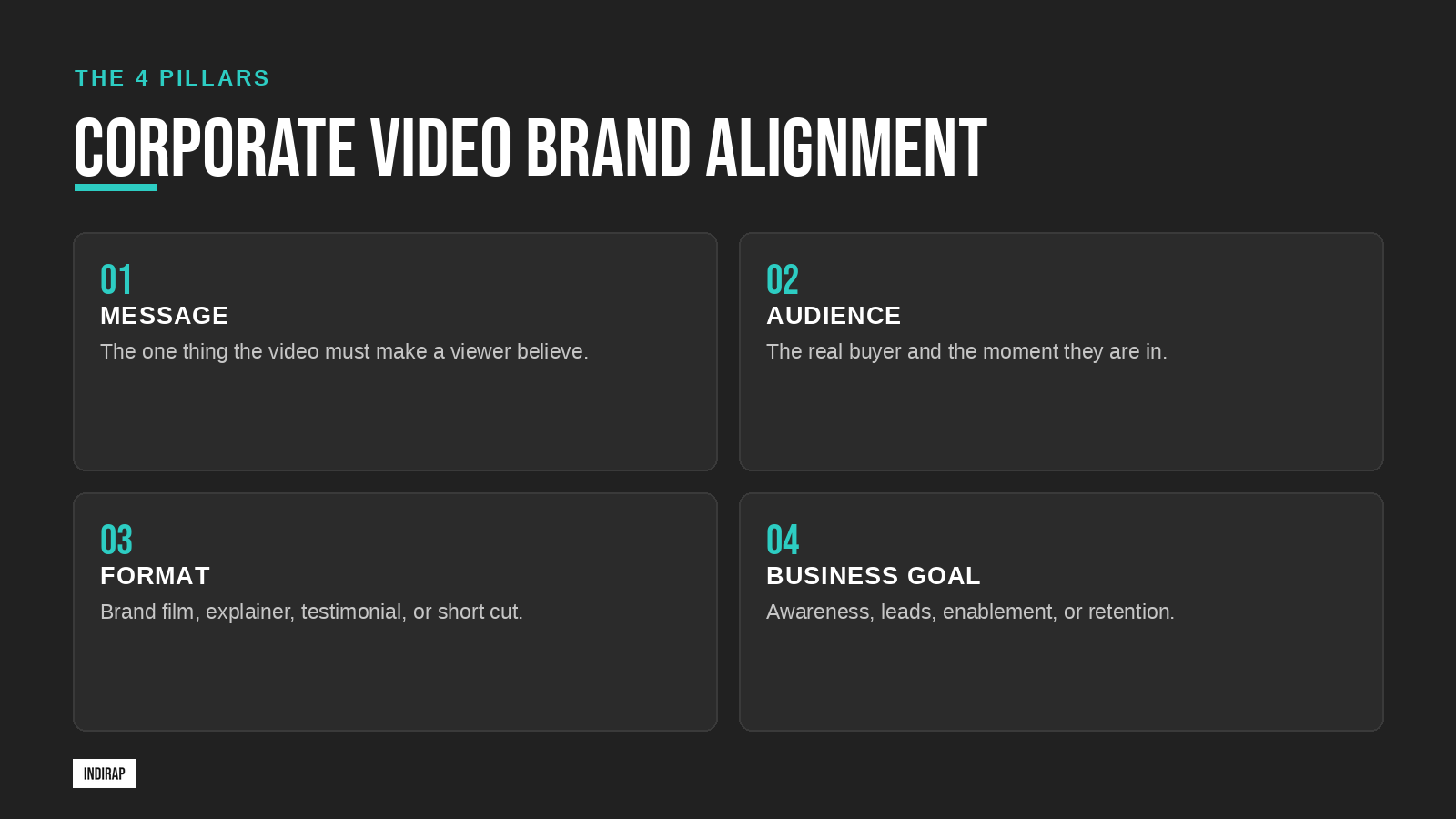
Corporate videos underperform when they drift from brand strategy. A video aligned to a clear message, a defined audience, the right format, and a business goal performs; a technically excellent video with none of those does not. Brand alignment is what turns video from a line item into a lever, because an aligned video reinforces everything else your brand is saying instead of adding noise to it. This guide breaks down the four dimensions of corporate video brand alignment, how to get each one right, and how alignment shows up in the numbers that matter.
The reason alignment beats production value is simple. Buyers do not remember individual videos; they remember a cumulative impression of your brand built from every touch. When each video points the same direction, those impressions stack into trust. When videos pull in different directions, each one quietly undercuts the last, and the money you spend making them works against itself. Alignment is how you make the budget compound.
It is tempting to judge a corporate video by how it looks: the camera work, the color grade, the motion graphics. Those things matter, but they are the last twenty percent, not the first eighty. A beautifully produced video built on a fuzzy message, aimed at no one in particular, in the wrong format for the job, with no business goal attached, will still fail. The reverse is also true: a modestly produced video that is sharply aligned on all four dimensions will often outperform a far more expensive one. Production value amplifies alignment; it cannot replace it. So the work of making video pay starts upstream of the shoot, in four decisions.
Alignment starts with message. Decide the single thing the video must make the viewer believe or feel, and commit to it before anything else is scoped. One video, one message. Everything else, the script, the visuals, the music, the edit, exists to support that one idea, and anything that does not support it is cut.
The discipline here is subtraction, not addition. Most corporate videos fail not because they are missing something but because they are carrying too much: a second theme, a third feature, a stakeholder's pet point. Write the message as one sentence and hold every creative choice against it. If a scene does not move the viewer closer to believing that one thing, it is decoration, and decoration dilutes. A tightly messaged ninety-second video will outperform a crowded three-minute one almost every time, because the viewer leaves with something they can repeat.
Message alignment also keeps the video consistent with the rest of your brand. The claim the video makes should be the same claim your website, your sales deck, and your campaigns make, phrased the same way. That repetition is not laziness; it is how a brand becomes memorable and, increasingly, how AI engines learn to describe you accurately when buyers ask.
The second dimension is audience, and the mistake to avoid is defining it too broadly. A video for everyone speaks to no one. Go past demographics to the real buyer: their role, the decision in front of them, and the worry underneath it. Then pin down the moment in the journey the video serves.
Awareness, consideration, and decision each call for a different video, with a different message and a different tone. At awareness, the buyer may not yet know they have the problem, so the video has to earn attention and name the tension. At consideration, they are weighing options, so the video has to make the case and build trust. At decision, they are nearly ready, so the video has to remove the last doubt, often with proof. A single video that tries to serve all three stages ends up serving none, because the message that fits one stage is wrong for the others. Pick the buyer, pick the stage, and let the specificity do the persuading.
The third dimension is format. The format is not a style choice; it is a function of what the video needs to accomplish for that buyer at that stage. A brand film builds belief and is right for awareness. An explainer clarifies a complex offering and is right for consideration. A demo shows the product working and is right late in the journey. A testimonial or case study supplies peer proof and is right when trust is the obstacle. A short social cut distributes the idea and drives reach at the top of the funnel.
Alignment means the format serves the message, not the other way around. When teams start from a format they want to make, a slick brand film, say, and then reverse-engineer a reason for it, the result feels hollow because the form does not fit the job. Start from the message and the moment, and the right format becomes obvious. One more alignment note: the format should match where the video will actually be watched. A film built for a dark conference room plays very differently in a muted LinkedIn feed, and a video aligned to its channel is cut accordingly.
The fourth dimension is the business goal, and it is the one teams skip most often. Tie the video to a specific outcome before you make it: brand awareness, lead generation, sales enablement, or customer retention. If you cannot name the goal, you cannot measure the return, and a video with no measurable goal is impossible to defend when budgets get reviewed.
Naming the goal also changes how the video is made. A video built for lead generation needs a clear next step and a way to capture intent. A video built for sales enablement needs to answer the objections that stall deals and live where the sales team can reach for it. A video built for retention speaks to existing customers, not prospects. The goal is not a label you add at the end; it shapes the script, the call to action, and the distribution from the start.
Message, audience, format, and goal are not a checklist to tick independently; they are four facets of a single decision. The message is shaped by who the audience is and what stage they are in. The format is chosen to deliver that message to that audience. The goal determines what the video asks the viewer to do and how you will know it worked. When all four line up, the video feels inevitable, like the only video you could have made for that job. When even one drifts, the whole thing loses force, which is why alignment is best treated as one discipline rather than four separate ones.
Before you approve a corporate video concept, confirm all four are locked:
If any answer is vague, align it before you scope the shoot. Alignment is cheap to fix on paper and expensive to fix in the edit.
Aligned video does not just feel more coherent; it performs measurably better. Because each piece reinforces one coherent brand story, aligned video tends to lower cost per lead, shorten the sales cycle, and compound in value over time as the impressions stack. A consideration-stage explainer that answers the real objection moves more deals forward than a generic overview. A sales-enablement video tied to a named goal gets used by the sales team instead of forgotten. And a library of aligned videos, each mapped to a buyer and a stage, becomes an asset that keeps working long after the production cost is paid, rather than a series of one-off expenses. When you plan one shoot to feed that whole library, see our guide to scaling corporate video.
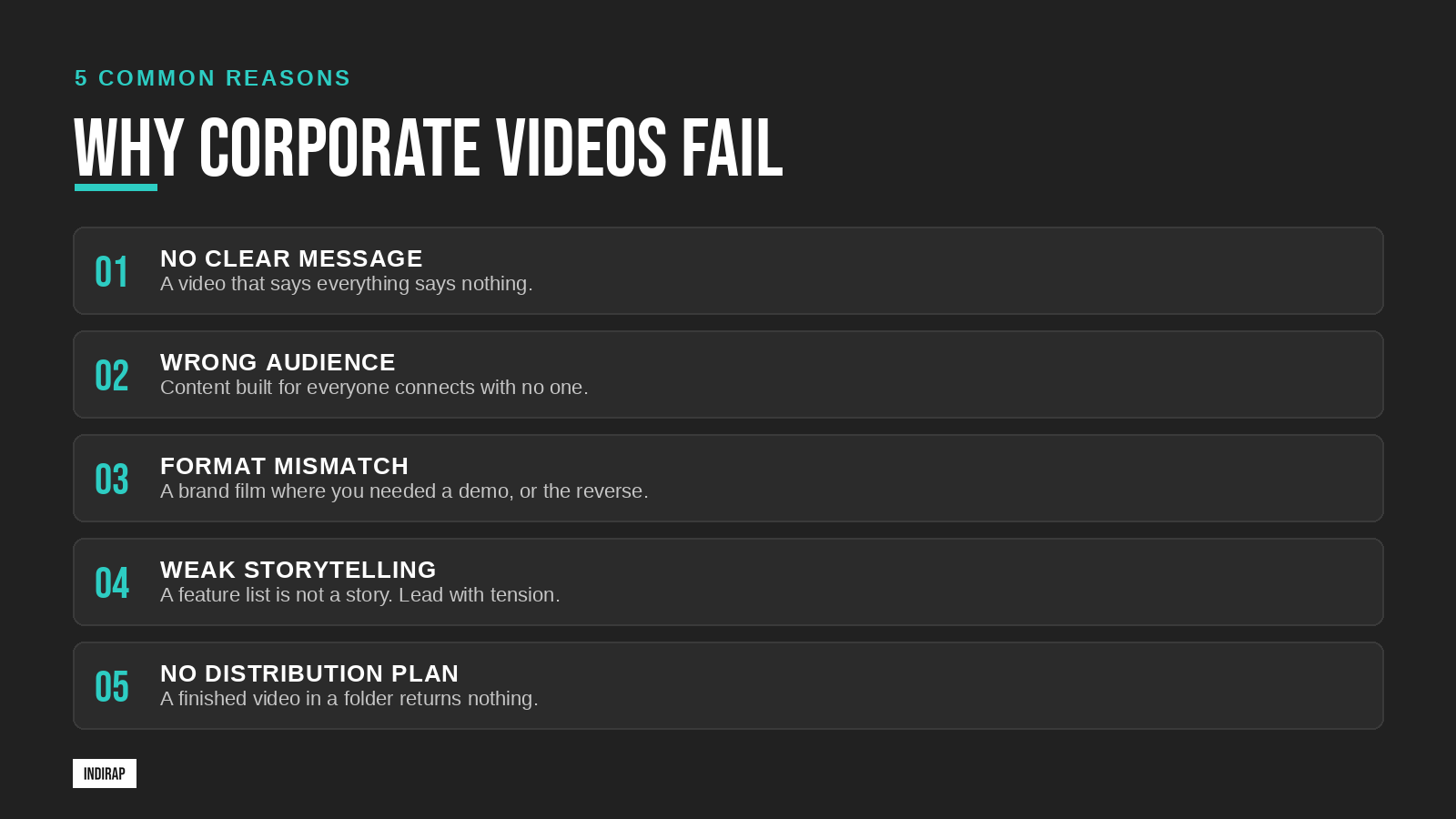
A few patterns show up again and again. The first is the everything video, which tries to carry three messages for three audiences and lands none. The second is the vanity film, chosen for how it will look rather than the job it has to do. The third is the goalless video, made because it felt like time for a new one, with no outcome attached. The fourth is the orphaned video, aligned on message and format but never given a distribution plan, so no one sees it. Each of these is an alignment failure, and each is avoidable by locking the four dimensions before production starts. For the full breakdown of how misaligned videos miss, read our guide to why corporate videos fail.
At INDIRAP, alignment is the first step, not an afterthought. We define the message, the buyer, the format, and the business goal before we scope a shoot, then plan the production as a system so one shoot yields a library of aligned assets mapped to every stage of the funnel, with distribution built in. That is how video becomes predictable growth rather than a recurring cost. See the approach in our corporate video production work and the full-funnel content engine, or book a strategy call to align your next video before you shoot it.
Why do corporate videos fail to support brand strategy?
They drift from a clear message, a defined audience, the right format, or a measurable business goal. Alignment on all four is what makes video reinforce the brand instead of adding noise, so missing even one dimension undercuts the result.
How do you align a corporate video with brand strategy?
Define the one message, the specific buyer and stage, the format that serves that message and that channel, and the measurable business goal, all before you scope the shoot. Treat the four as one decision rather than four separate ones.
What is the most common corporate video mistake?
Producing a polished video with no defined message or goal, so it looks good but moves no one. The fix is to lock the message and the business outcome before production starts.
Does brand alignment matter more than production quality?
Yes. Production value amplifies an aligned video but cannot rescue a misaligned one. A sharply aligned video at a modest budget usually outperforms a beautiful one with a fuzzy message and no goal.
How does aligned video improve marketing results?
Because each piece reinforces one coherent story, aligned video tends to lower cost per lead, shorten the sales cycle, and compound over time, turning a series of one-off productions into an asset library that keeps working.
How many messages should one corporate video carry?
One. A single, clear message that the viewer can repeat beats a crowded video that tries to say several things, because memory and persuasion both reward focus.


Julian Tillotson is the Founder & CEO of INDIRAP, a full-service video production and creative strategy agency based in Chicago, IL. With 10+ years of experience, INDIRAP has delivered 20,000+ videos to 900+ clients across 40+ industries, making it one of North America's leading digital creative agencies.