
The single biggest reason executive personal brands fail is not lack of expertise or lack of ideas. It is the absence of a system. Without a system, content creation feels like starting from scratch every week -- and for a founder or CEO managing a company, that friction is enough to kill the habit entirely.
Content buckets solve that problem. They give your executive personal brand a repeatable architecture: a defined set of topic categories and content types that you rotate through, rather than reinvent each time you sit down to post. Once you have your buckets, you are not asking "what should I post today" -- you are asking "which bucket is this from, and what specific angle am I taking?"
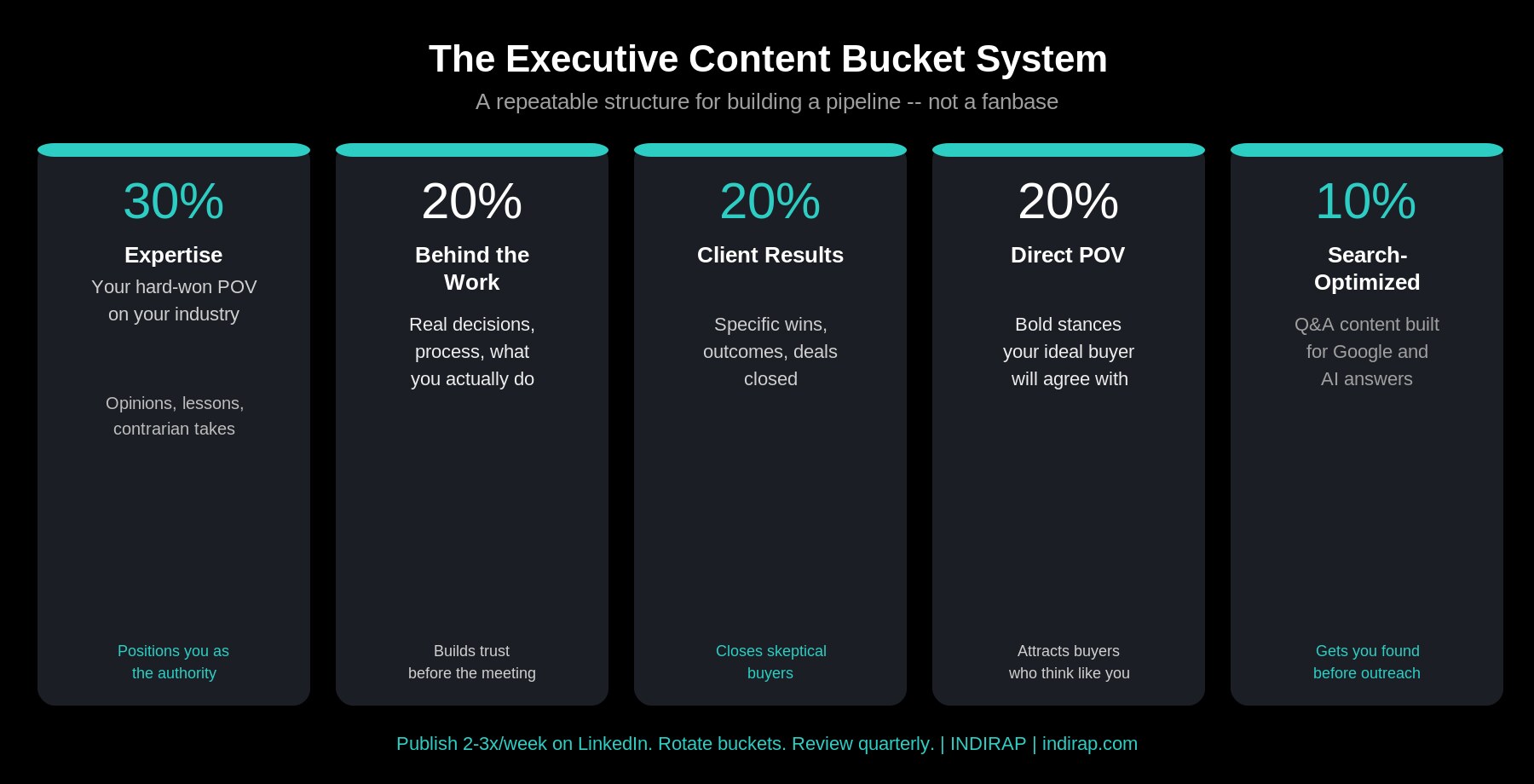
Content buckets are recurring topic categories that define the range of things you talk about publicly. Every piece of content you produce -- every LinkedIn post, video, article, or email -- belongs to one of your buckets. The buckets are broad enough to give you creative flexibility but specific enough to keep your presence coherent and recognizable.
An executive without content buckets produces scattered content: a book recommendation one week, a company announcement the next, an industry observation the week after. A buyer scrolling their feed cannot tell what this executive stands for or why they should care. An executive with content buckets has a recognizable point of view that shows up consistently -- and that consistency is what builds credibility with prospective clients over time.
This is your primary bucket and the one that does the most heavy lifting for business development. Expertise content shares a specific opinion, challenges a widely held assumption in your industry, or teaches something that took you years to learn. This is not general advice -- it is the kind of perspective that only someone with your specific experience and position could offer.
Examples for a CEO or founder: "Why most companies hire the wrong first VP of Sales," "What 10 years of running client projects taught me about scope creep," "The corporate video brief mistake that costs companies six figures in reshoots." Each of these establishes you as someone worth listening to -- not because of your title, but because of what you actually know.
Decision-makers and buyers want to know what it is actually like to work with you. Behind-the-work content gives them access to your process, your standards, and the texture of how you operate. It is the most humanizing category -- the one that converts a professional acquaintance into a prospective client who feels like they already know you.
Examples: A real client challenge and how you approached it. The decision-making process behind a recent strategic move. What a production day with your team looks like and why you run it the way you do. This category works especially well as short-form video -- a 60-second walk-through of what a brand photography session produces, for example, outperforms a written post describing the same thing because the buyer can see it rather than imagine it.
Before a buyer reaches out, they need evidence that you have solved a problem like theirs for someone like them. Client result content provides that evidence in a format that is honest and specific rather than generic and promotional. This is the bucket that directly supports business development because it answers the most common objection: has this worked before, for companies in my situation?
Examples: A specific engagement outcome with context about what made it difficult. A client testimonial video where the client describes the result in their own words. A before-and-after case summary that shows the actual problem, your approach, and the measurable result. Brand video case studies with the client's voice are particularly effective because they shift the credibility claim from you to an independent third party -- which is a far more persuasive position.
This is the bucket where you put a stake in the ground. Point of view content states what you believe -- specifically, not diplomatically -- about something relevant to your buyers. It is the most engagement-generating category because a genuine, specific opinion invites response. It is also the clearest signal of your positioning: the executives with the sharpest points of view attract the buyers who most want that specific perspective.
Examples: "The standard pitch deck format is making agencies look identical -- here is what we do instead." "Corporate training videos fail because companies confuse production value with learning design." "Most CEOs are building their LinkedIn presence for the wrong audience." These posts should make some people disagree. If your point of view content generates universal agreement, it is probably not specific enough to do any work.
This is the most overlooked bucket for executives -- and one of the highest-leverage ones for building inbound pipeline over time. Search-optimized content is designed to be found by buyers who are actively looking for what you offer, not just to be seen by existing connections in their feed.
In 2026, AI assistants and search engines increasingly answer buyer questions directly. The executives who show up in those answers are the ones who have published clear, structured responses to the questions their buyers are actually searching for. "What does a corporate video production company charge?" "How do I prepare for a brand photography session?" "What should I look for in an executive branding consultant?" A direct, well-written answer to each of these establishes your credibility with both human and AI search. This connects to the broader goal of social media content that builds discoverability rather than just engagement.
A 90-day plan removes the daily decision about what to post. For most executives, two to three posts per week on LinkedIn is sustainable and effective -- that is 24 to 36 posts over 90 days. Distribute those across your five buckets: roughly 30% expertise, 20% behind the work, 20% client results, 20% direct POV, and 10% search-optimized content. Batch-create topics within each bucket in a single focused session rather than producing one piece at a time. Add video to your highest-performing written posts. Review what drove actual business outcomes -- discovery calls, direct messages, referrals -- at the end of 90 days, and adjust your bucket weights accordingly.
Content buckets do not tell you what to say. They tell you what category to draw from. The specific angle, the hard-won example, the honest observation that makes the content worth reading -- that comes from you. Buckets are a system for organizing your existing expertise, not a substitute for having something real to say.
This is Post 3 in INDIRAP's Executive Personal Branding series. Read what executive personal branding is and why it matters, or continue to the executive branding mistakes that cost you deals.
Watch + Learn
Watch INDIRAP break down content strategy for executives and founders -- content buckets, batch creation, and 90-day planning that builds a client pipeline.
▶ Subscribe on YouTube -- watch full executive content strategy sessions -- bucket planning, batch creation, LinkedIn cadence
▶ Instagram Reels -- see how INDIRAP helps executives and founders build a repeatable content system that generates leads
▶ YouTube Shorts -- 90-second breakdowns of the executive content bucket system -- how to post without burning out
Content buckets are recurring topic categories that give an executive's public content a consistent structure. Instead of generating a new idea from scratch each time, you rotate through a defined set -- expertise, behind the work, client results, direct POV, and search-optimized content -- giving your presence a recognizable rhythm that builds credibility with prospective buyers over time.
Five buckets is the right number for most business leaders. Fewer than three makes your content feel repetitive to buyers who follow you closely. More than six makes the system too complex to maintain alongside running a company. Five buckets provide enough range to stay interesting while keeping your positioning sharp and coherent.
Two to three times per week is the optimal LinkedIn cadence for most founders and executives. It is frequent enough to build algorithm favorability and stay visible to prospective buyers, but manageable enough to sustain without a dedicated content team. Consistency over months matters far more than posting frequency in any single week.
Avoid generic motivational content that says nothing specific, company announcements that read like press releases, congratulatory posts that provide no value, and content designed to maximize engagement rather than attract buyers. If your content would be equally at home on any executive's LinkedIn page, it is not doing work for your specific positioning.
Start with your publishing cadence (2-3 posts per week). Divide across five buckets using a 30/20/20/20/10 split. Batch-create 8-12 specific topic angles within each bucket in a single session. Layer in video for your highest-value expertise and client result posts. Review at 90 days which content drove actual business outcomes -- meetings booked, direct messages, referrals -- and adjust bucket weights accordingly.


Julian Tillotson is the Founder & CEO of INDIRAP, a full-service video production and creative strategy agency based in Chicago, IL. With 10+ years of experience, INDIRAP has delivered 20,000+ videos to 900+ clients across 40+ industries, making it one of North America's leading digital creative agencies.


.png)
.png)