Statistics do not make the case for video on their own, but they do settle the argument about whether it works. Year after year the data points the same direction: video is now the default way buyers research, decide, and trust. Below are the video marketing statistics that actually matter in 2026, grouped by what they tell you, drawn from Wyzowl's annual State of Video Marketing report and a range of industry conversion studies, with a short takeaway after each section.
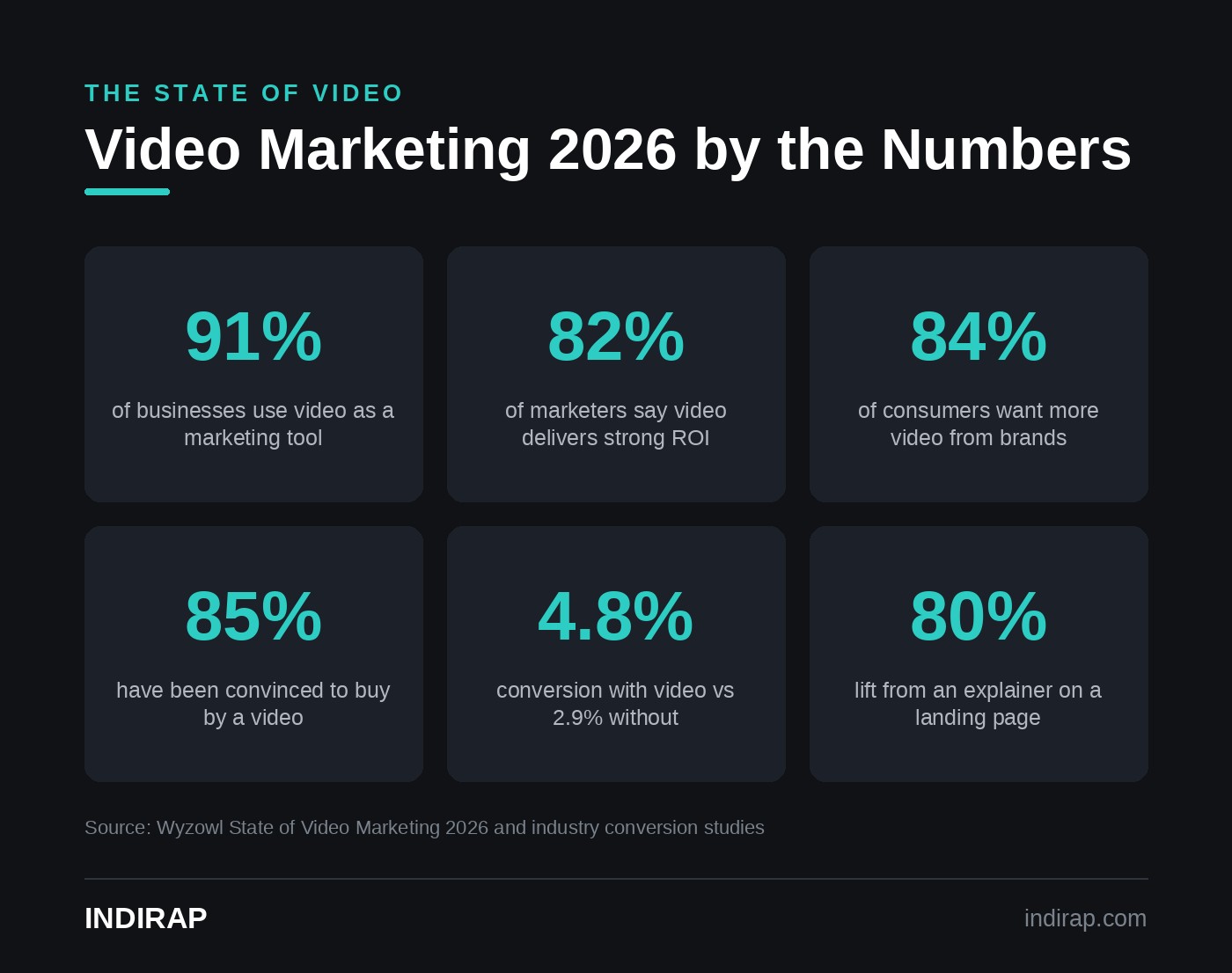
91 percent of businesses use video as a marketing tool, back to an all-time high. 93 percent of video marketers say video is an important part of their overall strategy. Marketers continue to favor YouTube, Instagram, Facebook, LinkedIn, and webinars as the channels that drive the most success.
Takeaway: video is no longer a differentiator, it is the baseline. The question is not whether to use video but whether yours is good enough to stand out.
82 percent of marketers say video gives them a good return on investment. 93 percent say video has increased user understanding of their product or service. 93 percent say it has increased brand awareness. 85 percent say video has helped them generate leads. 83 percent say video has directly increased sales. 82 percent say it has increased web traffic.
Takeaway: the ROI case is broad, not narrow. Video moves understanding, awareness, leads, sales, and traffic at the same time, which is why it tends to outperform single-purpose tactics.
84 percent of consumers want to see more video from brands, a figure that has stayed remarkably steady for years. 89 percent of consumers say the quality of a video impacts their trust in the brand behind it. 85 percent of people say they have been convinced to buy a product or service by watching a video.
Takeaway: audiences are asking for more video, but quality is a trust signal. A cheap-looking video can do more harm than no video at all, which is why production value is a business decision, not a vanity one.
Sites that use video convert at around 4.8 percent on average, compared with 2.9 percent for sites that do not. Adding an explainer video to a landing page can lift conversions by roughly 80 percent. Almost 90 percent of visitors stay longer on a page that has video, and that increased dwell time is also a positive SEO signal.
Takeaway: video earns its keep twice, once by converting more of the visitors you already have, and again by helping the page rank so you get more visitors in the first place. We break that mechanism down in our guide to video SEO and AEO.
71 percent of people believe videos between 30 seconds and two minutes are the most effective. Short-form video continues to dominate attention across LinkedIn, Instagram, and YouTube Shorts, while longer formats hold their value for education and search.
Takeaway: most of your marketing video should be short and focused. Lead with the point, respect the viewer's time, and save long-form for content people are actively searching to learn.
The statistics agree on a simple conclusion: video works, audiences expect it, and quality decides whether it builds trust or erodes it. The brands pulling ahead are not the ones making the most videos, they are the ones treating video as a system, produced well, optimized to be found, and distributed consistently. As a full-service video production company, INDIRAP builds that system, and our Content Kit turns a single production sprint into a full library of high-quality, on-brand video.
Watch + Learn
See how the data translates into content that actually performs.
▶ Subscribe on YouTube for video marketing breakdowns
▶ Instagram Reels for quick video strategy tips
According to Wyzowl's 2026 State of Video Marketing report, 91 percent of businesses use video as a marketing tool, an all-time high, and 93 percent of video marketers consider it an important part of their overall strategy.
Yes. 82 percent of marketers say video gives them a good return on investment, and large majorities credit video with increasing product understanding, brand awareness, leads, sales, and web traffic. The ROI case spans the full funnel rather than a single metric.
Yes. 84 percent of consumers say they want to see more video from brands, a figure that has held steady for years, and 85 percent say a video has convinced them to buy a product or service. 89 percent say video quality affects their trust in the brand.
Sites that use video convert at around 4.8 percent on average versus 2.9 percent for those that do not, and adding an explainer video to a landing page can lift conversions by roughly 80 percent. Video also increases time on page, which supports SEO.
71 percent of people say videos between 30 seconds and two minutes are most effective. Short-form video performs best for social and awareness, while longer formats remain valuable for education and search-driven content.
This is part of INDIRAP's video marketing and SEO guide series.


Julian Tillotson is the Founder & CEO of INDIRAP, a full-service video production and creative strategy agency based in Chicago, IL. With 10+ years of experience, INDIRAP has delivered 20,000+ videos to 900+ clients across 40+ industries, making it one of North America's leading digital creative agencies.


.png)
.png)