Corporate storytelling is the practice of using narrative structure to communicate a company's identity, mission, and value in a way that resonates with employees, customers, investors, and the public. Unlike traditional marketing, which leads with products and promotions, corporate storytelling leads with people, purpose, and proof. It is how organizations build trust at scale.
Corporate storytelling is not a buzzword. It is a discipline. At its core, it is the practice of organizing the true, human elements of your business, your origin, your people, your customers' transformations, and your mission, into a coherent narrative that others can understand, remember, and repeat.
Every company has a story. The question is whether that story is being told intentionally or left to chance. When it is left to chance, the story that gets told is usually shallow: a list of services, a boilerplate about page, and a collection of disconnected marketing messages. When it is told intentionally, a company story becomes a strategic asset that drives every function in the business, from sales and recruiting to investor relations and customer loyalty.
The companies that grow fastest are almost always the ones that have figured out how to make people care. And making people care requires story. It requires a clear sense of who you are, who you serve, and why the work you do matters in the world.
A lot of companies confuse marketing messaging with corporate storytelling. They are related, but they are not the same thing. Here is how to tell them apart.
Traditional marketing messaging is product-centric. It answers: "What does this do?" Corporate storytelling is people-centric. It answers: "Who does this help, and how does their life change because of it?" The shift from product to person changes the entire emotional register of your communication.
Marketing messaging is optimized to persuade. Corporate storytelling is optimized to connect. That distinction shows up in tone immediately. Promotional language signals that something is being sold. Authentic narrative signals that something real is being shared. Buyers in 2026 are extremely good at detecting the difference, and they respond accordingly.
Marketing messaging is often evaluated on click-through rates and conversion percentages. Those are legitimate metrics. But corporate storytelling operates on a longer timeline. Its goal is to create the conditions under which conversion becomes easy, because trust is already present. Think of corporate storytelling as the infrastructure that makes all your marketing more effective.
Marketing messaging lives in ads, landing pages, and email subject lines. Corporate storytelling lives everywhere: your website's about page, your pitch deck, your brand video, your leadership's social content, your onboarding materials, and your internal comms. It is not a campaign. It is a system.
Good marketing messaging produces a transaction. Good corporate storytelling produces a relationship. And relationships produce repeat business, referrals, word-of-mouth growth, and the kind of brand equity that is almost impossible for competitors to replicate. That is the compounding return on investing in story.

One of the most useful ways to think about corporate storytelling is as a layer that runs underneath every channel in your communications stack. Here is where it shows up most visibly.
Most about pages read like a company profile from a trade directory. A great about page reads like the first chapter of a book you want to keep reading. It introduces the people behind the business, names the problem they set out to solve, and gives the reader a clear sense of what it feels like to work with you. This is ground zero for your corporate story.
Investors do not fund spreadsheets. They fund founders who can articulate a vision compellingly enough that they want to be part of it. A pitch deck built around a narrative arc, the world as it was, the problem you identified, the solution you built, and the traction you have earned, is consistently more persuasive than one that leads with market size and unit economics.
Video is the most efficient format for corporate storytelling because it combines every element of story at once: the spoken word, the visual proof, the music and tone, and the faces of real people. A two-minute brand video can communicate in emotional depth what a ten-page document cannot. It is also the format that travels best across platforms, from your website to your sales outreach to your social channels.
Example: Dove Real Beauty Sketches (2013) -- one of the most cited examples of customer-centered corporate storytelling:
Your content strategy should be an extension of your corporate story. Every post, article, and video is an opportunity to reinforce who you are, what you believe, and who you serve. When content is disconnected from a core narrative, it performs poorly and accumulates without building anything. When it flows from a documented story, it compounds.
Corporate storytelling is not only external. The companies with the strongest cultures are the ones that tell their story internally as well as externally. New employee onboarding, all-hands meetings, and team updates that reinforce the company's origin, mission, and values are all forms of corporate storytelling. When your team understands the story, they become its most authentic ambassadors.
Here is something most startup founders do not realize: you have a storytelling advantage over every Fortune 500 company on your competitive landscape. Not in budget. Not in production quality. In authenticity.
Large corporations have legal teams, brand committees, and approval processes that sand down every rough edge in their communications. The result is often messaging that is technically correct but emotionally inert. It does not feel like anything because it was designed by committee to offend no one.
Startups do not have that problem. You have a founder who took a real risk. You have a team that chose a scrappy, growing company over a stable corporate job. You have customers who believed in you before you had a track record. Those are story ingredients that money cannot manufacture.
The startups that win on brand are the ones that recognize this advantage and lean into it. They tell the real story, including the hard parts, the uncertainty, the pivots, and the moments that almost did not work. That kind of honesty is magnetic. It stands out in a world of polished corporate communications precisely because it feels real.
A mature corporate storytelling system is built from multiple story types that work together. Here are the three every company should develop.
Why did this company start? What did the founder see, experience, or get frustrated by that made them believe something better was possible? The origin story is the foundation of your corporate narrative. It humanizes your business, establishes your values, and gives your audience a reason to root for you before they have ever worked with you.
Nothing builds trust faster than showing what success looks like for someone who has already chosen you. Customer stories, told through case studies, testimonial videos, or feature profiles, are the proof layer of your corporate narrative. They demonstrate that your origin story and your values are not just words. They translate into real results for real people.
Who are the people inside your company, and what do they believe? Culture stories attract talent, build public trust, and differentiate you from competitors who may offer a similar service. In a market where buyers increasingly care about who they do business with, the culture story is not optional. It is a competitive asset.
You do not need a finished brand strategy document or a full production budget to start. You need three things: clarity, consistency, and a commitment to showing up. Here is how to get started in a practical way.
Before you write a single word of brand copy, get aligned internally on these four questions:
Look at your website, your social profiles, and your most recent marketing materials. Ask honestly: does this content reflect the story we want to tell, or does it sound like every other company in our category? Most audits reveal that 80 percent of existing content is product-focused and interchangeable. That is the gap your corporate story will fill.
If you are going to invest in one storytelling format, make it video. A brand video or founder story film that you can use on your website, in sales conversations, and across social channels will generate more return than any other single content asset you can produce. It is also the format that makes your story most portable. People can share a video. They do not share an about page.
This post is part of INDIRAP's Brand Storytelling Series. If you found this useful, these posts go deeper on the topics most relevant to building your corporate narrative.
Corporate storytelling is the use of narrative to communicate a company's identity, mission, and value to employees, customers, investors, and the public. Unlike marketing messaging, which leads with products and features, corporate storytelling leads with people, purpose, and proof. It is how organizations build trust at scale.
Brand storytelling is the broader practice of using narrative to build an emotional connection between a company and its audience. Corporate storytelling is a subset of that -- it specifically refers to how organizations communicate their identity and values across all stakeholder groups, including employees, investors, media, and customers. Brand storytelling is often audience-facing. Corporate storytelling encompasses internal and external communication alike.
Startups need it more than anyone. Large companies have brand recognition built over decades. Startups have to earn trust faster, with fewer resources, and in a noisier environment. A clear, authentic corporate narrative is one of the few advantages a startup can deploy immediately -- it costs more time than money, and it works across every channel at once.
A company history is a chronological account of events. A brand story is a narrative built around transformation -- the problem your customer faces, the solution your company offers, and the meaningful change that results. Company histories are about the company. Brand stories are about the people the company serves. One is a record. The other is a reason to care.
Start with your founder's story and one customer success case. Those two pieces -- why this company exists and what it has done for someone real -- are the nucleus of every corporate narrative. From there, the story grows through consistent use: every blog post, every sales conversation, every social update reinforces the same core arc. Budget matters less than consistency.
Corporate storytelling is not a nice-to-have. It is the foundation of every marketing investment you make. Without it, your content has no center of gravity and your audience has no reason to remember you. With it, everything you publish compounds into a brand that people trust before they ever book a call. At INDIRAP, we help startups and growing companies turn their stories into high-quality video content that builds that foundation fast. If you are ready to stop blending in and start standing out, connect with our team and let us get to work.
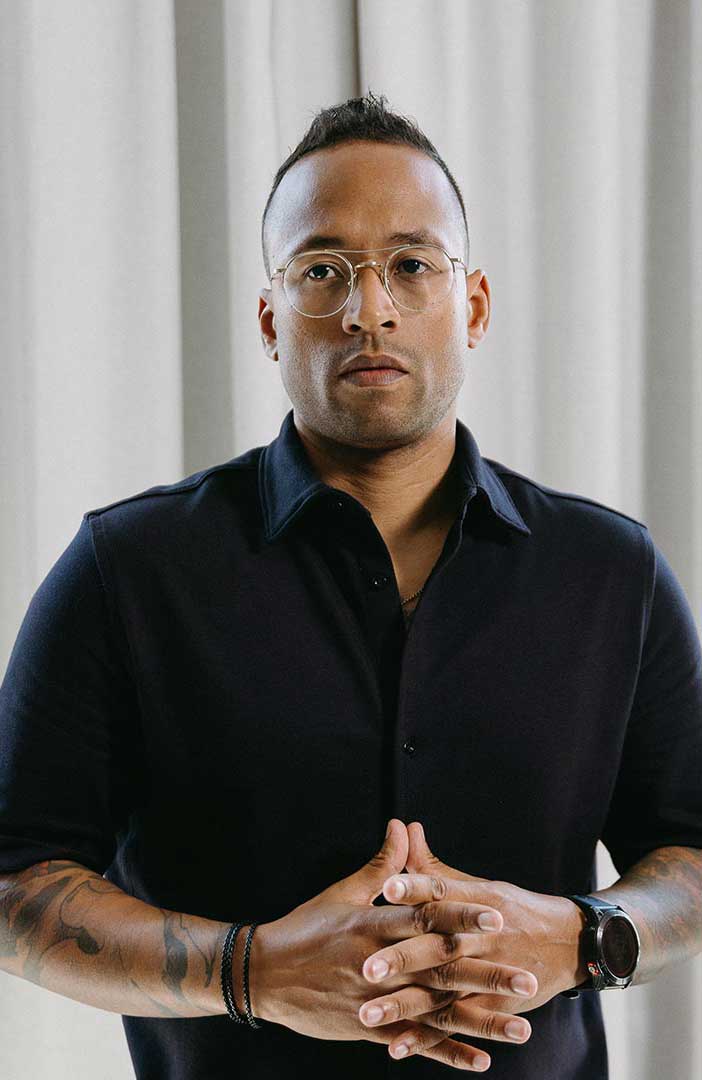

Julian Tillotson is the Founder & CEO of INDIRAP, a full-service video production and creative strategy agency based in Chicago, IL. With 10+ years of experience, INDIRAP has delivered 20,000+ videos to 900+ clients across 40+ industries, making it one of North America's leading digital creative agencies.


.png)
.png)