
If you are about to invest in your first piece of video content, the single most expensive mistake you can make is to start by booking a crew. Start by mapping a content system instead. The brands whose first video scales the business, rather than lighting the marketing budget on fire, decide three things weeks before anyone picks up a camera: who the video is for, what it should get that person to do, and how it will be found. This guide walks through all three, plus the per-asset cost math that changes how you should think about a video budget, and the one advantage first-time video buyers hold over brands that have been producing content for years.
Over the last decade, INDIRAP has delivered more than 20,000 videos to over 900 brands across 40 industries. The pattern is consistent: most companies treat video as a one-off project. They shoot, edit, post, and hope. That is not how content actually compounds. Here is how to plan a first brand video that looks excellent and drives predictable, long-term growth.
A video crew is production. Production is the middle of the process, not the beginning. When you lead with a booking, you are buying a shoot before you have defined the job that shoot is supposed to do. The camera shows up, everyone works hard, and you walk away with a polished asset that may or may not move a single business metric, because the decisions that determine whether video works were never made.
Smart brands do the opposite. They treat video as content infrastructure, and they build the system before they build the shot list. The good news for a first-time buyer is that infrastructure is easiest to build when you are starting with a clean slate. You have no legacy library to retrofit, no old positioning to unwind, and no five-year-old strategy to work around. You get to do it right the first time.
A video content system is a plan that treats every shoot as the foundation of an ongoing library rather than a single deliverable. It starts with a specific audience and a specific action, captures enough raw material in one production to generate weeks or months of assets, and is built from day one to be discovered on the platforms where buyers actually look. In plain terms: one shoot on the calendar, a whole content engine on the back end.
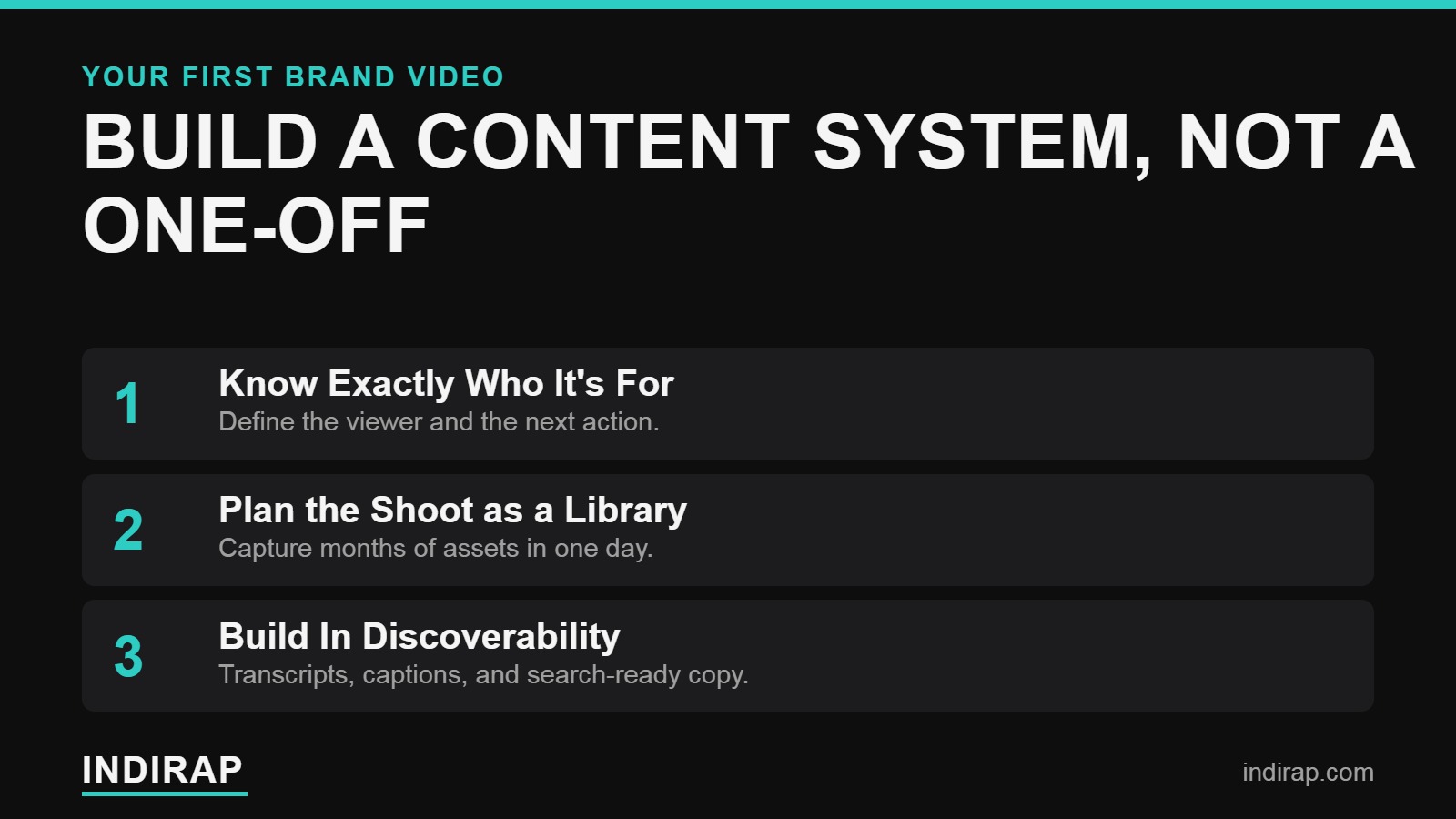
The difference between a first video that builds your business and a first video that becomes an expensive lesson gets decided before production starts. It comes down to three moves.
Start with the audience, and be far more specific than feels comfortable. The wrong answer sounds reasonable. "It is for our customers." "It is for decision-makers in our space." "It is for marketing teams at companies like ours." None of that is specific enough to make a single creative decision.
A specific target sounds like this: "A head of sales at a mid-market B2B company who has heard our category exists, but does not really understand what makes us different from the three other vendors that pitched them last month." When the target is that precise, the script writes itself. The pacing writes itself. The platform writes itself. You stop guessing.
Then answer the second half of the same question: what do you want that person to do after they watch? Not "consider us." Not "feel something." A specific next action. Book a fifteen-minute call. Reply to the email this video arrived in. Forward it to their team. Visit one page on your site.
If you can name the buyer and name the next action, you have a brief. Without those two things, you do not have a brief, and no production company can create one for you. This matters most on the first video because your first video sets how your company shows up. The visual language, the tone, the level of polish, the way you describe what you do. Every video after the first one borrows from it. Pointing that first video at exactly the right person is the highest-leverage decision in your entire video strategy.
This is the move that doubles the value of every dollar you spend on production. Treat your first shoot day as the foundation of a content library, not a single deliverable.
Most first-time buyers think about a shoot as "we need a brand video," so they plan a brand video, and they get a brand video, maybe with a couple of social cutdowns included as a courtesy. The brands that get the most from their first shoot plan it like they are building a library from the very beginning. Same crew. Same day. Same talent. Same budget. The only thing that changes is the brief. Instead of asking "what is the video," it asks "what are all the assets we want to walk away with?"
That one shift changes how the day runs. You shoot extra B-roll for future edits. You capture vertical safe zones in camera so the same takes can be cut for Reels and Shorts without reframing later. You record extra dialogue moments that never make the main video but get pulled into testimonial clips and social posts. The best shoot days look like one shoot on the calendar and generate thirty to ninety days of content across every platform. Some generate a full year.
Here is the budget math that matters most for a first-time buyer. If you spend twenty thousand dollars on a shoot that produces one brand video, your per-asset cost is twenty thousand dollars. If you spend the same twenty thousand dollars on a shoot that produces fifty deliverable assets, your per-asset cost is four hundred dollars. Same dollars out the door. Fifty times the leverage.
Per-asset cost, side by side. A $20,000 shoot that yields 1 asset costs $20,000 per asset. A $20,000 shoot that yields 50 assets costs $400 per asset. Same budget. The plan is the difference.
The mistake is anchoring on the total budget number when the metric that actually matters is per-asset cost over the next twelve months. A twenty-thousand-dollar shoot is either very expensive or very cheap depending entirely on how you plan it.
A quick note if you have ever searched Google for production companies and walked away more confused than when you started. You are not the problem. The category can be confusing, because most production companies are set up to sell you a shoot. They rarely explain that a shoot is a project, when what you are really trying to buy is infrastructure. That gap is exactly what causes first-time buyers to delay a decision for a year or two. You are not slow. You are trying to make a smart decision in a market that often pitches the wrong thing.
This is the move that quietly makes you competitive with companies that have been producing video for years. Build discoverability, what we call answer engine optimization, into the system from day one.
Three years ago you could ignore this. Today you cannot, because the way buyers find video has changed completely. They search on YouTube. They ask ChatGPT. They scroll past Google AI Overviews. They watch LinkedIn autoplays. None of those surfaces show your video unless the video is built to be surfaced.
The brands that launched in the last twelve months and are doing this correctly are already showing up in search results, getting cited inside AI answers, and outranking competitors who have been around for ten years. The reason is simple. Those competitors built their video strategy years ago, before any of this changed. Their content is not optimized for AI surfaces. Their transcripts are missing. Their descriptions read like internal jargon.
As a first-time buyer, you do not have that problem yet, which means you get to do it right from day one:
Every one of those additions is free to include on a video that is already being produced. They are invisible to your audience and enormous to the algorithm. That is the whole advantage: the brands trying to retrofit all of this onto five years of existing content are spending real money to catch up to where you get to start.
Put the three moves together and the picture gets clear. The brands you will compete with in five years are not the ones with the longest video history. They are the ones with the best video infrastructure. A clean slate lets you build that infrastructure correctly the first time, while more established brands are still fixing work they published before the world changed. A specific audience and action, a shoot planned as a library, and discoverability baked in from the first upload. That is a system a first-time buyer can stand up in a single production cycle, and it compounds every quarter after that.
Here is the assignment before you call a single production company. Write down one sentence describing the person this video is for, specific enough that you could pick them out of a room. Then write down the one thing you want that person to do after watching. If you can do both in five minutes, you are ready to have a real conversation about production. If you cannot, that is useful to know, because it means the brief needs work first, and that is work worth doing. Most production companies will not hand you those answers, because most of them are not in the business of asking. Doing that thinking now is exactly the work that the brands who wasted two or three years never did.
This content-system approach is the foundation of how we work. Rather than selling a single shoot, INDIRAP plans each production as the start of a library, maps it to a specific audience and action, and builds discoverability in from day one so the work keeps earning attention long after it goes live. If you want to see the framework applied to your brand, our video production team and our Content Kit program are both built around exactly this model, and our social media content work turns a single shoot into a steady feed of platform-ready assets. You can also browse client success stories to see the system in action.
What is the biggest mistake first-time video buyers make?
The biggest mistake is booking a crew before defining a content system. Production is the middle of the process. The decisions that determine whether video works, who it is for, what it should get them to do, and how it will be found, all happen before the shoot. Define those first, then book production.
What is a video content system?
A video content system is a plan that treats every shoot as the foundation of an ongoing library rather than a single deliverable. It starts with a specific audience and a specific next action, captures enough material in one production to generate weeks or months of assets, and is built to be discovered on search, social, and AI surfaces from day one.
How should I budget for my first brand video?
Anchor on per-asset cost over twelve months rather than the total shoot price. A twenty-thousand-dollar shoot that produces one video costs twenty thousand dollars per asset. The same shoot planned to produce fifty assets costs four hundred dollars per asset. Plan the shoot as a library and the same budget delivers far more.
How many assets can one shoot day produce?
A shoot planned as a content library, with extra B-roll, vertical safe zones captured in camera, and additional dialogue moments, commonly generates thirty to ninety days of content across platforms. A well-planned day can produce fifty or more deliverable assets from a single production.
What is answer engine optimization for video?
Answer engine optimization, or AEO, is the practice of building video so it can be surfaced by search engines and AI tools. For video that means a full transcript, a description written the way buyers search, schema markup on the page, and periodic FAQ-format videos that AI tools can pull from when answering questions.
Why do first-time video buyers have an advantage?
First-time buyers start with a clean slate. They can build audience targeting, a library-first production plan, and discoverability into their content from the first upload, while established brands spend real money retrofitting those things onto years of older content that was created before search and AI surfaces changed.
Written by Julian Tillotson, Founder and CEO of INDIRAP. INDIRAP is a video production, social media marketing, and creative strategy agency that has delivered more than 20,000 videos to over 900 brands across 40 industries.


Julian Tillotson is the Founder & CEO of INDIRAP, a full-service video production and creative strategy agency based in Chicago, IL. With 10+ years of experience, INDIRAP has delivered 20,000+ videos to 900+ clients across 40+ industries, making it one of North America's leading digital creative agencies.


.png)
.png)