
Artificial intelligence is reshaping how video gets made. That part is not in dispute. What is in dispute -- and what most coverage gets wrong -- is what that actually means for a business that needs video content to do something: generate leads, build trust, close deals, train employees, or establish authority. The hype cycle has produced a lot of content about AI as a creative revolution. This guide is about AI as a production tool -- what it concretely delivers, where it genuinely underperforms, and how to make intelligent decisions about when to use it and when not to.
INDIRAP has tested AI tools across real client projects. This is what we have actually found.
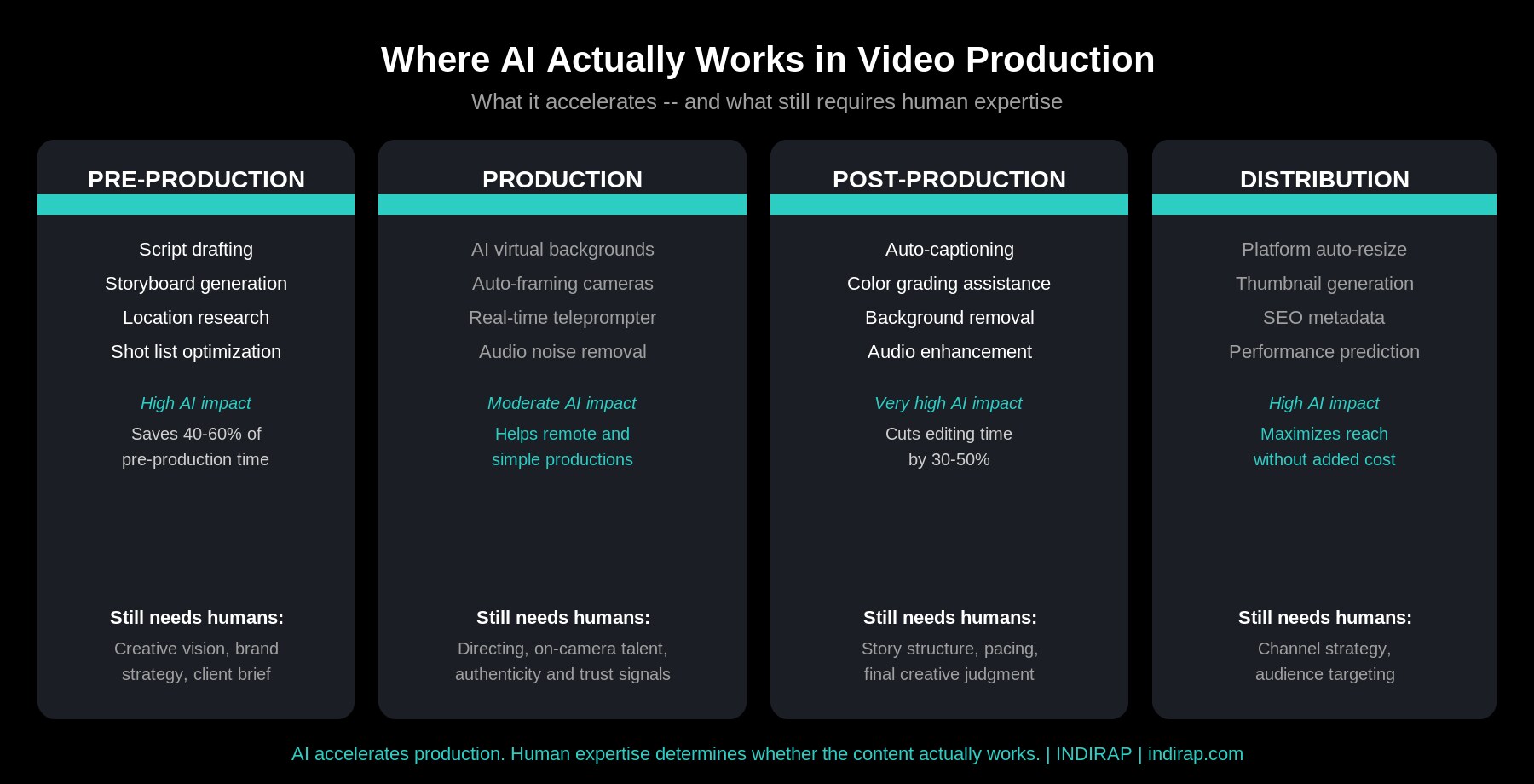
AI in video production refers to the application of machine learning and generative AI systems to tasks across the pre-production, production, and post-production pipeline. This includes tools that help write scripts, generate storyboards, automate editing tasks, enhance audio, remove backgrounds, caption footage, resize content for different platforms, and analyze performance data to inform future production decisions.
It does not -- despite a significant amount of marketing copy suggesting otherwise -- replace the strategy, creative direction, and human authenticity that determine whether a piece of video content actually does its job for a business.
AI tools like ChatGPT, Claude, and specialized platforms like ScriptHop can reduce script drafting time by 40 to 60 percent. For a business producing regular video content, this is a meaningful operational change. A first draft that once took a copywriter two days can be produced in under an hour, leaving more time for refinement, client review, and strategic adjustment. This is AI's most consistent, well-demonstrated value in the production pipeline.
Modern AI captioning tools (Descript, Adobe Premiere's auto-transcription, Kapwing) achieve accuracy rates above 95 percent on clear audio. For any business publishing video on LinkedIn, YouTube, or Instagram -- where 70 to 85 percent of viewers watch without sound -- this eliminates a labor-intensive post-production task that was previously outsourced or handled manually. The time savings is real and the accuracy is production-worthy.
Tools like Adobe Enhance Speech and Descript's audio cleanup can transform audio recorded in an office, conference room, or remote setting into broadcast-quality sound. For businesses producing executive thought leadership content, internal training videos, or Q&A sessions in environments that are not acoustically ideal, this is a genuine production equalizer. You no longer need a purpose-built studio for audio that sounds professional.
Matching the color and exposure of footage shot on multiple cameras -- a common challenge in corporate interview productions -- has traditionally required a skilled colorist and significant post-production time. AI tools like Cinematch and Adobe Sensei's color matching significantly reduce this workflow. For a two-camera corporate interview with a client and a spokesperson, this can cut color grading time by 50 percent or more.
A single corporate video now needs to exist in multiple formats: 16:9 for YouTube and website embeds, 9:16 for LinkedIn video and Instagram Reels, 1:1 for LinkedIn feed posts, and 4:5 for certain ad formats. AI-powered tools like Kapwing and AutoReframe automate this reformatting with intelligent subject tracking, so the key visual element stays in frame across all crops. What once required manual editing per format now takes minutes.
AI image generation tools (Midjourney, DALL-E, Adobe Firefly) can generate rough storyboard frames from text descriptions in minutes. For pre-production planning with clients, this replaces hand-drawn or stock-image storyboards with something that more accurately represents the intended visual approach. Client alignment on visual style early in the process reduces expensive revision cycles and reshoots.
Tools like ElevenLabs, Play.ht, and Synthesia enable businesses to produce localized versions of video content with AI-generated voiceovers in multiple languages without the cost of separate recording sessions with native speakers. For businesses operating in multiple markets or producing training content for globally distributed teams, this is a meaningful cost reduction at scale.
AI tools like Descript and Munch can analyze hours of interview or event footage and identify the highest-quality clips based on audio clarity, facial engagement, and content relevance. For a business that shoots a 90-minute executive interview or panel discussion and needs to produce five to eight social media clips, AI clip selection can reduce the selection and editing process from two days to two hours.
AI-assisted editing enables faster production of multiple versions of a piece of content -- different hooks, different call-to-action endings, different thumbnail options -- for A/B testing. For businesses investing in paid video distribution on LinkedIn or YouTube, the ability to rapidly produce and test variants without proportional cost increases is a genuine competitive advantage in optimizing content performance.
The list above is real. What is equally real -- and considerably less discussed in AI-enthusiasm coverage -- is the category of video production work that AI tools do not do well and may actively harm.
Client testimonial videos require real clients, on camera, describing a real result. An AI avatar saying the same words has never, in any documented case, produced the same conversion impact. Trust signals are human signals.
Brand story videos require a creative director who understands the brand's positioning, audience, and strategic objectives -- and can make dozens of judgment calls in a production day that no current AI tool can make. The script AI produces is a starting point, not a production brief.
Executive thought leadership content -- the kind that builds an executive's personal brand and generates inbound deal flow -- requires the executive to be on camera, speaking from genuine experience. AI voiceover over a slide deck is not thought leadership. It is a slide deck with a voice.
The most effective approach is not all-AI or no-AI. It is strategic integration: use AI where it delivers genuine time and cost savings without sacrificing the content qualities that determine whether the video actually works. Use human-led production for content where trust, authenticity, and creative direction determine the outcome.
INDIRAP uses AI tools across pre-production scripting, automated captioning, audio enhancement, color consistency, and platform optimization on client productions. We do not use AI avatar video for client-facing content, AI-generated testimonials, or AI scriptwriting as a substitute for strategic content development. The dividing line is always the same: does the AI output serve the content's business objective, or does it undermine the trust and authenticity that the content needs to work?
For a more detailed comparison of AI-assisted versus human-led production outcomes, read our guide to AI video vs. live action production for corporate brands. For a practical breakdown of the tools that deliver real value on business productions, see the best AI video production tools for business marketers in 2026.
INDIRAP is a Chicago-based full-service video production agency that integrates AI tools into every production where they deliver genuine value. If you want to understand how AI fits into your specific content strategy, that is the conversation to have before you invest in tools or production.
This is Post 1 in INDIRAP's AI Video Production series. Continue to AI video vs. human-led production for B2B brands.
Watch + Learn
INDIRAP publishes hands-on guides to AI in video production based on real client work. Watch on YouTube, Reels, and Shorts.
▶ Subscribe on YouTube -- watch INDIRAP's full breakdown of AI in video production -- what it does, what it doesn't, and how Chicago brands are using it
▶ Instagram Reels -- see how INDIRAP integrates AI tools into real client video production workflows
▶ YouTube Shorts -- 60-second breakdowns of AI video tools tested in real production -- what actually works for businesses
AI in video production refers to machine learning tools applied across the production pipeline -- scripting, storyboarding, automated editing, audio enhancement, captioning, color grading, platform resizing, and performance analytics. AI accelerates specific production tasks but does not replace strategic creative direction, authentic client testimonials, or the human elements that determine whether video content actually converts.
The most validated benefits are faster script development (40-60% time reduction), accurate auto-captioning (95%+ accuracy), audio enhancement from non-studio environments, color consistency across multi-camera shoots, automated platform resizing, AI-assisted storyboarding, multilingual voiceover, intelligent clip selection from long footage, and faster A/B testing of content variants.
No. AI replaces specific tasks within the production workflow -- not the creative direction, client relationship, strategic alignment, and on-camera authenticity that production companies provide. For high-stakes business video content (brand stories, testimonials, executive thought leadership), AI-only production consistently underperforms human-led production because buyers recognize and discount AI-generated trust signals.
AI is reducing per-unit production costs for specific tasks -- scripting, captioning, color grading, platform resizing -- by 30 to 60 percent. It is enabling businesses to produce more content from a single shoot by automating the repurposing workflow. It is not significantly reducing the cost of the highest-value production elements: location, crew, talent, and creative direction.
Know what your video needs to accomplish before choosing a production approach. AI-generated content works for high-volume, lower-stakes content where speed and cost matter more than authenticity. For content where trust, credibility, and conversion are the primary measures -- testimonials, brand stories, executive content, investor-facing video -- human-led production with AI-assisted workflows delivers better outcomes.
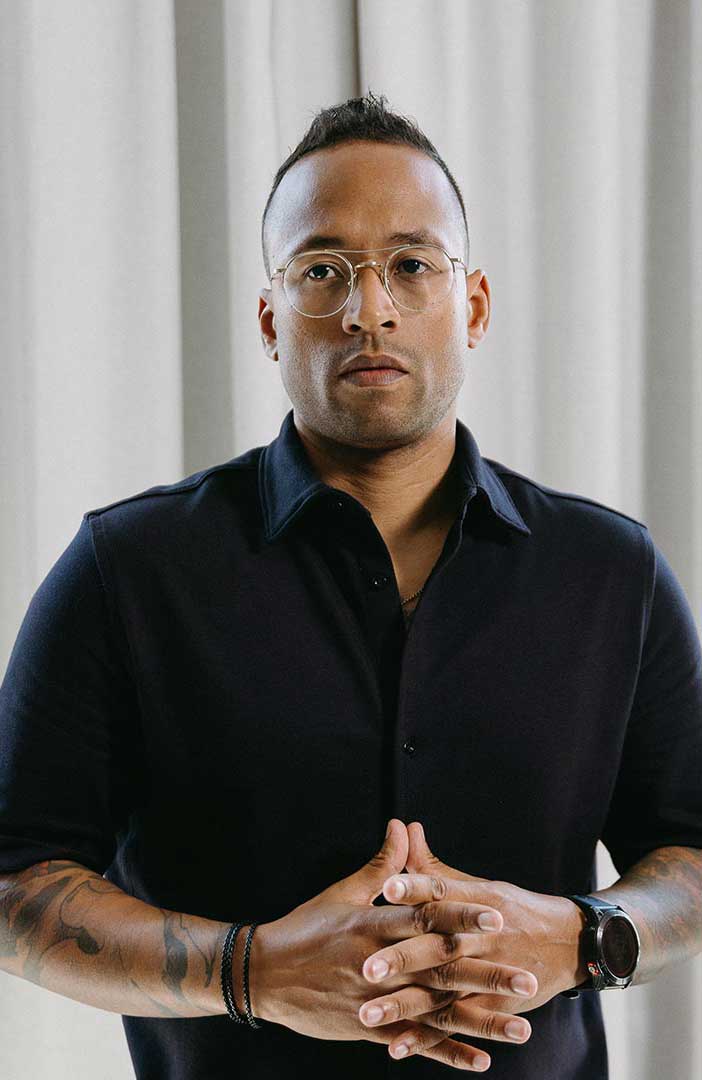

Julian Tillotson is the Founder & CEO of INDIRAP, a full-service video production and creative strategy agency based in Chicago, IL. With 10+ years of experience, INDIRAP has delivered 20,000+ videos to 900+ clients across 40+ industries, making it one of North America's leading digital creative agencies.


.png)
.png)