
Why Your Company Website Needs Video in 2026

Think about the last time you landed on a website that was just... walls of text. You didn’t read it, did you? You skimmed, felt a slight hit of information fatigue, and bounced. 

That’s because, biologically speaking, we’re still hunter-gatherers carrying around smartphones. Our brains are hardwired to notice a rustle in the bushes (or a play button on a screen) way before we care about a well-written paragraph.

In fact, if you want to get nerdy about it – and trust us, your bottom line will thank you for this – neuroscience tells us that video activates multiple cognitive pathways. Research from Dr. Carmen Simon at Corporate Visions has shown that video actually makes people happier than text

Her team found that digging through a text-heavy inbox often triggers a micro-state of “unpleasantness,” video neutralizes it and shifts the brain into a more positive state. So, when we talk about why your company needs website video content in 2026, we’re not merely referring to the “engagement metrics.” We’re telling you not to be the brand that gives your customers a headache.

Why Every Brand Needs a Company Website Video In 2026

When you browse the web, your attention span is being pulled in six different directions, and you’ve developed a sixth sense for filtering out corporate fluff. 

That’s when you don’t want to read a 1,000-word manifesto on “Synergy” and “Innovation.” You want to look someone in the eye (even through a screen) and know they’re the real deal. And guess what, your audience is no different. 

We’ve officially moved past the era where video was a luxury add-on for the brands with massive budgets. Today, a company website video is the core of your digital presence, and here’s why. 

1. Video Reduces Buyer Friction at Every Stage

Let’s talk about that annoying little voice in the back of every customer’s head, the one that says, “What if this is a scam?” or “Is this actually going to fit in my living room?”

In marketing-speak, we call that friction. In real-world speak, it’s just the “I’m scared to press the buy button” jitters.

By 2026, we’ve all been burned by a too-good-to-be-true Instagram ad at least once. We’re guarded and skeptical. And honestly, a little lazy, too. If someone has to read a 12-page whitepaper just to figure out if your software integrates with their calendar, they’ll probably just close the tab and find someone who shows them in a 15-second clip.

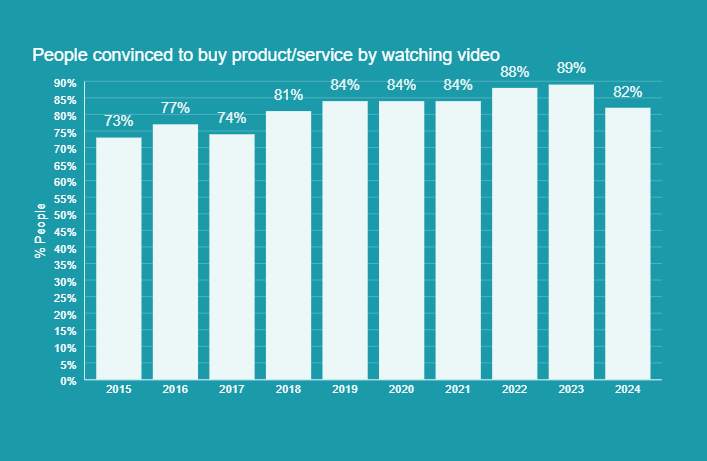
According to a long-running study by Wyzowl, a staggering 82% of people say watching a video has convinced them to buy a product or service. That’s basically nine out of ten people saying they weren’t sure until they saw it move. 
Video marketing statistics

At the Awareness Stage, you can target your audience with a quick, punchy company website video. At the Consideration Stage, a demo video can answer their questions in real-time. 

Lastly, a video of a real person saying, “I used this, and it solved my problem,” gives your audience a nudge to pull out their credit card at the Decision Stage. 

2. Website Video Content Builds Trust Before a Sale Call Happens

There is nothing more awkward than hopping on a discovery call with a total stranger. It’s that first-date energy, with lots of forced small talk and that lingering feeling of “Who is this person, and are they about to waste my next 30 minutes?”

But when you put a video of yourself (or your team) on your site, you’re basically letting them hang out with you before the clock even starts. They get to hear the cadence of your voice and catch that genuine smirk when you talk about the problem you solve.

This kills the skepticism gap because you’ve already done the heavy lifting through a video. 

Check out this 30-second reality check, “Business is ALWAYS human” from Simon Sinek. He explains perfectly that business is about connecting with people. 

Not to mention, there’s a bit of a psychological concept at play here called the Mere Exposure Effect. Essentially, the more we’re exposed to something (or someone), the more we tend to like and trust them.

Research from the Journal of Consumer Research has consistently shown that humanizing a brand through sensory cues, like a face and a voice, drastically lowers a buyer’s perceived risk. 

In simple words, if they’ve seen you on video, their brain already categorizes you as someone known, not a stranger. 

3. It Explains Complex Services In Under Two Minutes 

We’re all suffering from a bit of mental load fatigue, and the last thing your potential client wants is a homework assignment. If your service requires a PhD and three cups of espresso to understand, you’ve got a problem. 

Video takes those chunky, terrifying concepts and makes them easier to understand. 

In fact, Science tells us that our brains are basically built to ignore static data and prioritize moving stories. According to Dr. Richard Mayer’s Multimedia Learning Theory, we learn significantly better from words and pictures combined than from words alone.

When you pair a clear voiceover with a simple animation or a screen-share, you’re hitting the brain’s dual-coding system. Because you’re feeding the “auditory” and “visual” channels at the same time. 

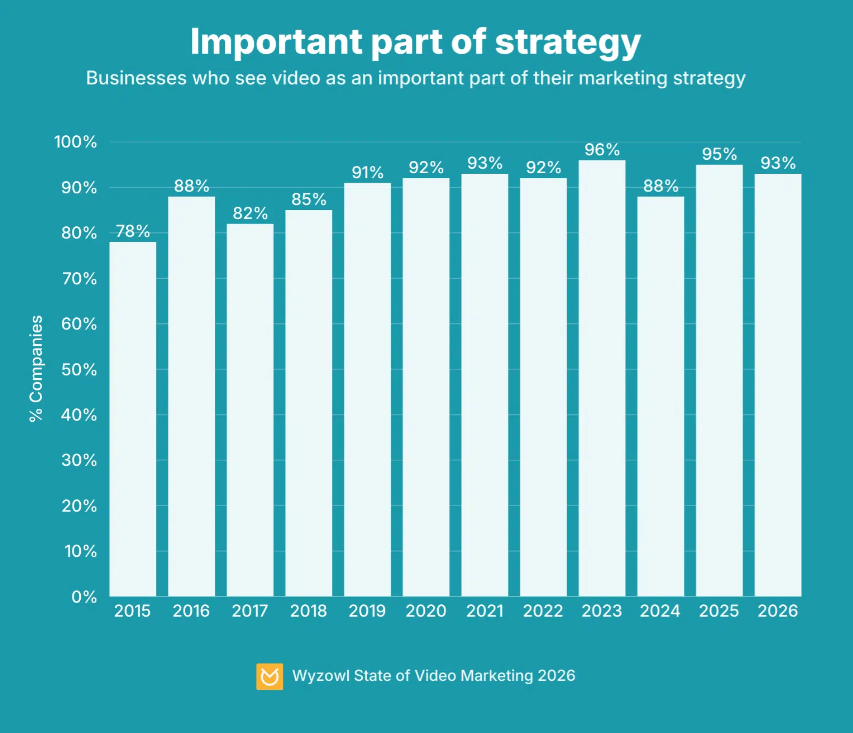
What’s more, research by Wyzowl shows that 93% of marketers report that video has improved their audience's understanding of products and services.
Wyzowl video marketing report

That means, say, with a 90-second explainer video, you’re doing three things at once.

  • The “What”: You define the problem they have (instead of the one you think they have).
  • The “How”: You show the solution in motion. 
  • The “Aha!”: You show the result.

So, by the time the progress bar hits the one-minute mark, you’ve taken a complex service and made it understandable

  1. Video Content Strategy Strengthens Brand Recall Through Visual Identity

Let’s play a quick game. If we say “blue box with a white ribbon,” you’re thinking Tiffany’s. If we say “a giant yellow M against a red background,” you’re already smelling French fries.

That’s brand recall. In 2026, where every company and its cousin is competing for a sliver of your brain space, having a vibe is a survival tactic.

Static text is great for details, sure, but it’s remarkably forgettable. For example, you can read a perfectly fine About Us page today, and by next Tuesday, you might remember the info, but you won’t remember the soul. Video, however, is the glue that makes your brand stick to the ribs of someone’s memory. 

Besides, it makes you uncopyable. Anyone, for instance, can copy your sales copy or bid on your keywords. But nobody can replicate the way your CEO laughs or the specific industrial-cool look of your warehouse. 

Here’s an example of a memorable video content strategy by Liquid Death. They’re absolute masters of taking something as simple as water and making it uncopyable. You see, it’s just a water can, but because of their absurd (in a good way) video style, you’ll never mistake them for anyone else. 

There’s also a psychological phenomenon called the Picture Superiority Effect. It basically proves that humans are much more likely to remember images than words. 

If we tell you a piece of information, you’ll remember about 10% of it three days later. But if we add a relevant image or video? That number jumps to a massive 65%!

5. Time-Collapsing and the “Perceived History”

Have you ever met someone and, within ten minutes, felt like you’ve known them for a decade? That’s called Time-Collapsing. In the online world, video is the only medium that can pull off this kind of time travel!

Philosophically speaking, we don’t measure our lives in minutes; we measure them in moments. A wall of text feels like a chore because people view it as clock time they’ll never get back. But beautifully edited website video content? That’s an experience. 

Research into Narrative Transport Theory suggests that when we are lost in a story (especially a visual one), our internal clock shifts. We stop analyzing the passage of time and start absorbing the weight of the experience.

By showing a time-lapse of a project coming to life or a quick-cut history of your team’s growth, you’re giving your customers the shortcut to trust. You’re telling them they don’t have to wait five years to trust you because you’re literally showing them five years of work in one video. 

The viewer’s brain processes those visual milestones so quickly that they subconsciously move you from the “new guy” category to the “established authority” category. 

Watch how Nike uses a quick-cut history of legendary sports comebacks to pull you into a shared emotional journey. By the end of this clip, you trust their resilience as if you’ve been on the sidelines for every one of those wins. 

6. Video Encourages Social Sharing More Than Static Content

When was the last time you texted a friend a link to a really thrilling paragraph of text? Exactly. Never.

Unless it’s a breaking news headline or a particularly spicy piece of gossip, text usually stays exactly where it was born (on the page). But video? It has wings. 

Research highlights that video content generates 1200% more shares than text and image content combined. That is a staggering number. So, if your company website video has the potential to make someone laugh, gasp in surprise, or understand something they’ve been struggling with, they’re going to pass it on.

Here are some reasons why website video content beats static content. 

  • The Low Effort Invite. Asking a colleague to read an article feels like giving them a chore. But asking them to watch a 30-second clip feels like sharing a snack.
  • The Emotional Bridge. It’s hard to share the feeling of a blog post. But the energy of a video is infectious. If your video content strategy captures a specific mood, maybe it’s a relatable frustration, followed by the perfect solution, that emotional arc is what triggers the Share button. 
  • The 2026 Loop. With the way algorithms work now, time spent on a page and outbound shares are the ultimate gold stars for SEO. When people share your video, they’re basically telling Google and the rest of the web that your brand is the real deal.

7. Brands Often Don’t Feel Real Online

Because the internet is so fluid (pages change, links break, and AI can hallucinate an entire storefront in seconds), our brains have started to treat digital brands as ghosts. They often don’t feel real. 

Video fixes that! Think about the difference between a high-res photo of a watch and a video of someone picking that watch up. When you see the light catch the steel, hear the thud as it’s placed on a wooden table, and feel its weight in your hand, your brain registers a sense of its presence (also called Spatial Presence). 

This triggers a customer’s brain to map out your brand in their physical world memory, which is a plus. Here’s how.

  • A company website video provides the shadows, the textures, and the sounds that a JPEG can’t. It proves a certain thing actually exists in three dimensions.
  • When we watch a video, our brains use the same neural pathways as if we were physically standing in that room. 
  • It’s much harder to believe a brand is going to disappear overnight if you’ve seen their space and felt their products.

8. Video Is Among the Most-Watched Media Formats 

According to the Cisco Visual Networking Index, video now accounts for a staggering 82% of all internet traffic.

Think about that for a second. If your website is 100% text and static images, you’re effectively fighting for a tiny 18% slice of the attention pie. You’re trying to sell a silent movie in the age of IMAX. But a video changes that. 

See this watch commercial by OMEGA. Notice the product’ss micro-details in the video. It keeps one hooked till the end. Do you think an image alone can capture that? Not a chance.

Globally, around 3.37 billion people watch videos, making it one of the most-watched digital media formats, according to Statista. 

Why is this happening? Here’s why. 

  • Passive vs. Active. Reading is active work. Your brain has to comprehend the letters and build the images itself. Watching a video is passive; it’s a guided experience that delivers the info directly to the entertainment center of your brain. 
  • The New Default. For the younger demographic hitting the workforce in 2026, video is the primary source of truth. If they can't find a video of your service, they assume it’s either too complicated to explain or not worth their time. Data shows that around 73% of consumers prefer short videos to learn about products and services. Another reveals that a whopping 90% of Gen Z want more videos from brands

By uploading a company website video, you’re simply meeting your customers where they already live. 

9. Video Marketing ROI Is Positive 

Let’s talk about the elephant in the room: the budget. We know, we know. Every time someone says, “We should do video,” the first thing you see in your head is a giant pile of cash flying out the window. It feels like a big, expensive mountain to climb. But the view from the top of that mountain is where all the profit is hiding.

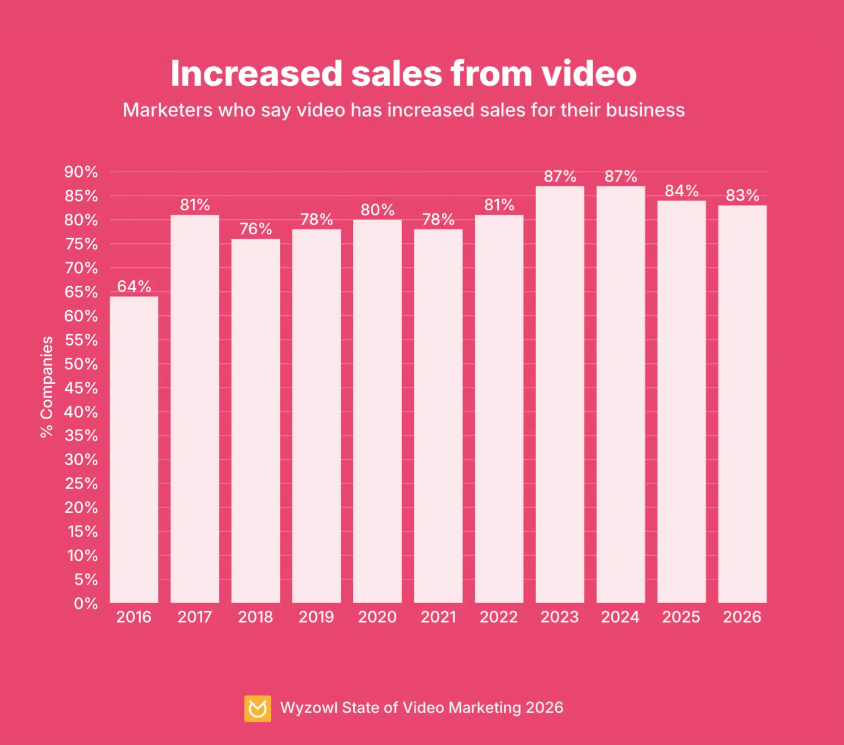
Website video content is a high-performance salesperson that works 24/7 without asking for a commission. According to Wyzowl, about 83% of marketers say video has directly increased their sales.
Sales from company website video

If you’re still skeptical, let’s look at the hidden ways a solid video content strategy maximizes ROI and saves you money while making you more.

  • The One-to-Many Leverage. You record one high-quality explainer video once, and it sells your product to 10,000 people while you’re sleeping. It’s the ultimate way to scale your time.
  • Lowering Support Costs. If a 60-second video on your site answers a common question that used to take a 15-minute support call, that video just paid for itself in saved man-hours within a month.
  • The Ad-Spend Efficiency. In 2026, ad platforms (like LinkedIn and Meta) practically beg you to use video. It gets cheaper clicks and better placement because the platforms know their users want it. You’re literally getting more eyeballs for your buck.
  1. Company Website Video Helps With Brand Awareness 

In the crowded marketplace of 2026, being ‘good at what you do’ is only half the battle. If nobody knows you exist, you’re essentially the world’s best-kept secret (and secrets don’t pay the bills).

Brand Awareness sounds like one of those fluffy marketing terms that belongs in a boardroom, but at its heart, it simply means being “the one they remember.” 

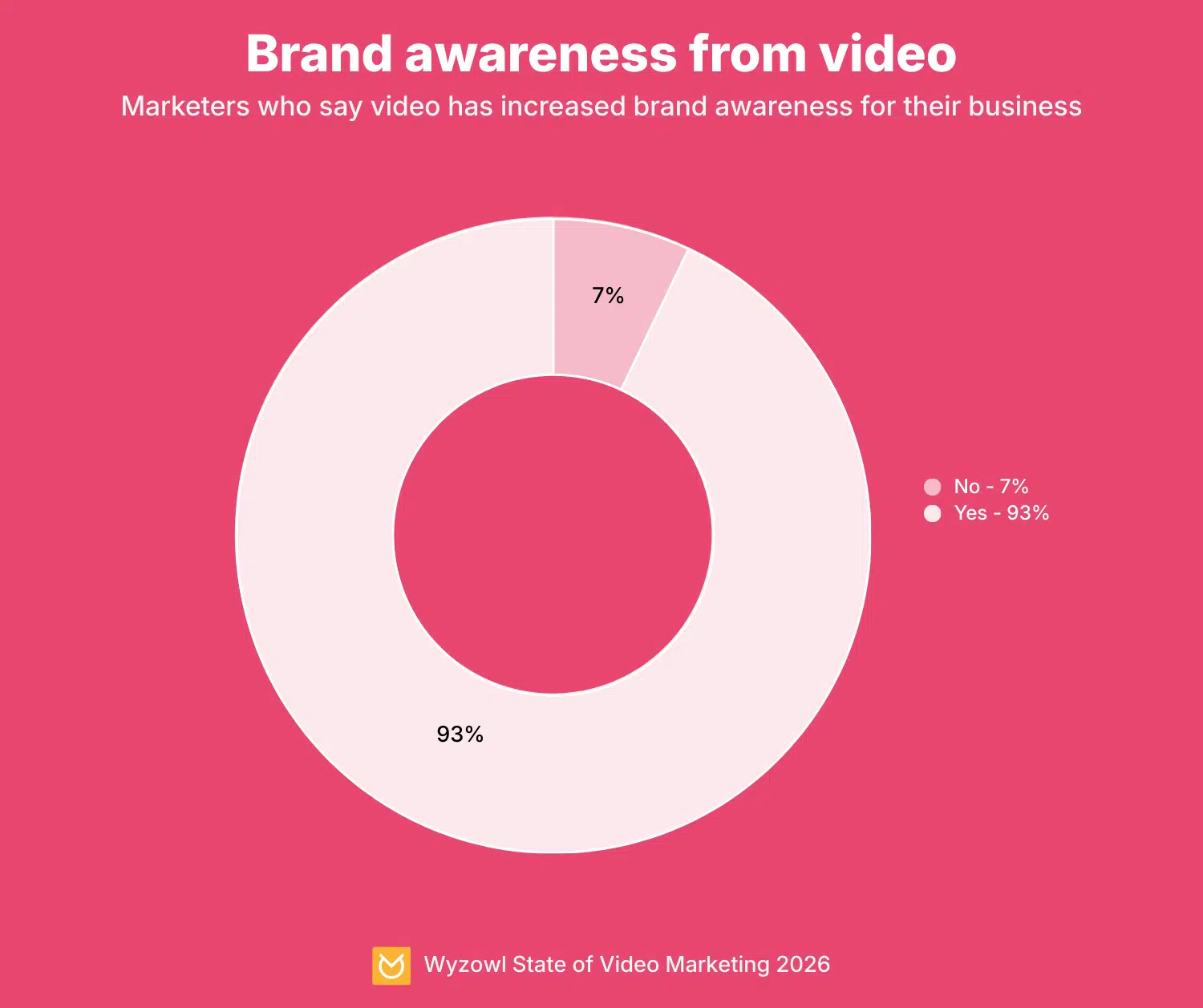
Website video content forces your audience to acknowledge your existence in a way a paragraph of text does not. There’s a reason 93% of brands report landing a new customer through a video. Likewise, 9 out of 10 marketers noticed improved brand visibility from video marketing.
Brand awareness from company website video

Here’s how a video content strategy leaves an emotional imprint. 

  • You might forget the exact wording of a mission statement, but you’ll remember the vibe of the video. Was it funny, serious, sleek, or helpful? That emotional aftertaste is what keeps your brand floating at the top of their mind.
  • When you have a killer video on your site, people talk about it. “Have you seen that one company’s site with the cool animation?” That’s brand awareness working for you while you’re busy doing other things.
  1. The Audience Gets to Know About Your Personality

In 2026, we are absolutely drowning in professionalism. Every website has the same polished copy and the same stock photo of a woman laughing at a salad. It’s boring, and quite frankly, forgettable.

Website video content is where the mask comes off. It’s the only place on your website where your audience can meet the personality behind the brand. Are you a bit of a quirky perfectionist? Or maybe you’re high-energy and disruptive? Whatever your flavor is, video lets it shine through.

Not to mention, we’ve entered an era where consumers are making buying decisions based on someone’s vibe. It sounds superficial, but it’s actually a very human way of filtering for authenticity. 

After all, we want to know if we actually like the people we’re giving our money to. And website video content helps with that. 

  • Micro-Expressions & Tone. You can’t write a genuine smile or a reassuring tone of voice into a bulleted list. But in a video, those tiny human cues do the heavy lifting. They tell the viewer you’re a real person and you care about their problems.
  • Breaking the Corporate Wall. When you show a bit of your personality (maybe a joke that lands or even a self-deprecating comment), you’re lowering the customer's guard. You’re bridging the gap between transaction and relationship.

Ready to Be the Brand They Remember? Explore INDIRAP Video Production Services Today!

Look, you’ve probably been there, lying in bed at 11:00 PM, and realizing you’ve spent twenty minutes watching a video of a guy in Sweden building a log cabin by hand. You didn’t plan on it. But you couldn’t look away because, as humans, we are biologically wired to crave the movement and the realness it offers.

Now, compare that to the experience of landing on a website that feels like a desert with endless dunes of dry text and corporate-speak. The truth is, the old way of building a website was about providing information. But the new way requires you to provide an experience.

That’s exactly where a video production company like INDIRAP comes in. We’re here to make sure your brand is the one people can’t stop talking about at dinner. Our video marketing strategy is designed to do the talking so you don’t have to. 

Let’s grab a coffee (or jump on Zoom) and bring your brand to life!

Related Articles
video marketing strategy for SaaS
February 16, 2026

Why Your Company Website Needs Video in 2026

blog
Show all

Think about the last time you landed on a website that was just... walls of text. You didn’t read it, did you? You skimmed, felt a slight hit of information fatigue, and bounced. 

That’s because, biologically speaking, we’re still hunter-gatherers carrying around smartphones. Our brains are hardwired to notice a rustle in the bushes (or a play button on a screen) way before we care about a well-written paragraph.

In fact, if you want to get nerdy about it – and trust us, your bottom line will thank you for this – neuroscience tells us that video activates multiple cognitive pathways. Research from Dr. Carmen Simon at Corporate Visions has shown that video actually makes people happier than text

Her team found that digging through a text-heavy inbox often triggers a micro-state of “unpleasantness,” video neutralizes it and shifts the brain into a more positive state. So, when we talk about why your company needs website video content in 2026, we’re not merely referring to the “engagement metrics.” We’re telling you not to be the brand that gives your customers a headache.

Why Every Brand Needs a Company Website Video In 2026

When you browse the web, your attention span is being pulled in six different directions, and you’ve developed a sixth sense for filtering out corporate fluff. 

That’s when you don’t want to read a 1,000-word manifesto on “Synergy” and “Innovation.” You want to look someone in the eye (even through a screen) and know they’re the real deal. And guess what, your audience is no different. 

We’ve officially moved past the era where video was a luxury add-on for the brands with massive budgets. Today, a company website video is the core of your digital presence, and here’s why. 

1. Video Reduces Buyer Friction at Every Stage

Let’s talk about that annoying little voice in the back of every customer’s head, the one that says, “What if this is a scam?” or “Is this actually going to fit in my living room?”

In marketing-speak, we call that friction. In real-world speak, it’s just the “I’m scared to press the buy button” jitters.

By 2026, we’ve all been burned by a too-good-to-be-true Instagram ad at least once. We’re guarded and skeptical. And honestly, a little lazy, too. If someone has to read a 12-page whitepaper just to figure out if your software integrates with their calendar, they’ll probably just close the tab and find someone who shows them in a 15-second clip.

According to a long-running study by Wyzowl, a staggering 82% of people say watching a video has convinced them to buy a product or service. That’s basically nine out of ten people saying they weren’t sure until they saw it move. 

Video marketing statistics

At the Awareness Stage, you can target your audience with a quick, punchy company website video. At the Consideration Stage, a demo video can answer their questions in real-time. 

Lastly, a video of a real person saying, “I used this, and it solved my problem,” gives your audience a nudge to pull out their credit card at the Decision Stage. 

2. Website Video Content Builds Trust Before a Sale Call Happens

There is nothing more awkward than hopping on a discovery call with a total stranger. It’s that first-date energy, with lots of forced small talk and that lingering feeling of “Who is this person, and are they about to waste my next 30 minutes?”

But when you put a video of yourself (or your team) on your site, you’re basically letting them hang out with you before the clock even starts. They get to hear the cadence of your voice and catch that genuine smirk when you talk about the problem you solve.

This kills the skepticism gap because you’ve already done the heavy lifting through a video. 

Check out this 30-second reality check, “Business is ALWAYS human” from Simon Sinek. He explains perfectly that business is about connecting with people. 

Not to mention, there’s a bit of a psychological concept at play here called the Mere Exposure Effect. Essentially, the more we’re exposed to something (or someone), the more we tend to like and trust them.

Research from the Journal of Consumer Research has consistently shown that humanizing a brand through sensory cues, like a face and a voice, drastically lowers a buyer’s perceived risk. 

In simple words, if they’ve seen you on video, their brain already categorizes you as someone known, not a stranger. 

3. It Explains Complex Services In Under Two Minutes 

We’re all suffering from a bit of mental load fatigue, and the last thing your potential client wants is a homework assignment. If your service requires a PhD and three cups of espresso to understand, you’ve got a problem. 

Video takes those chunky, terrifying concepts and makes them easier to understand. 

In fact, Science tells us that our brains are basically built to ignore static data and prioritize moving stories. According to Dr. Richard Mayer’s Multimedia Learning Theory, we learn significantly better from words and pictures combined than from words alone.

When you pair a clear voiceover with a simple animation or a screen-share, you’re hitting the brain’s dual-coding system. Because you’re feeding the “auditory” and “visual” channels at the same time. 

What’s more, research by Wyzowl shows that 93% of marketers report that video has improved their audience's understanding of products and services.

Wyzowl video marketing report

That means, say, with a 90-second explainer video, you’re doing three things at once.

  • The “What”: You define the problem they have (instead of the one you think they have).
  • The “How”: You show the solution in motion. 
  • The “Aha!”: You show the result.

So, by the time the progress bar hits the one-minute mark, you’ve taken a complex service and made it understandable

  1. Video Content Strategy Strengthens Brand Recall Through Visual Identity

Let’s play a quick game. If we say “blue box with a white ribbon,” you’re thinking Tiffany’s. If we say “a giant yellow M against a red background,” you’re already smelling French fries.

That’s brand recall. In 2026, where every company and its cousin is competing for a sliver of your brain space, having a vibe is a survival tactic.

Static text is great for details, sure, but it’s remarkably forgettable. For example, you can read a perfectly fine About Us page today, and by next Tuesday, you might remember the info, but you won’t remember the soul. Video, however, is the glue that makes your brand stick to the ribs of someone’s memory. 

Besides, it makes you uncopyable. Anyone, for instance, can copy your sales copy or bid on your keywords. But nobody can replicate the way your CEO laughs or the specific industrial-cool look of your warehouse. 

Here’s an example of a memorable video content strategy by Liquid Death. They’re absolute masters of taking something as simple as water and making it uncopyable. You see, it’s just a water can, but because of their absurd (in a good way) video style, you’ll never mistake them for anyone else. 

There’s also a psychological phenomenon called the Picture Superiority Effect. It basically proves that humans are much more likely to remember images than words. 

If we tell you a piece of information, you’ll remember about 10% of it three days later. But if we add a relevant image or video? That number jumps to a massive 65%!

5. Time-Collapsing and the “Perceived History”

Have you ever met someone and, within ten minutes, felt like you’ve known them for a decade? That’s called Time-Collapsing. In the online world, video is the only medium that can pull off this kind of time travel!

Philosophically speaking, we don’t measure our lives in minutes; we measure them in moments. A wall of text feels like a chore because people view it as clock time they’ll never get back. But beautifully edited website video content? That’s an experience. 

Research into Narrative Transport Theory suggests that when we are lost in a story (especially a visual one), our internal clock shifts. We stop analyzing the passage of time and start absorbing the weight of the experience.

By showing a time-lapse of a project coming to life or a quick-cut history of your team’s growth, you’re giving your customers the shortcut to trust. You’re telling them they don’t have to wait five years to trust you because you’re literally showing them five years of work in one video. 

The viewer’s brain processes those visual milestones so quickly that they subconsciously move you from the “new guy” category to the “established authority” category. 

Watch how Nike uses a quick-cut history of legendary sports comebacks to pull you into a shared emotional journey. By the end of this clip, you trust their resilience as if you’ve been on the sidelines for every one of those wins. 

6. Video Encourages Social Sharing More Than Static Content

When was the last time you texted a friend a link to a really thrilling paragraph of text? Exactly. Never.

Unless it’s a breaking news headline or a particularly spicy piece of gossip, text usually stays exactly where it was born (on the page). But video? It has wings. 

Research highlights that video content generates 1200% more shares than text and image content combined. That is a staggering number. So, if your company website video has the potential to make someone laugh, gasp in surprise, or understand something they’ve been struggling with, they’re going to pass it on.

Here are some reasons why website video content beats static content. 

  • The Low Effort Invite. Asking a colleague to read an article feels like giving them a chore. But asking them to watch a 30-second clip feels like sharing a snack.
  • The Emotional Bridge. It’s hard to share the feeling of a blog post. But the energy of a video is infectious. If your video content strategy captures a specific mood, maybe it’s a relatable frustration, followed by the perfect solution, that emotional arc is what triggers the Share button. 
  • The 2026 Loop. With the way algorithms work now, time spent on a page and outbound shares are the ultimate gold stars for SEO. When people share your video, they’re basically telling Google and the rest of the web that your brand is the real deal.

7. Brands Often Don’t Feel Real Online

Because the internet is so fluid (pages change, links break, and AI can hallucinate an entire storefront in seconds), our brains have started to treat digital brands as ghosts. They often don’t feel real. 

Video fixes that! Think about the difference between a high-res photo of a watch and a video of someone picking that watch up. When you see the light catch the steel, hear the thud as it’s placed on a wooden table, and feel its weight in your hand, your brain registers a sense of its presence (also called Spatial Presence). 

This triggers a customer’s brain to map out your brand in their physical world memory, which is a plus. Here’s how.

  • A company website video provides the shadows, the textures, and the sounds that a JPEG can’t. It proves a certain thing actually exists in three dimensions.
  • When we watch a video, our brains use the same neural pathways as if we were physically standing in that room. 
  • It’s much harder to believe a brand is going to disappear overnight if you’ve seen their space and felt their products.

8. Video Is Among the Most-Watched Media Formats 

According to the Cisco Visual Networking Index, video now accounts for a staggering 82% of all internet traffic.

Think about that for a second. If your website is 100% text and static images, you’re effectively fighting for a tiny 18% slice of the attention pie. You’re trying to sell a silent movie in the age of IMAX. But a video changes that. 

See this watch commercial by OMEGA. Notice the product’ss micro-details in the video. It keeps one hooked till the end. Do you think an image alone can capture that? Not a chance.

Globally, around 3.37 billion people watch videos, making it one of the most-watched digital media formats, according to Statista. 

Why is this happening? Here’s why. 

  • Passive vs. Active. Reading is active work. Your brain has to comprehend the letters and build the images itself. Watching a video is passive; it’s a guided experience that delivers the info directly to the entertainment center of your brain. 
  • The New Default. For the younger demographic hitting the workforce in 2026, video is the primary source of truth. If they can't find a video of your service, they assume it’s either too complicated to explain or not worth their time. Data shows that around 73% of consumers prefer short videos to learn about products and services. Another reveals that a whopping 90% of Gen Z want more videos from brands

By uploading a company website video, you’re simply meeting your customers where they already live. 

9. Video Marketing ROI Is Positive 

Let’s talk about the elephant in the room: the budget. We know, we know. Every time someone says, “We should do video,” the first thing you see in your head is a giant pile of cash flying out the window. It feels like a big, expensive mountain to climb. But the view from the top of that mountain is where all the profit is hiding.

Website video content is a high-performance salesperson that works 24/7 without asking for a commission. According to Wyzowl, about 83% of marketers say video has directly increased their sales.

Sales from company website video

If you’re still skeptical, let’s look at the hidden ways a solid video content strategy maximizes ROI and saves you money while making you more.

  • The One-to-Many Leverage. You record one high-quality explainer video once, and it sells your product to 10,000 people while you’re sleeping. It’s the ultimate way to scale your time.
  • Lowering Support Costs. If a 60-second video on your site answers a common question that used to take a 15-minute support call, that video just paid for itself in saved man-hours within a month.
  • The Ad-Spend Efficiency. In 2026, ad platforms (like LinkedIn and Meta) practically beg you to use video. It gets cheaper clicks and better placement because the platforms know their users want it. You’re literally getting more eyeballs for your buck.
  1. Company Website Video Helps With Brand Awareness 

In the crowded marketplace of 2026, being ‘good at what you do’ is only half the battle. If nobody knows you exist, you’re essentially the world’s best-kept secret (and secrets don’t pay the bills).

Brand Awareness sounds like one of those fluffy marketing terms that belongs in a boardroom, but at its heart, it simply means being “the one they remember.” 

Website video content forces your audience to acknowledge your existence in a way a paragraph of text does not. There’s a reason 93% of brands report landing a new customer through a video. Likewise, 9 out of 10 marketers noticed improved brand visibility from video marketing.

Brand awareness from company website video

Here’s how a video content strategy leaves an emotional imprint. 

  • You might forget the exact wording of a mission statement, but you’ll remember the vibe of the video. Was it funny, serious, sleek, or helpful? That emotional aftertaste is what keeps your brand floating at the top of their mind.
  • When you have a killer video on your site, people talk about it. “Have you seen that one company’s site with the cool animation?” That’s brand awareness working for you while you’re busy doing other things.
  1. The Audience Gets to Know About Your Personality

In 2026, we are absolutely drowning in professionalism. Every website has the same polished copy and the same stock photo of a woman laughing at a salad. It’s boring, and quite frankly, forgettable.

Website video content is where the mask comes off. It’s the only place on your website where your audience can meet the personality behind the brand. Are you a bit of a quirky perfectionist? Or maybe you’re high-energy and disruptive? Whatever your flavor is, video lets it shine through.

Not to mention, we’ve entered an era where consumers are making buying decisions based on someone’s vibe. It sounds superficial, but it’s actually a very human way of filtering for authenticity. 

After all, we want to know if we actually like the people we’re giving our money to. And website video content helps with that. 

  • Micro-Expressions & Tone. You can’t write a genuine smile or a reassuring tone of voice into a bulleted list. But in a video, those tiny human cues do the heavy lifting. They tell the viewer you’re a real person and you care about their problems.
  • Breaking the Corporate Wall. When you show a bit of your personality (maybe a joke that lands or even a self-deprecating comment), you’re lowering the customer's guard. You’re bridging the gap between transaction and relationship.

Ready to Be the Brand They Remember? Explore INDIRAP Video Production Services Today!

Look, you’ve probably been there, lying in bed at 11:00 PM, and realizing you’ve spent twenty minutes watching a video of a guy in Sweden building a log cabin by hand. You didn’t plan on it. But you couldn’t look away because, as humans, we are biologically wired to crave the movement and the realness it offers.

Now, compare that to the experience of landing on a website that feels like a desert with endless dunes of dry text and corporate-speak. The truth is, the old way of building a website was about providing information. But the new way requires you to provide an experience.

That’s exactly where a video production company like INDIRAP comes in. We’re here to make sure your brand is the one people can’t stop talking about at dinner. Our video marketing strategy is designed to do the talking so you don’t have to. 

Let’s grab a coffee (or jump on Zoom) and bring your brand to life!

Don't forget to share this post!